
Opinion
13:24, 10-May-2019
Why the global technology revolution has not created expected economic benefits
Updated
15:58, 10-May-2019
 ["china"]
Share







Copied

Editor's note: Hou Ruoshi is the deputy director of the Institute for Fiscal Big-Data & Policy of Zhejiang University. The article reflects the author's opinions, and not necessarily the views of CGTN.
The digital revolution has been in full swing since the 1980s, with the development of now widely-used new technologies such as the Internet, big data and artificial intelligence.
While such a revolution should have led the world onto a path of robust economic development, global growth has only been lukewarm. The 2008 financial crisis scarred the global economy even more than the Great Depression in the 1930s.
History has taught us that technological advancement is the engine for economic growth. The second Industrial Revolution powered by electricity was the driving force behind two episodes of global economic growth – one in the early 20th century when the U.S. economy first outstripped that of Britain; the other in the years after WWII when the Western European and Japanese economies rebounded robustly.
As another major technological breakthrough after the second Industrial Revolution, the digital revolution has already left its mark, the most significant example being the decline of the relative price of machinery.
Since 1990, it has dropped by 60 percent in developed countries and 40 percent in emerging and developing economies, while that of computing devices has gone down by a stunning 90 percent.
The law of the market dictates that a lower price leads to a higher quantity demanded. Such a big drop in machine price would certainly lead to a frenzy among companies to invest in manufacturing equipment.
Statistics show that every 1 percent of decline in the relative price of machinery would push up investment rate by 0.3 to 0.5 percentage points. One third of the rise of investment in machinery during the past three decades in emerging and developing markets can be attributed to the decline of the relative price.
Such a God-given opportunity was fully harnessed by China in its 40 years of reform and opening-up, during which enabling macroeconomic policy has been put in place to stimulate investment and drive economic growth.
Major developed economies, however, have followed the wrong track and let the once-in-a-century opportunity slip. Their problem lies in the excessively free rein given to capital, which has consequently engulfed the dividends of the technology revolution.
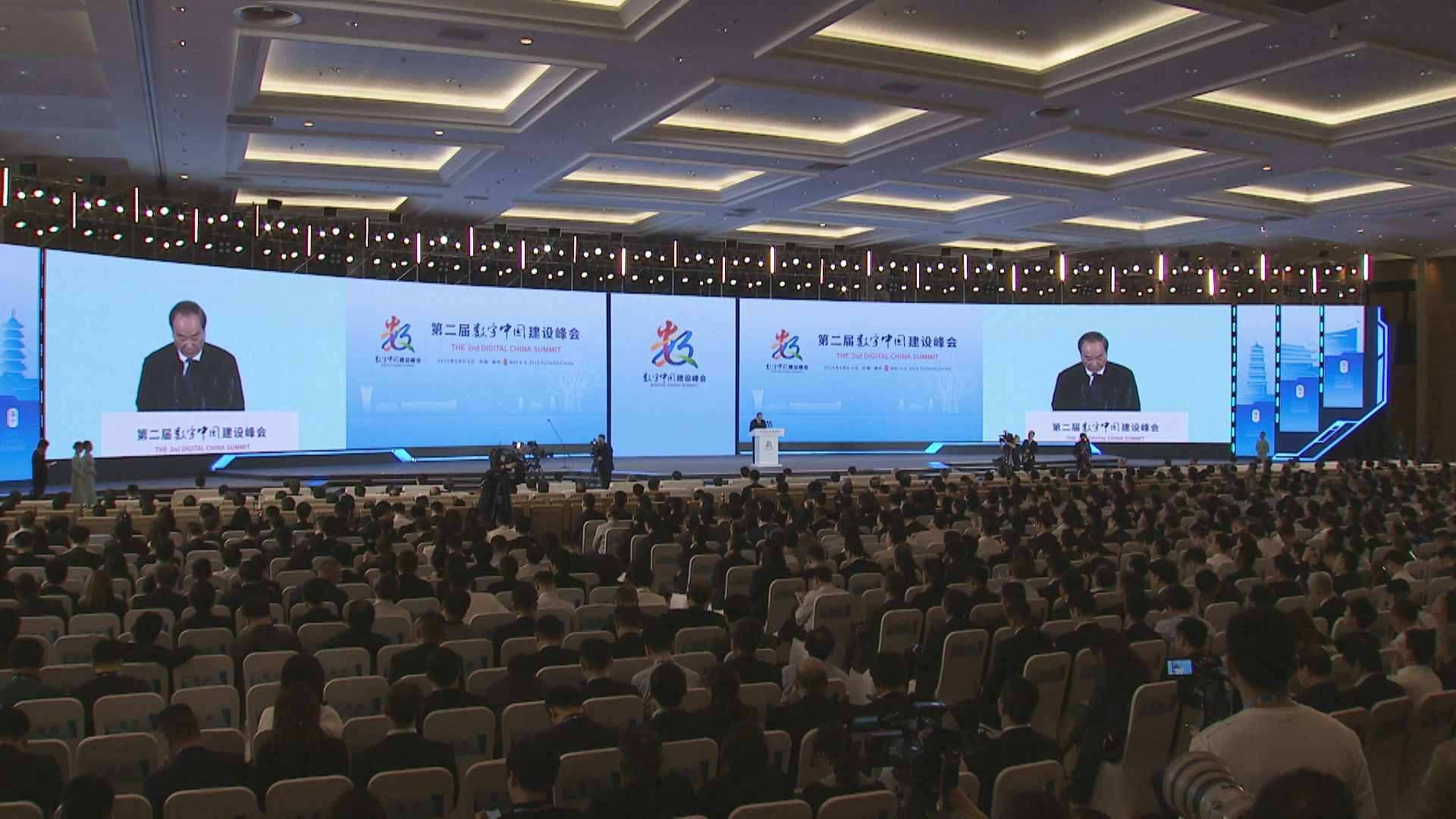
More than 1,500 officials, company representatives and scholars are attending the second Digital China Summit in Fuzhou, Fujian Province. /CGTN Photo
More than 1,500 officials, company representatives and scholars are attending the second Digital China Summit in Fuzhou, Fujian Province. /CGTN Photo
Big capitalist corporations make exorbitant profits with their powerful grip on the market. The market concentration rates of major industries across the world have been on the rise, and dominant companies are equipped with ever increasing market manipulating and political lobbying power.
The latest study by McKinsey shows that in 2013, 80 percent of the profits of the world's non-financial listed companies were held by only 10 percent of companies; and that for corporations with an annual revenue of more than 1 billion U.S. dollars, their business income accounted for 60 percent of the global total.
Statistics from the United Nations Conference on Trade and Development shows that for the top 100 most valuable companies in the world, the ratio of abnormal to total profit increased from 16 percent in 2000 to 40 percent in 2015.
With a single focus on profits, these companies overlooked investment. In spite of declining investment costs and real interest rate, the growth rate of investment in fixed assets in developed countries dropped from 3.4 percent in 1989-1998 to 2.3 percent in 1999-2008 and then to a meager 1 percent in 2009-2018.
Sluggish investment has directly affected technological upgrading and the application of new technologies. Even the International Monetary Fund (IMF) has to admit that since the turn of the century, the rising rate of profit has led to shrinking, instead of growing, corporate investments.

Global digital economy. /VCG Photo
Global digital economy. /VCG Photo
As monopoly companies increasingly dominate the market, they boost profits by raising prices and reducing output. This leads to a dwindling demand for capital, and repressed production and investment. The greater the profit growth, the lower the rate of investment. The global technology revolution has not brought about expected economic benefits.
In the meantime, major companies' tax evasion is jeopardizing the world economy. With the development of digital technology, leading high-tech companies become more capable of increasing business value and controlling the market.
Therefore, they turn to rent-seeking strategies, rather than innovation or productive investment in rare recourses, to push up profits.
Since major assets of high-tech companies, namely intellectual property and data assets, can be easily transferred among countries, these companies can conveniently avoid taxes through digital means.
Placing assets in low-tax jurisdictions has thus become a common rent-seeking strategy for businesses to evade tax. Such behavior has led to hundreds of billions of dollars in revenue loss in poor countries.
In developed states, the government turns a blind eye to the behavior of major corporations. While the anti-monopoly law exists in name only, intellectual property protection rules, which serve the interests of big companies, are overly harsh.
To stem the tide of a sluggish economy, restrain excessive corporate manipulation of the market and facilitate technological advancement, the cry for strengthened control over big companies is running high.
People could no longer tolerate a global economy being hijacked by only a few corporations. Christine Lagarde, Managing Director of the IMF, called for tax rises on big tech companies such as Google, Facebook and Amazon.
U.S. presidential candidate Elizabeth Warren said if she won the 2020 general election, she would break up these companies to promote benign competition in the industry.
VCG Photo
VCG Photo
In a draft bill proposing a tax on digital services submitted by Bruno Le Maire, Minister of the Economy and Finance in France, it is stated that the French government started collecting digital tax from over 30 Internet giants across the world in 1 January 2019.
Britain announced its plan to impose a "digital services tax" on the worlds' largest tech companies as early as November 2018.
In March last year, the European Commission put forward a legislative proposal to adjust taxation rules on tech giants.
Japan Fair Trade Commission has also decided to apply an anti-monopoly law against big tech companies if they illegally collect and use personal data in Japan.
(If you want to contribute and have specific expertise, please contact us at opinions@cgtn.com.)