
Opinions
08:07, 01-Jul-2018
Opinion: Is RIMPAC back to its mode in the Cold War?
Updated
07:09, 04-Jul-2018
 ["china"]
Share







Copied
Editor’s note: The article is translated and edited from an article written by the special commentator Cao Weidong. The article reflects the author’s opinion, and not necessarily the views of CGTN.
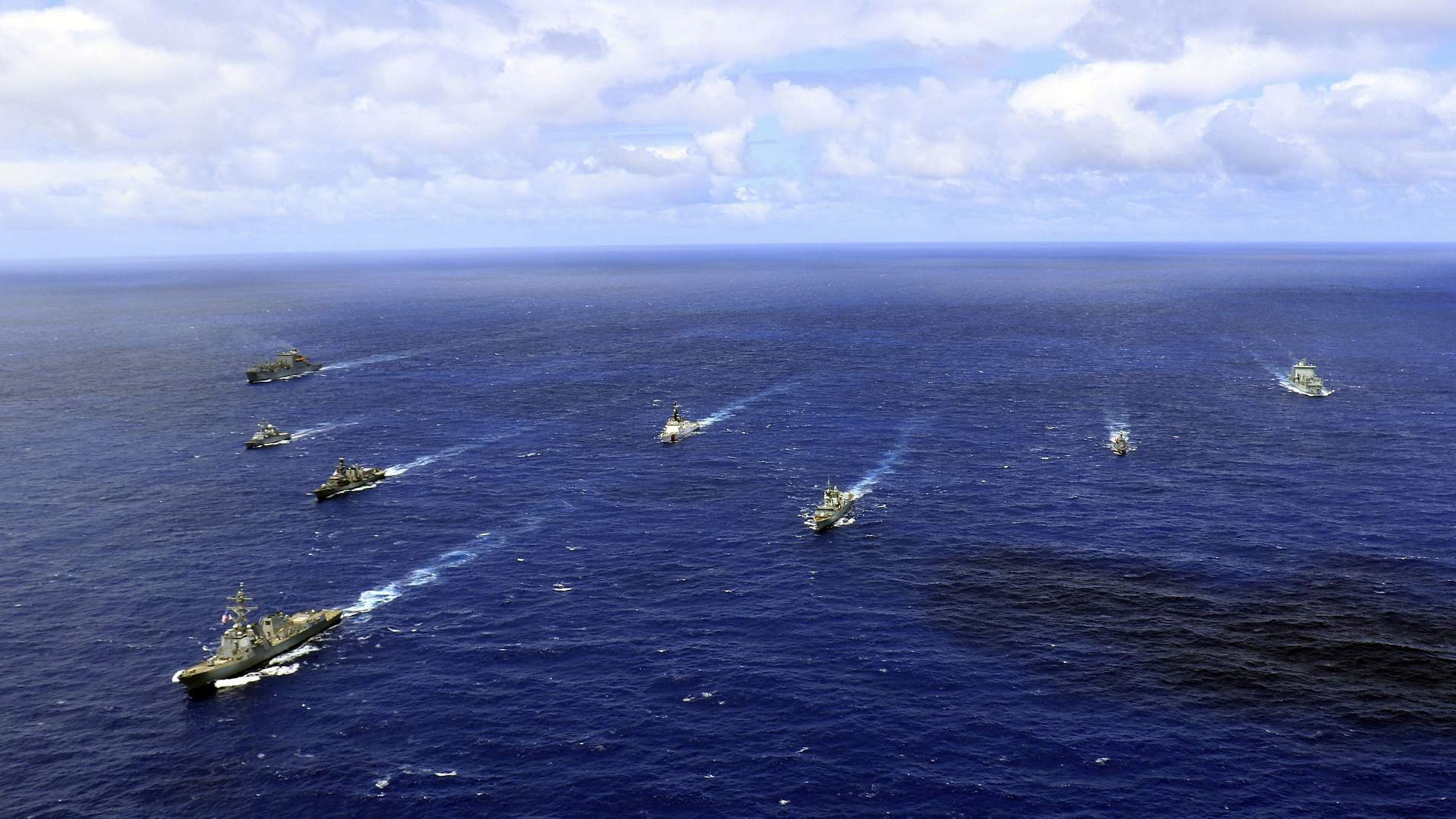
The 26th Rim of the Pacific Exercise (RIMPAC) began on June 27 when James Mattis, US secretary of defense, was paying his official visit to China. Although China participated in the exercise in 2014 and 2016, the US decided to withdraw its invitation to China a month ago under the so-called excuse of "continued militarization" of disputed features in the South China Sea.
Aiming to “deter and defeat aggression by major powers across all domains and levels of conflict,” 25 countries participated in this year’s US-led multinational naval exercises, among them Brazil, Vietnam, Sri Lanka and Israel are making their debut.
Excluding Russia in 2014 and kicking out China in 2018, RIMPAC seems to be repeating its old path back in the Cold War when it was first launched.
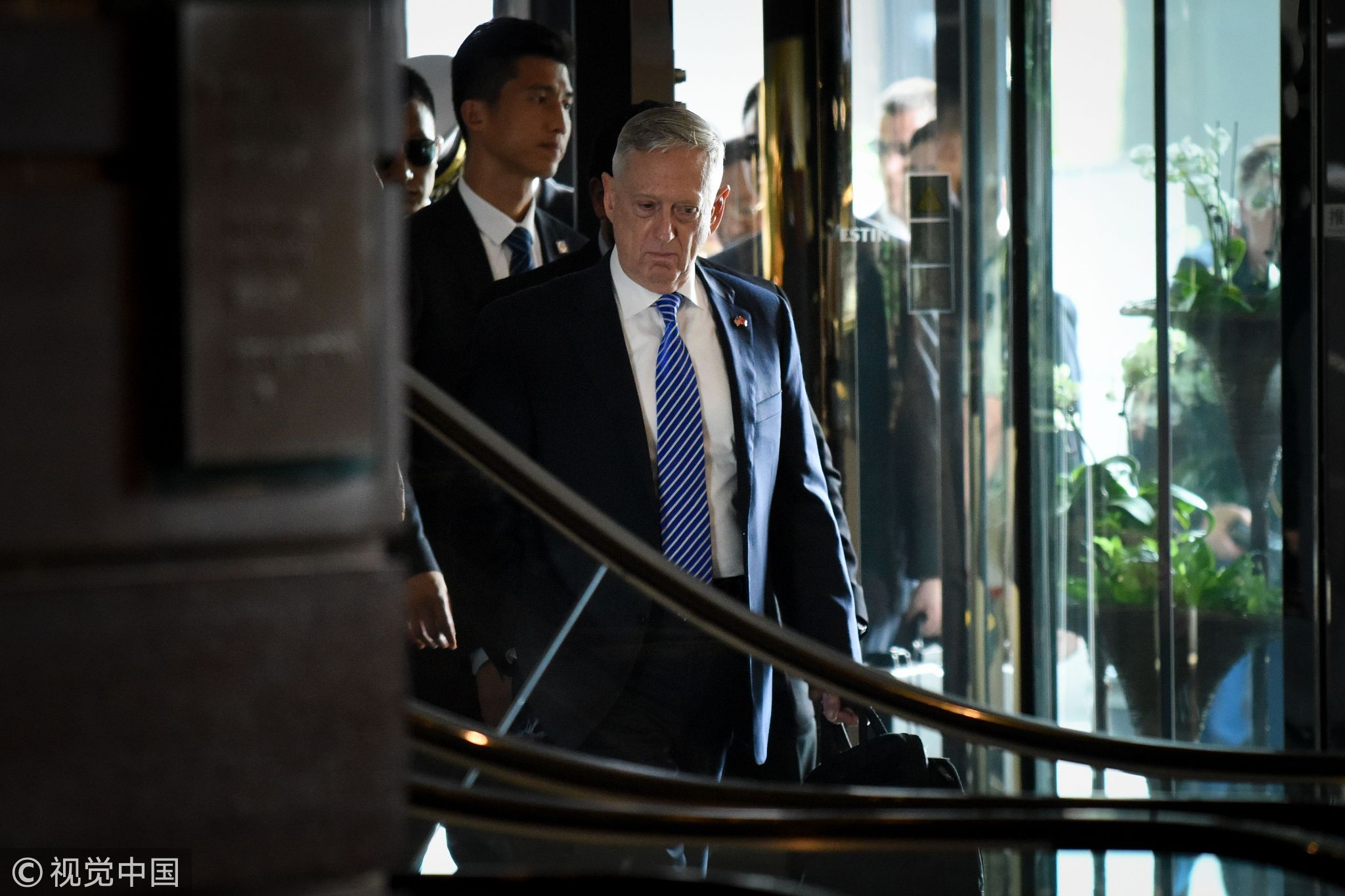
US Secretary of Defense James Mattis arrives at a hotel in Beijing on June 26, 2018. /VCG Photo
US Secretary of Defense James Mattis arrives at a hotel in Beijing on June 26, 2018. /VCG Photo
RIMPAC: Born in the Cold War
Back to the '60s, while the US was still trapped in the Vietnam War, the Soviet Union was expanding its military strength to compete with the US in Europe, which had long been within spheres of influence of the US. At the same time, the Soviet Union actively proceeded with its military expansion and economic penetration in the Middle East, Africa and Asia. Such rapid expansion triggered concerns in the US, and America soon adjusted its global strategy accordingly. In its global deployment, the US strengthened its confrontation with the Soviet Union in Europe and at the same time continued to seek power in Asia.
RIMPAC was born under this context and has a very strong character of confrontation with the Soviet Union. Launched in 1971, the exercise aimed to safeguard the safety of the US and its allies in trade and sea lines of communication, to demonstrate the national power of US, to uphold the national interest of the US, to ensure the US’ "free navigation" in the Pacific.
As the military competition between the two super-powers became increasingly heated, the scale of the exercise was also on the rise. Between 1984 and 1990, the scale was kept at around 50,000 personnel.
From confrontation to cooperation?
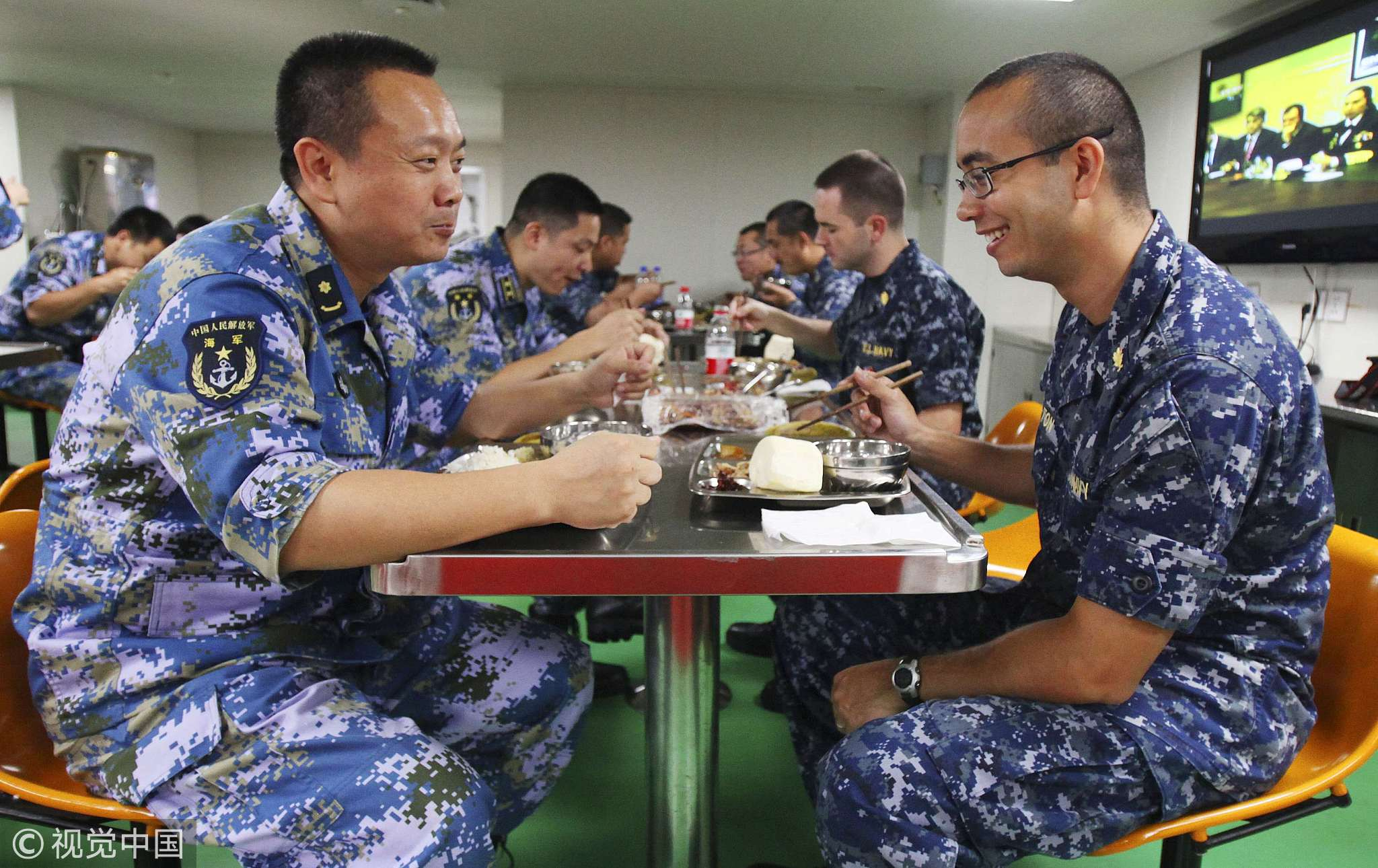
US Navy Lieutenant Donald Skelton (R) eats lunch with Naval Commander Qi Yungzhi from China's People's Liberation Army (PLA) while aboard the PLA ship Peace Ark during the multinational military exercise RIMPAC in Honolulu, Hawaii, July 23, 2014. /VCG Photo
US Navy Lieutenant Donald Skelton (R) eats lunch with Naval Commander Qi Yungzhi from China's People's Liberation Army (PLA) while aboard the PLA ship Peace Ark during the multinational military exercise RIMPAC in Honolulu, Hawaii, July 23, 2014. /VCG Photo
According to the changes in the history, RIMPAC is just like the barometer of the US military strategy. It changes according to America’s military strategy and its imaginary “enemies.”
After the Cold War ended, the US government launched a regional defense strategy in which its opponent shifted to the regional military power that might threaten the US’ strategic interest. China and Russia were considered to be the main threats.
Therefore, the background of RIMPAC is considered to be “dictatorial countries with poor economy invading rich but small democratic countries.”
After 9/11 attacks, the US government launched the Global War on Terrorism, an international military campaign. Realizing that military means can’t solve all problems, the US government seeks more cooperation with non-ally countries, including China and Russia. RIMPAC was shifted from the cooperation between military allies to a multinational maritime military cooperation. The exercise also started to involve more humanitarian assistance, maritime search and rescue, and anti-piracy.
The changes of RIMPAC after the Cold War show a clinging to cooperation rather than its previous confrontation. But as China was kicked out in the 2018 exercise, with an excuse that doesn’t even hold water – the militarization of the South China Sea, RIMPAC seems to be repeating its old path back in the Cold War.
Back to its mode in the Cold War?
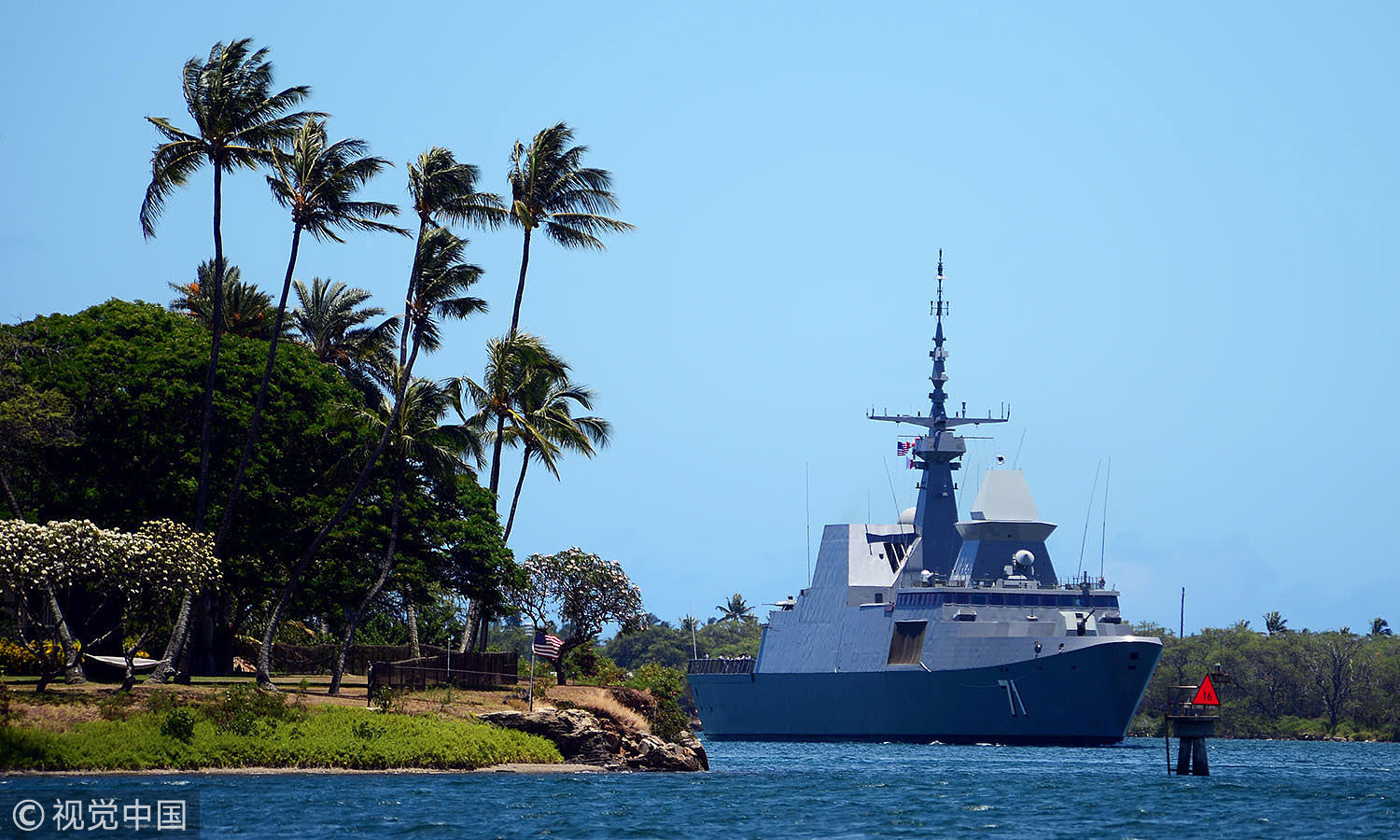
Royal Australian Navy frigate HMAS Toowoomba arrives in preparation for the Rim of the Pacific (RIMPAC) military exercises at Joint Base Pearl Harbor-Hickam, Hawaii, US, on June 25, 2018. /VCG Photo
Royal Australian Navy frigate HMAS Toowoomba arrives in preparation for the Rim of the Pacific (RIMPAC) military exercises at Joint Base Pearl Harbor-Hickam, Hawaii, US, on June 25, 2018. /VCG Photo
China has many islands in the South China Sea, to process economic and defense construction in its own territory is reasonable and legal. But the US has used it as an excuse to cancel China’s invitation to RIMPAC, which is supposed to be a place for all sides to build credibility and cooperation. What the US did was to create the confrontation, causing conflict and narrowing cooperation – an action that breaks the safety of the Pacific region and weakens its own dominance, an action that is “unconstructive.”
Chinese warships will continue to sail in the Pacific Ocean and the Chinese Navy will continue to cooperate with the Russian Navy to hold joint military exercises, for both counties hope to work together to maintain the stability of the Pacific region.
China will not abandon its legal rights and proper benefits just because it wasn’t invited to RIMPAC. Mattis should have understood this better after he visited China. He said he was ready to listen, then he should have listened.
It is unrealistic to bring RIMPAC back to its mode in the Cold War. Even if the US has such intentions, the other countries may not follow. Though no geographic location has been changed among countries around the rim of the Pacific Ocean, the aim they are pursuing has been changed, and this is a reality that the US will never be able to change.