
10:24, 18-Aug-2017
The Moringa Plant: Young entrepreneur looking to nourish the world
 []
[]
Share







Copied
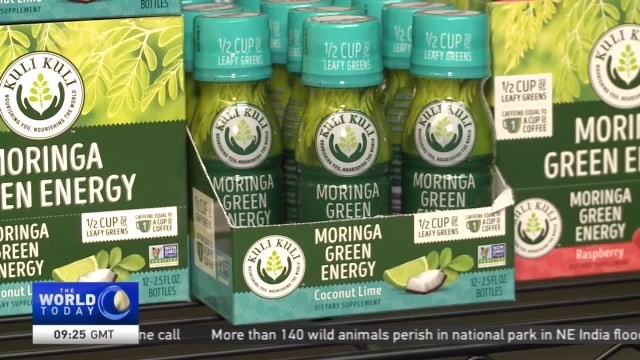
With healthy eating becoming an increasingly significant topic across the globe, so-called superfoods like kale and quinoa have dramatically risen in popularity in recent years. And now one startup from Oakland, California, has sought to kickstart the latest global food trend with a snack that has its roots in West Africa. CGTN's Mark Niu has the details.
Working as a peace corps volunteer in 2011 in Niger, West Africa, Lisa Curtis, a vegetarian, was feeling weak from a poor diet until nurses there introduced her to this - moringa. She mixed the leaves with a West African peanut snack called Kuli Kuli, and within a week felt rejuvenated and inspired.
LISA CURTIS FOUNDER & CEO, KULI KULI "I was taken aback that this tree was so nutritious, has complete protein, you are getting a lot of calcium, iron, and vitamins. But as I found in Niger, there were so many people who weren't eating it. And this is in one of the most malnourished countries in the world. And when I dug a little further and asked some of the women's groups that I was working with why they weren't eating it or growing it. They said because, why are we gonna grow a crop that we can't sell."
In Oakland, California, Curtis started Kuli Kuli foods to create a supply chain that could bring moringa to the U-S market.
LISA CURTIS FOUNDER & CEO, KULI KULI "It wasn't easy. It's still not easy. One of the biggest parts was figuring out how to get high quality moringa here, because it's a really easy tree to grow, because it grows like a weed, but it's tricky to process and in order to process in a way that preserves the nutritional quality, and also meets U.S. health and sanitary standards."
Kuli Kuli began with a moringa energy bar, which turned out to be one of the most popular food campaigns ever on crowd funding site Indiegogo. Its food products are now available in U-S supermarket chain Whole Foods. And recently, food giant Kellogg announced that its venture capital fund eighteen 94 capital, was leading a four-point-25 million round of funding for Kuli Kuli.
MARK NIU OAKLAND "With their four products - bars, energy shots, powder and herbal tea - Kuli Kuli had $2 million dollars in sales last year. They are hoping to top that and release a new product, which hasn't been disclosed yet, later this year."
The biggest seller right now is their moringa powder, which makes it convenient to get your greens from a smoothie. Hardly any Americans have heard of Moringa, so Kuli Kuli's best sales pitch has been labeling it the new kale, while pointing out moringa has twice kale's protein and more vitamins and nutrients.
While Kuli Kuli has been attracting investment, it's actually classified as a full-fledged benefit corporation - putting profit, the planet and people on the same level. Kuli Kuli works directly with 800 farmers in Ghana, Haiti and Nicaragua and seeks to pay them above market wages.
LISA CURTIS FOUNDER & CEO, KULI KULI "Most recently when we were in Ghana, I had a really interesting discussion with this woman that said since she started growing moringa in Ghana, and she started to feed it to her family and she had found that it had improved her husband's condition who had been chronically ill for a long time. And she said that it was amazing and that she doesn't know what it did, but he was feeling a lot better and we also had lots of women tell us they now had more income and they were able to send their kids to school and really make an impact on their lives."
An impact that's come full circle for a young entrepreneur looking to nourish the world. Mark Niu, CGTN, Oakland.