
Chip
20:45, 07-Jun-2018
Int’l research team may come up with a way to make computer chips smaller
 ["china"]
Share







Copied
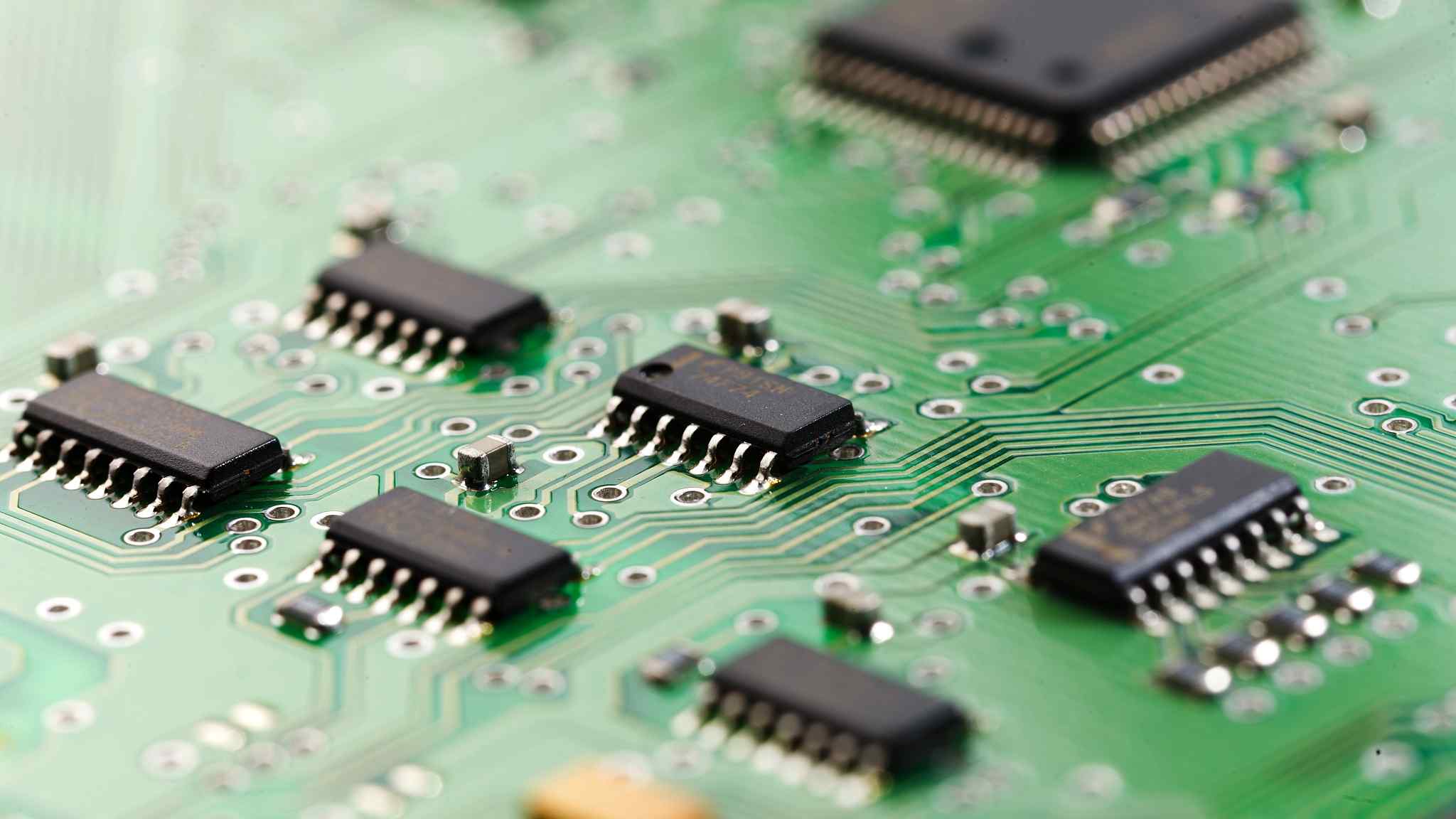
An international research team comprising of scientists from Denmark, China and US developed the first insulating molecule more effective than a vacuum barrier, making transistors in a computer chip potentially smaller and more powerful.
According to the study published in the journal Nature on Wednesday, their design of an extremely rigid silicon-based molecule under one nanometer in length can block tunneling conduction at the nanoscale.
The phenomenon called "quantum mechanical tunneling" is the major challenge when the gap between two metal electrodes narrows to the point that electrons are no longer contained by their barriers, causing a leakage current. It is a hurdle standing in the way of making transistors smaller, according to the researchers.
"Our molecular strategy represents a new design principle for classic devices, with the potential to support continued miniaturization in the near term," said Columbia University engineering physicist and the paper's co-author Latha Venkataraman, who heads the lab where researcher Li Haixing conducted the project's experimental work.
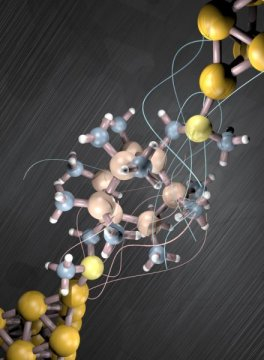
An illustration of the silicon-based single-molecule device that functions as an efficient insulator through a sigma-based quantum interference effect. /Photo courtesy of Li Haixing of Columbia Engineering
An illustration of the silicon-based single-molecule device that functions as an efficient insulator through a sigma-based quantum interference effect. /Photo courtesy of Li Haixing of Columbia Engineering
The molecular synthesis was carried out in a lab at Columbia University's Department of Chemistry, in partnership with Xiao Shengxiong's team at Shanghai Normal University.
The synthetic molecule they designed exhibits comprehensive destructive interference signatures that lead to complete cancellation of tunneling probability, according to the paper's lead author Marc Garner, a chemist in the University of Copenhagen's Solomon Lab, which handled the theoretical work.
Destructive quantum interference occurs when the peaks and valleys of two waves are placed exactly out of phase, so that they can annul oscillation.
According to the researchers, electronic waves can be thought of as sound waves, flowing through barriers just as sound waves "leak" through walls. The unique properties exhibited by the team's molecule mitigated tunneling without requiring, in this analogy, a thicker wall.
Their silicon-based strategy also presents a potentially more factory-ready solution, since this insulator is compatible with current industry standards.
[Top image: VCG Photo]
Source(s): Xinhua News Agency