
Opinions
20:43, 04-May-2018
Wei, the World: The moment of truth on the Korean Peninsula
 ["other","Asia"]
Share







Copied
04:39

There has been a long stretches of time – years then decades – where solutions to the nuclear challenge on the Korean Peninsula seemed impossible. Until, the past few months.
I remember covering the Democratic People's Republic of Korea (DPRK) nuclear issue in the early days. At the time, China was being repeatedly pressured for "not doing enough to make the DPRK have a change of heart.” That accusation continued for decades until a few weeks ago, when China was all of a sudden, being described by some, as being “afraid to be sidelined” on talks about the Korean Peninsula denuclearization and "has to struggle to find its role.”
Well, what has been China’s role? That’s the big question.
If one has even little knowledge of the issue, it would not be that difficult to recall that it was China that worked hard to facilitate rounds of “Six Party Talks”, a platform – well, the only platform – where all the stakeholders came together to try to seek a solution to the Korean Peninsula issue.
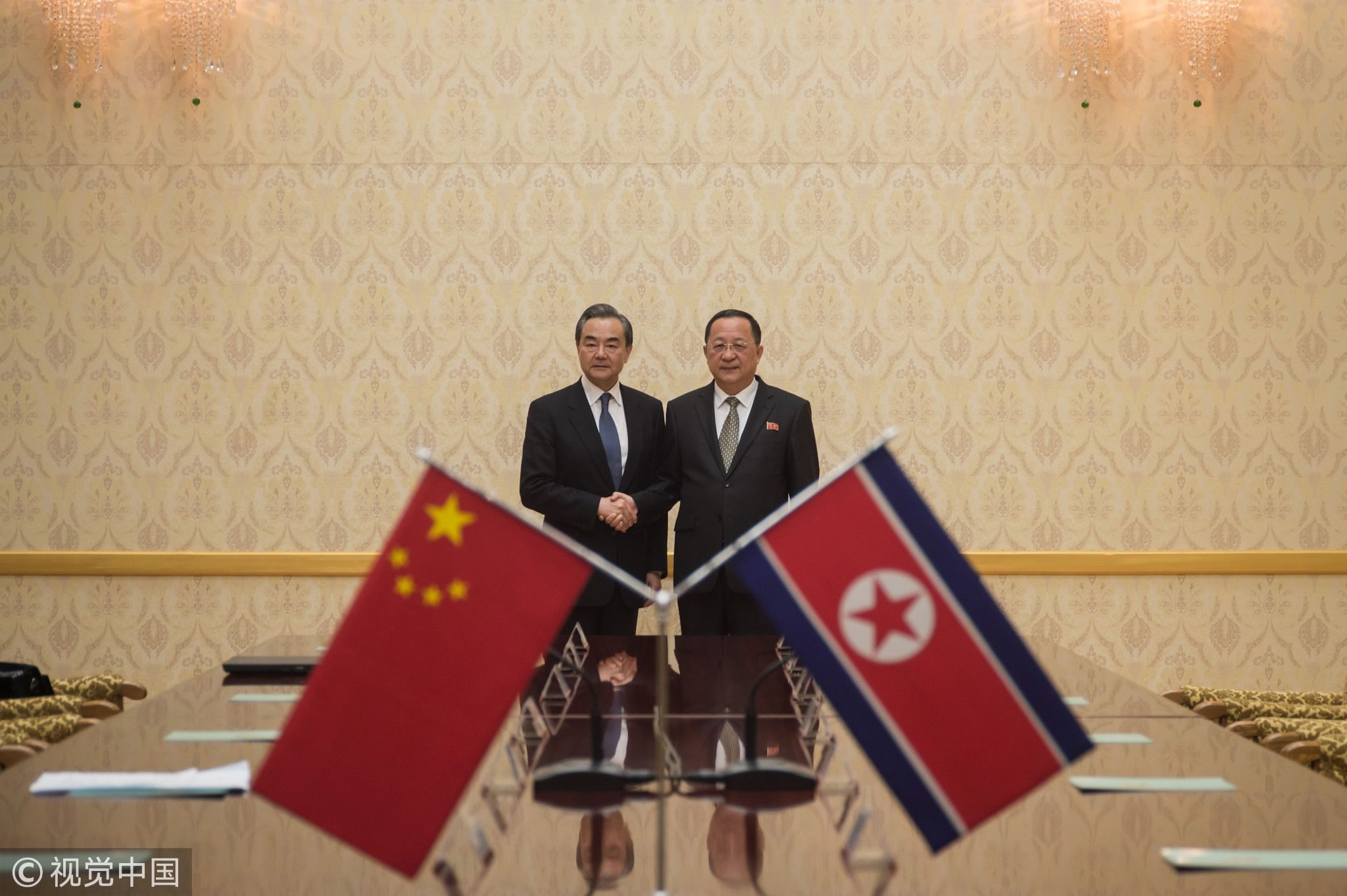
China's Foreign Minister Wang Yi (L) shakes hands with DPRK Foreign Minister Ri Yong Ho at the Mansudae Assembly Hall in Pyongyang, May 2, 2018. /VCG Photo
China's Foreign Minister Wang Yi (L) shakes hands with DPRK Foreign Minister Ri Yong Ho at the Mansudae Assembly Hall in Pyongyang, May 2, 2018. /VCG Photo
Then came years of deadlock, while the DPRK was busy developing nuclear technologies and inter-continental ballistic missiles (ICBM). No one came up with a viable roadmap of how things would stop from continuing to go down the drain. It was China then which proposed the strategy of “double suspensions,” that is for the DPRK to suspend tests, while the US and Republic of Korea to suspend joint military exercises. The DPRK took those exercises as attempts to seek a regime change in Pyongyang.
Then, after the breaking of ice between the two countries at the PyeongChang Olympic Games, it was China that started the highest level of interactions among the involved parties. Chinese President Xi Jinping hosted Kim Jong Un's first-ever high profile public appearance outside his country. It was believed that the heads of states of the two countries had some deep discussions about the future of the DPRK and the denuclearization of the Korean Peninsula.
After that, we've seen things rolling on the fast track: the inter-Korean summit in Panmunjom, the possible inter-Korean high level talks later in May, and the upcoming DPRK-US Summit, likely in late May or early June.
Don’t get me wrong. I am not making a list to say that China made everything happen. It was not. Because it took efforts of all parties to make things happen. Yes, China made that clear too. In fact, from the very beginning, as early as the very first round of the six-party talks.
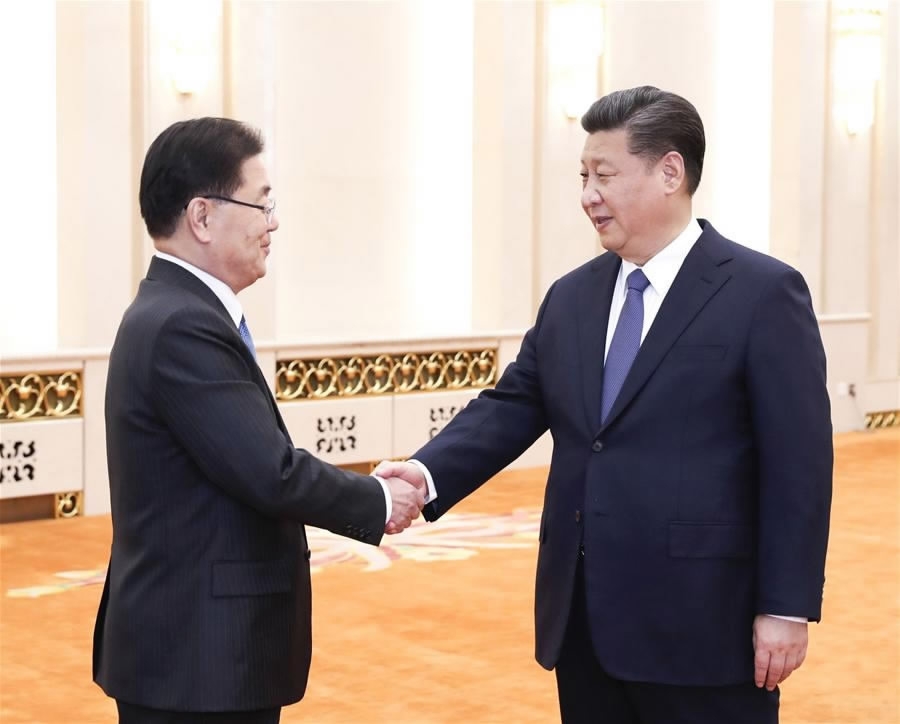
Chinese President Xi Jinping (R) meets with Chung Eui-yong, national security advisor for Moon Jae-in and also a special envoy of Moon, in Beijing, China, March 12, 2018. /Xinhua Photo
Chinese President Xi Jinping (R) meets with Chung Eui-yong, national security advisor for Moon Jae-in and also a special envoy of Moon, in Beijing, China, March 12, 2018. /Xinhua Photo
I am not saying either that the direct interactions between the two Koreas are not as significant as they are. They are extremely significant. After all, blood is thicker than water as we Asians believe. The two Koreas are the direct parties that are going to be most impacted by the nuclear challenge on the Korean Peninsula. They are also the direct parties involved by the security issue: a peace treaty is still not in place six decades after the Korean War ended in an armistice.
I am not saying either that the efforts of the US are any less important than any other parties. In fact, its role is more than important, as China has been suggesting from the very beginning. Even more, as the sophistication of the DPRK nuclear and missile technologies grew, the DPRK and the US had to work out directly a solution.
What I am trying to say here is to point out clearly that we may soon be approaching a moment of truth, in which the real intentions of all parties are likely to be revealed to the rest of the world, whether they are really committed to the goal of denuclearizing the Korean Peninsula, or they are pushing their own agenda on the sly, as long as there is a crisis on the Peninsula.