
World
12:34, 13-May-2019
Orban, first leader to endorse Trump, returns to White House
 ["other"]
Share







Copied
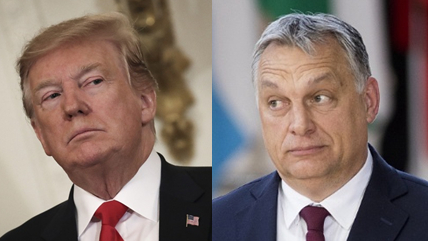
Viktor Orban's last visit to the White House to meet a U.S. president was 21 years ago, in his first spell as Hungary's prime minister.
The nationalist leader has been back only once since that meeting with Bill Clinton, for talks with then Vice President Dick Cheney in 2001.
But on Monday, three years after Orban became the first foreign leader to endorse Donald Trump's candidacy for the Oval Office, the 55-year-old is due in Washington for one-on-one talks with the president.
The right-wing leaders of the United States and Hungary have some striking commonalities: A nationalistic outlook and skepticism of both immigration and international institutions. Orban has successfully built a barrier on Hungary's border with Croatia and Serbia, while Trump continues to strive to build a wall on the U.S.-Mexico border.
"We have enthusiastically applauded the president of the United States for thinking precisely as we do when he says ‘America First.' We say the same: ‘Hungary first, and then everyone else,'” Orban said in a June 2017 speech.
Trump and Orban are also associated with a loose alliance of populists and nationalists that has won power across the world in recent years, euroskeptic representatives of which hope to make further gains in the upcoming European Parliament elections.

Hungarian Prime Minister Viktor Orban speaks during a joint news conference with
Italian Deputy Prime Minister Matteo Salvini in Budapest, Hungary, May 2, 2019. /VCG Photo
Hungarian Prime Minister Viktor Orban speaks during a joint news conference with Italian Deputy Prime Minister Matteo Salvini in Budapest, Hungary, May 2, 2019. /VCG Photo
Orban has often clashed with the EU over recent years, and his Fidesz party has been suspended from the European People's Party (EPP), the center-right conservative grouping in the European Parliament, over criticisms of EU migration policy.
He has also refused to back the EPP's candidate for European Commission president, and has held regular talks with other high profile nationalist leaders such as Italian Deputy Prime Minister Matteo Salvini.
The Hungarian leader praised Trump as "a phenomenon, an icon" among nationalists and isolationists after Trump denounced a "globalist" view of the world in a speech at the United Nations in 2018. Ahead of the EU elections, the Trump meeting gives Orban an important platform.
While evidence of a personal Trump-Orban rapport will be closely watched, eyes will also be on the future relationship between the countries. Under Trump, the U.S. has sought to thaw ties that became decidedly chilly during the Obama administration, which accused Hungary of curtailing civil liberties and press freedom.
"The Obama administration and the State Department completely shut out Orban. He's an individual who Trump has tracked very closely,” Steve Bannon, the former Trump aide who is deeply involved in the populist movement, told Politico.
An improvement in relations was signaled by the appointment of David Cornstein, an old friend of Trump, as ambassador to Hungary.
Asked about Orban's own description of Hungary as an "illiberal democracy" in a recent interview with The Atlantic, the 80-year-old ambassador said, “I can tell you, knowing the president for a good 25 or 30 years, that he would love to have the situation that Viktor Orban has, but he doesn't.”
Evidence of warmer ties includes the signing of a bilateral defense cooperation agreement in April, and Hungarian plans to buy medium-range missiles from U.S. manufacturers.
A White House official told Reuters the talks were part of a U.S. re-engagement strategy with Central and Eastern Europe. Trump has hosted Czech Prime Minister Andrej Babis and Slovak Prime Minister Peter Pellegrini in recent months, while Polish President Andrzej Duda visited the White House in September 2018.
"The point of this meeting is simply just to reinforce the strategic relationship between allies ... not necessarily to thrash out every issue on the bilateral agenda, which we have been doing constantly for the past two years,” the official said.