
China
13:08, 08-Aug-2018
Are smartphone games ruining children in rural China?
Updated
12:44, 11-Aug-2018
 ["china"]
Share







Copied
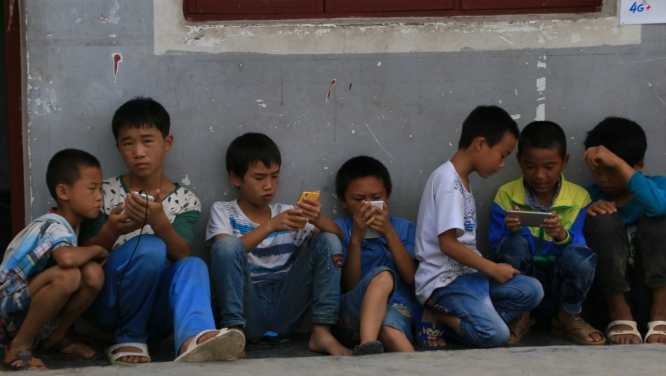
Away from the pressures of school and with parents working in Beijing, Xiaolong has immersed himself in the world of mobile entertainment. “If I don’t play smartphone games, what else can I do?”
The junior school student from north China’s Hebei Province might be right. Unlike children in big cities with loads of homework and access to different kinds of classes, kids in rural areas seem to have no choice but spending more time on mobile gaming, since the entertainment and education resources there are scarce.
In places where children don’t have many options for playing and studying, what is more tempting than gaming?
“Seeking excitement in games”
According to China Youth News, rural children who play mobile games are mostly looking for a thrill.

Kings of Glory, the most popular game among children in rural China. /CGTN Screenshot
Kings of Glory, the most popular game among children in rural China. /CGTN Screenshot
Students used to skip classes to go to Internet cafes to play games on desktops, but the prevalence of portable devices means that more children are now turning to mobile games.
According to Liu Chengliang, a researcher in the China Rural Governance Research Center under Huazhong University of Science and Technology, parental neglect can contribute to children in rural areas indulging in such games.
Research shows that left-behind children are spending more time on playing smartphone games than other children of similar ages. Many of them have ticked the boxes for playing 4 hours a day or more.
“Some parents in rural places are realizing the harm of children addicted to playing smartphone games, while most of them still think of smartphones as an ‘electronic babysitter’ – children won’t wander everywhere if they play with smartphones,” said Zhang Haibo, the director of the children education research center in the Youth Palace Association.
“Compared to those in big cities, most parents in rural places have not really realized the influence of children getting addicted to phones.”
Because their parents are not at home, left-behind children are mostly disciplined by their grandparents, many of who also lack awareness of the detrimental effects of indulgent gaming.
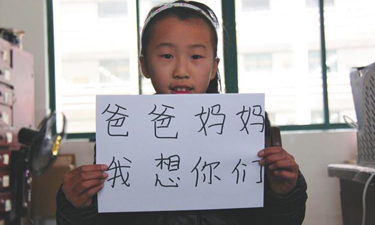
A left-behind child: "I miss you, mom and dad." / Photo via Sina News
A left-behind child: "I miss you, mom and dad." / Photo via Sina News
What can schools do?
Since the family can’t effectively discipline children, schools should shoulder the responsibility of addressing the addiction of their students to mobile games.
However, teachers find that it has become harder to manage these students, with some saying that those children have developed these bad habits from youth, and that students aren’t being punished for indulging in such games.
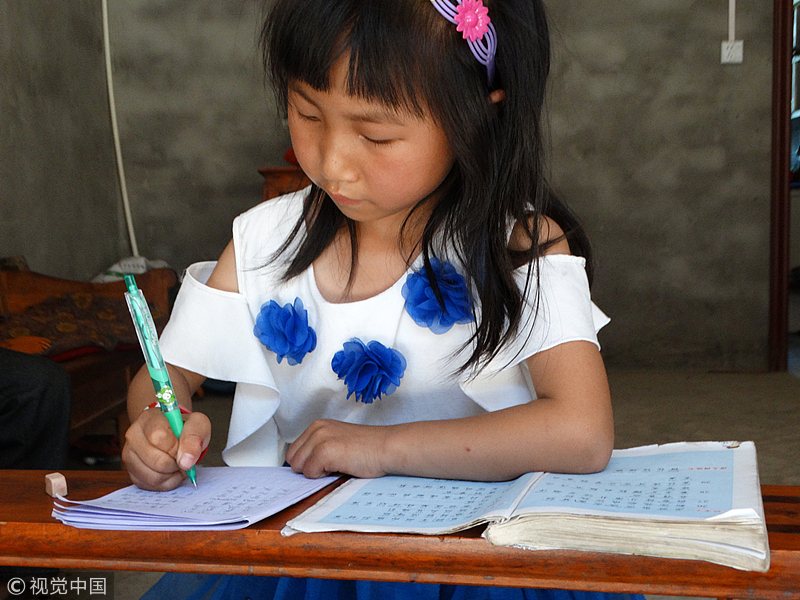
A left-behind child is studying./ VCG Photo
A left-behind child is studying./ VCG Photo
In fact, "gaming disorder" has officially been classified as a mental health condition by the World Health Organization (WHO), defining it as “a pattern of persistent or recurrent gaming behavior ('digital gaming' or 'video-gaming'), which may be online (i.e., over the Internet) or offline."
Villagers have told Liu, the researcher, that students have started losing interest in studying after playing mobile games. It seems futile to rely on the children’s self-control.
It is worth mentioning that in the next 10 to 20 years, these children from rural areas will become important members of society.