
Business
19:37, 06-Jun-2018
World Bank report: Rising trade protectionism may hit global economy
 ["china"]
Share







Copied

The newly released World Economic Outlook by the World Bank on Tuesday warns that trade protectionism may bring a downward pressure to global economy amid the predictably unchanged economic growth over this year and next.
The report predicts that the global economy will increase by 3.1 percent and 3 percent respectively in these two years, which is in line with the World Bank’s January forecast. The World Bank also expects the growth of developed economies to slow down to 2.2 percent and 2 percent respectively due to the gradually abolished monetary stimulus measures in those countries. Given that the commodity of exporting countries has recovered and commodity prices have gradually eased after this year’s spike, the World Bank predicts that the economic growth of emerging markets and developing economies may increase to 4.5 percent this year and to 4.7 percent next year.
China’s economic growth
Thanks to the robust consumer market in China, the Bank predicts China’s economic growth rate to be 6.5 percent this year, up by 0.1 percentage point. And that of the next year will be 6.3 percent.
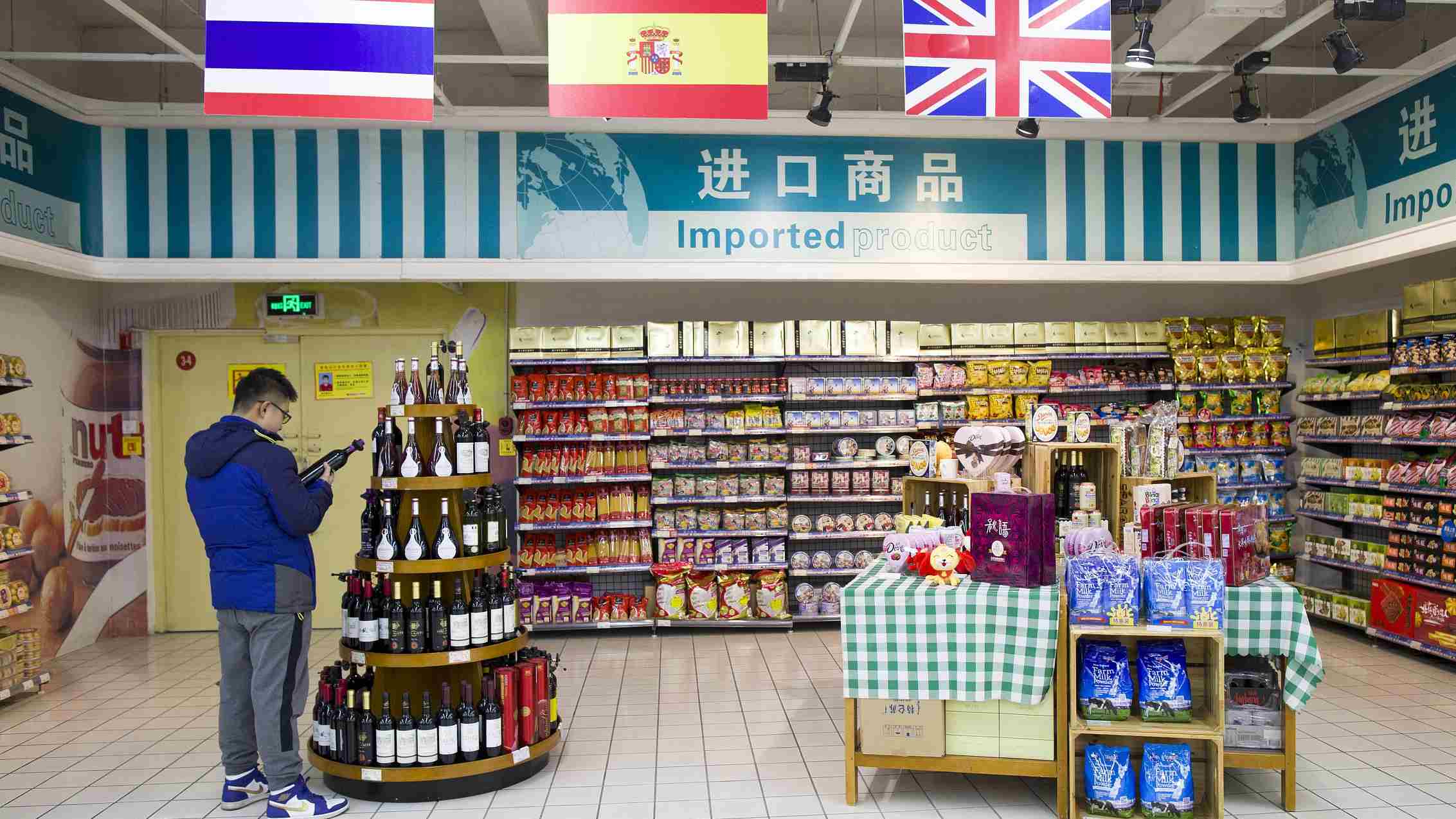
A man is selecting food from imported goods supermarket in China. /VCG Photo
A man is selecting food from imported goods supermarket in China. /VCG Photo
China said in a statement that it is willing to increase imports from multiple countries in order to meet the Chinese people's ever-growing needs for a better life, and to serve the needs of high-quality economic development.
Downward pressure cannot be ignored
Despite the unchanged economic growth trends, the global economy still faces considerable downward pressure, including mounting possibilities of unstable fluctuations in the financial market, the vulnerability of some emerging markets and developing economies, and the rise of trade protectionism and geopolitical risks.
Negative effects caused by the exacerbation of trade protectionism are underlined in the report. Heightened trade restraints and threats from major economies have caused unbearable risks. For example, the newly announced tariff measures in US has stirred up the global economic market and brought about counter blows from its major trading partners. The strike, meanwhile, has done notable harm to the investment environment of emerging markets and developing economies, especially those highly connected to the US trading and financial markets. Alongside that, rising trade protectionism may easily hit those countries in industries like agriculture and food processing.