Editor’s note: Zhang Ye is a research fellow of the PLA Naval Research Academy. The article reflects the author’s opinion, and not necessarily the views of CGTN.
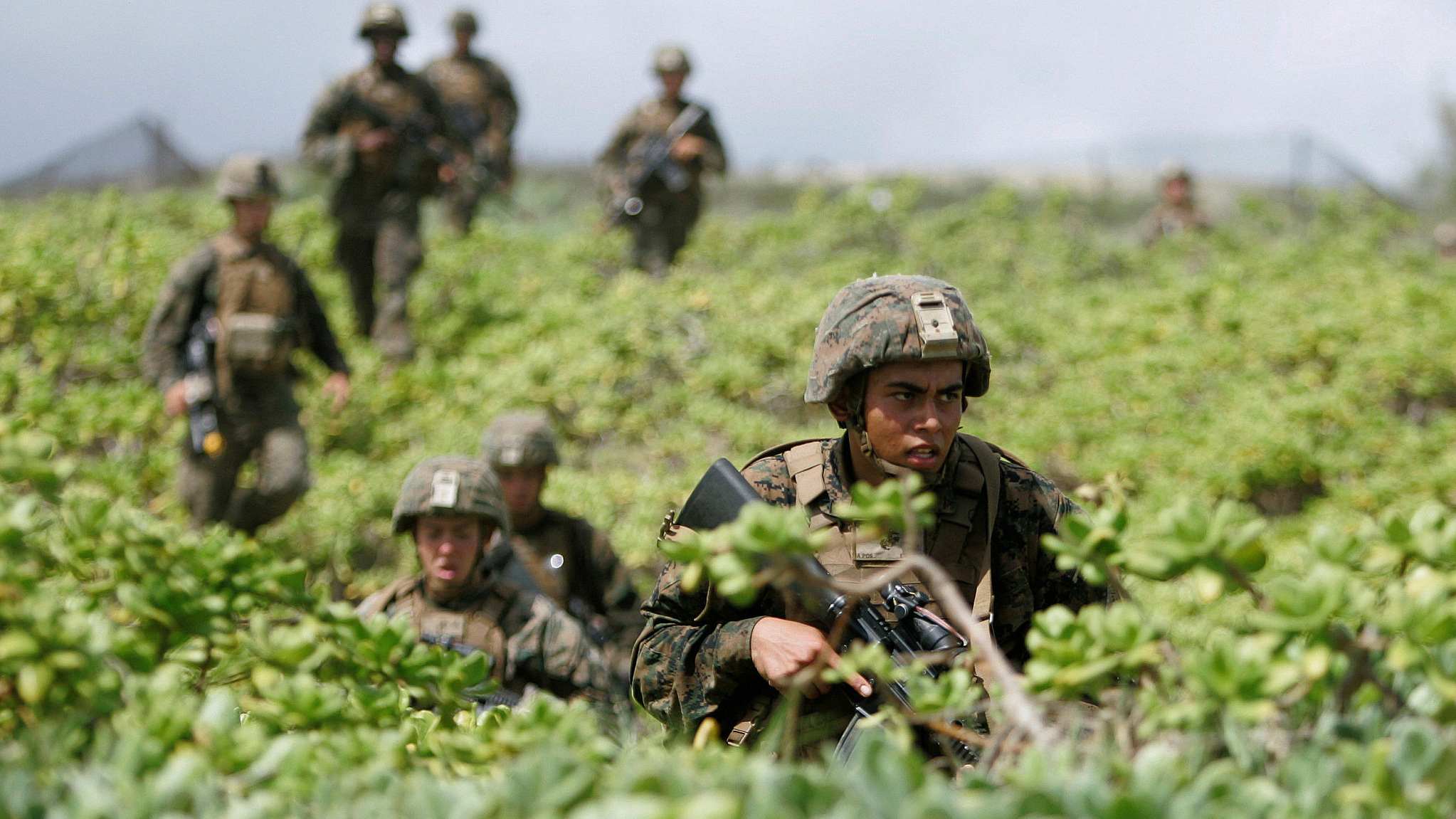
On 27th June, Adm. John C. Aquilino, Commander of US Pacific Fleet announced the start of RIMPAC 2018, which is scheduled to go on to August 2 in and around the Hawaiian Islands and Southern California, with 25 nations, more than 45 surface ships and submarines, 17 national land forces, and 25,000 personnel taking part in.
China's PLA Navy was disinvited from the RIMPAC Exercise 2018 in May, because “China’s continued militarization of disputed features in the South China Sea only serves to raise tensions and destabilize the region,” said Marine Lt. Col. Christopher Logan, a Pentagon spokesman.
But ironically Vietnam, who carried out its construction in the South China Sea earlier than China, and installed a lot of military facilities and weapons there, has been invited to participate for the first time.
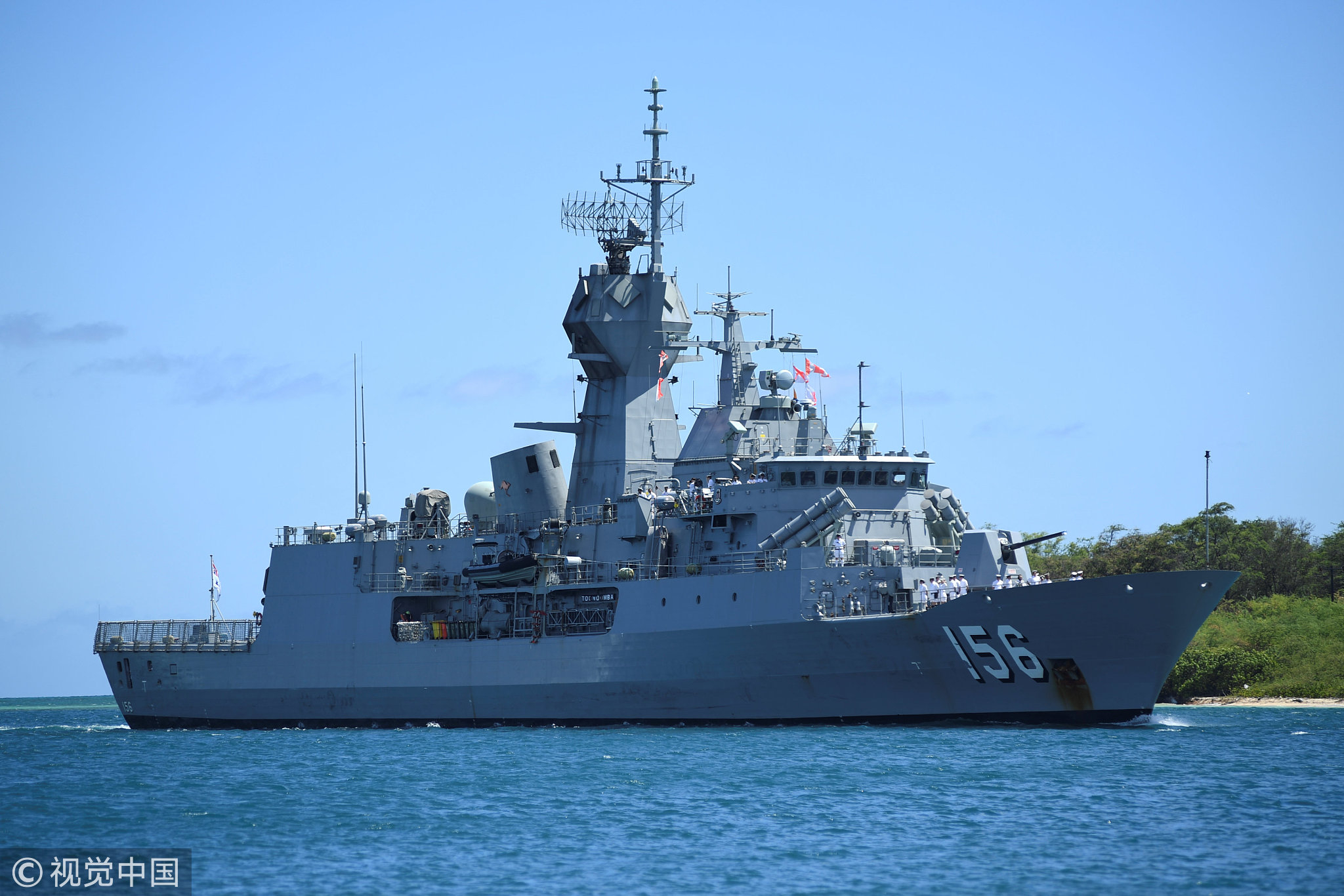
Royal Australian Navy frigate HMAS Toowoomba arrives in preparation for the Rim of the Pacific (RIMPAC) military exercises at Joint Base Pearl Harbor-Hickam, Hawaii, US, June 25, 2018. /VCG Photo.
Royal Australian Navy frigate HMAS Toowoomba arrives in preparation for the Rim of the Pacific (RIMPAC) military exercises at Joint Base Pearl Harbor-Hickam, Hawaii, US, June 25, 2018. /VCG Photo.
Obviously the reality is not as the story told by the US. Actually, the changes in RIMPAC are the reflection of the change in US perception of the global maritime environment and its naval strategy.
In 1971, when the first edition of the RIMPAC was held, it was limited to America’s closest allies, and its primary aim was to enhance their joint operational capability to counter the Soviet Union’s military ambitions in East Asia. So the RIMPAC Exercise was originally a product of big power confrontation.
After the cold war, in addition to its allies and partners in the Pacific Rim, US wanted to foster and expand cooperative relationships with more other countries, even some of its original and potential adversaries, hoping through wide and multidirectional engagement to ensure the maritime safety and maintain US dominant position in the ocean.
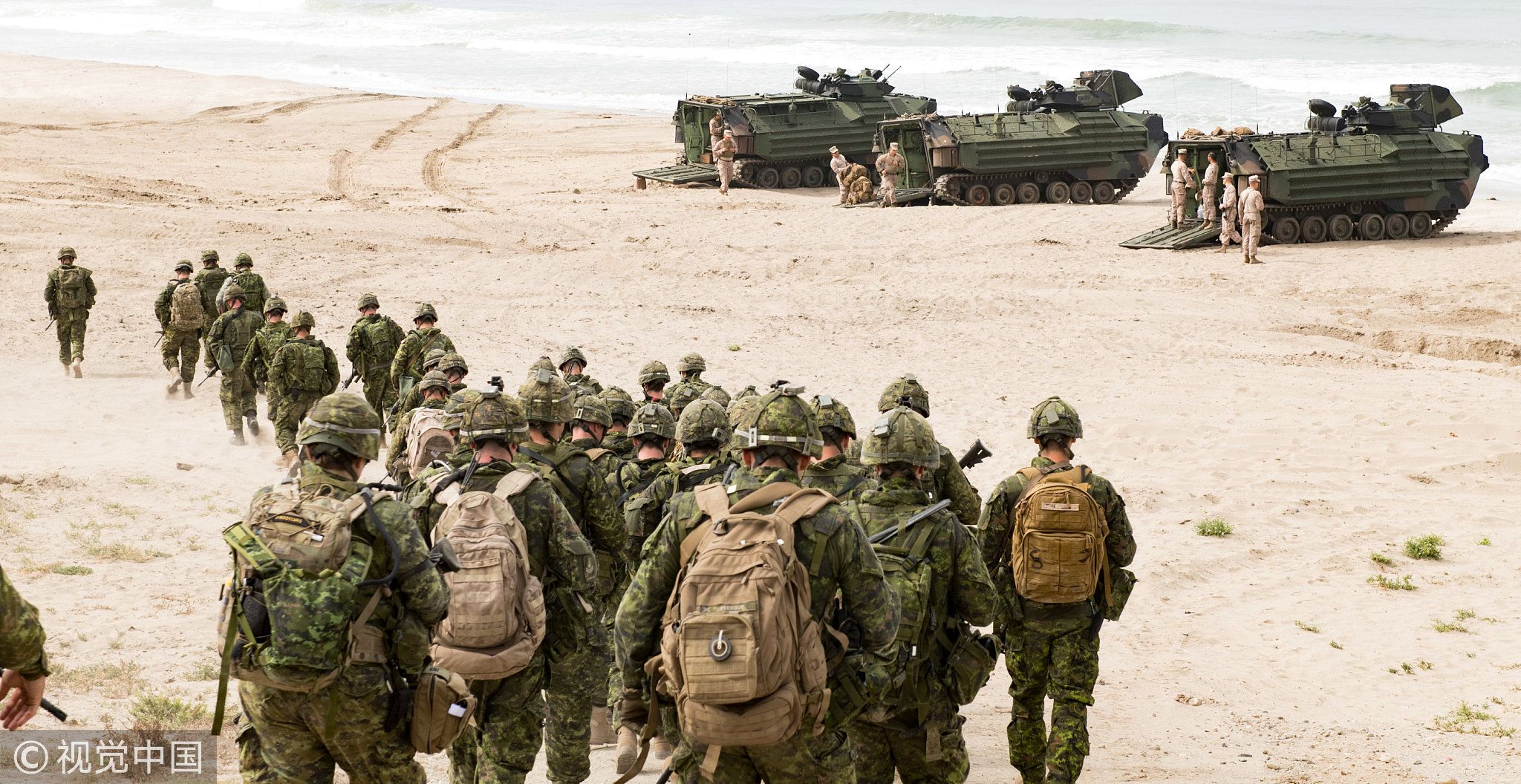
Canadian troops of the 2nd Battalion Royal 22e Regiment Bravo Company move toward amphibious assault vehicles during the biennial Rim of the Pacific (RIMPAC) exercise at Red Beach Training Area, Camp Pendelton, California, US, June 27, 2018. /VCG Photo.
Canadian troops of the 2nd Battalion Royal 22e Regiment Bravo Company move toward amphibious assault vehicles during the biennial Rim of the Pacific (RIMPAC) exercise at Red Beach Training Area, Camp Pendelton, California, US, June 27, 2018. /VCG Photo.
In 2012, Russia was invited to participate in the exercise, and in 2014 and 2016, China's navy was invited as well. Meanwhile, more non-combat training and exercises in terms of maritime security and cooperation were added, such as disaster relief, search-and-rescue, anti-piracy, etc.
With the engagement of more participants and an expansion of the exercise contents, RIMPAC’s tradition of big power confrontation is weakening, and its international coordination and cooperation is rising.
Unfortunately, things changed in recent years. In 2014 Russia was kept out of the exercise because of the Ukraine issue. In May this year, China was disinvited from the RIMPAC 2018. Changes in RIMPAC again reflected the adjustment of US naval strategy.
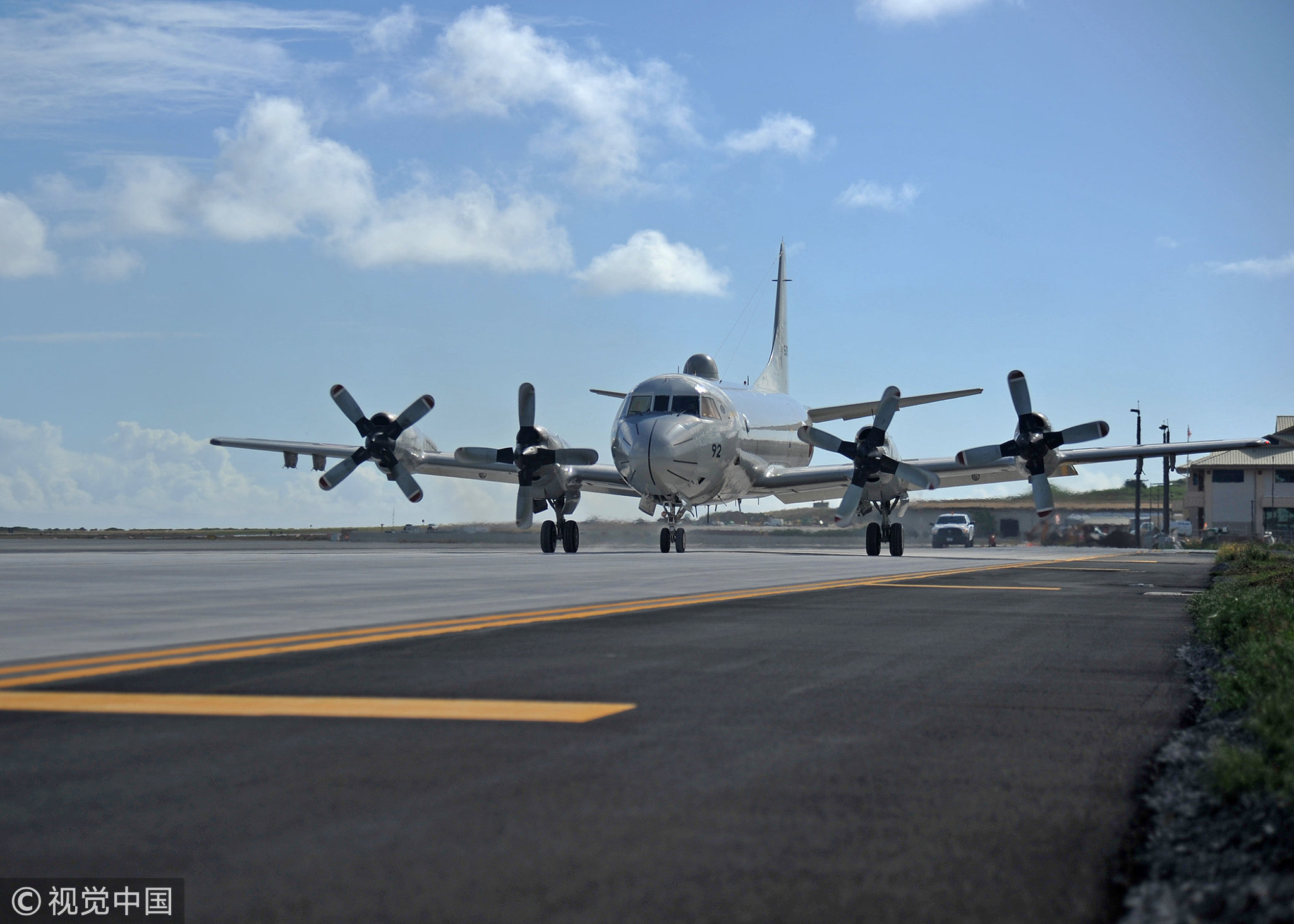
A Japan Maritime Self-Defense Force P-3C Orion arrives on Marine Corps Base Hawaii for the Rim of the Pacific (RIMPAC) military exercises at Kaneohe Bay, Hawaii, US, June 25, 2018. /VCG Photo.
A Japan Maritime Self-Defense Force P-3C Orion arrives on Marine Corps Base Hawaii for the Rim of the Pacific (RIMPAC) military exercises at Kaneohe Bay, Hawaii, US, June 25, 2018. /VCG Photo.
In January 2016, the CNO of the US Navy issued the report: "A Design for Maintaining Maritime Superiority," arguing that “for the first time in 25 years, the United States is facing a return to great power competition,” and “Russia and China both have advanced their military capabilities to act as global powers.”
A year later, the Surface Command of the US Navy published the Surface Force Strategy, reiterating “A quarter-century of global maritime dominance by the US Navy is being tested by the return of great power dynamics,” and emphasizing the concept of Distributed Lethality “as an operational and organizational principle for achieving and sustaining sea control at will,” the core of which is that more ships should be equipped with more firepower and operate in a more dispersed and independent way to enhance the US Navy’s combat capability, and sustain its advantages in the complicated high-end maritime warfare.
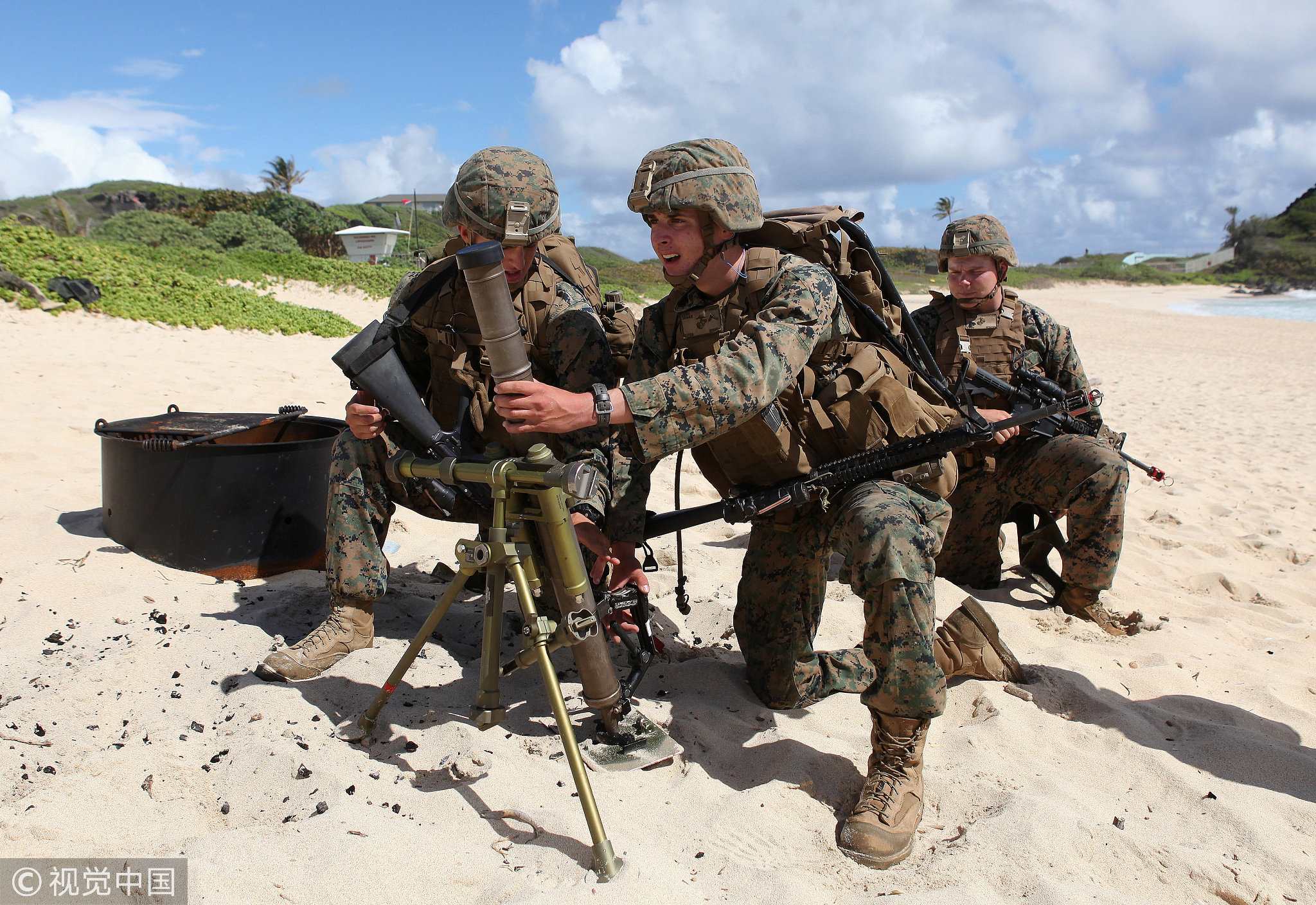
US Marines set up a mortar defense during a simulated beach assault at Marine Corps Base Hawaii with the 3rd Marine Expeditionary Unit during the multi-national military exercise RIMPAC in Kaneohe, Hawaii, July 30, 2016. /VCG Photo.
US Marines set up a mortar defense during a simulated beach assault at Marine Corps Base Hawaii with the 3rd Marine Expeditionary Unit during the multi-national military exercise RIMPAC in Kaneohe, Hawaii, July 30, 2016. /VCG Photo.
So it is not surprising when we read the statement on official website of the exercise that “RIMPAC 2018 contributes to the increased lethality, resiliency, and agility needed by the Joint and Combined Force to deter and defeat aggression by major powers across all domains and levels of conflict,” and in the starting ceremony of the exercise, Admiral Aquilino said RIMPAC 2018 “shows that like-minded nations who value a free and open Indo-Pacific want this opportunity to improve our cooperation with each other.”
When China and Russia are kept out of the RIMPAC Exercise, we have every reason to believe that the two important countries in this area are not the “like-minded nations,” but the “major powers” that should be deterred and defeated.
So two decades after the cold war ended, it seems that the RIMPAC Exercise is shifting back to its tradition of competing with major powers, which sends a dangerous message to the region and the world that the danger of confrontation of big powers in the ocean is on the rise.
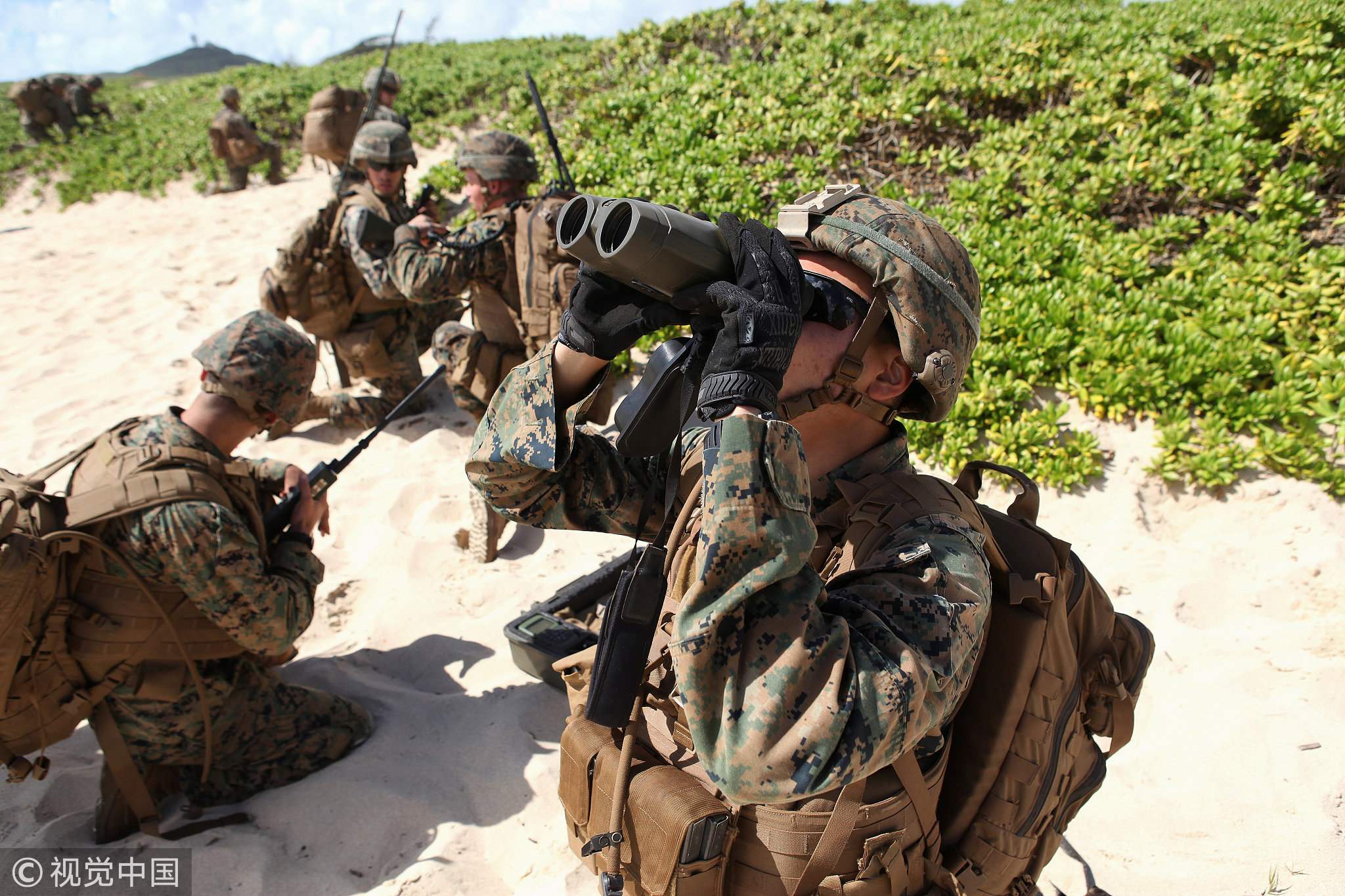
A US Marine checks GPS coordinates for his mortar team during a simulated beach assault at Marine Corps Base Hawaii with the 3rd Marine Expeditionary Unit during the multi-national military exercise RIMPAC in Kaneohe, Hawaii, July 30, 2016. /VCG Photo.
A US Marine checks GPS coordinates for his mortar team during a simulated beach assault at Marine Corps Base Hawaii with the 3rd Marine Expeditionary Unit during the multi-national military exercise RIMPAC in Kaneohe, Hawaii, July 30, 2016. /VCG Photo.
However, the world is changing, and the relationship between China and US is not that between the Soviet Union and the United States.
The disinvitation of China to the exercise will not change China’s position in the South China Sea, but only damages the communication and stability between the two navies, which is not in the interest of either country. Perhaps that’s the reason why Mr. Mattis visited China a day before the start of RIMPAC Exercise.
Only through communication and cooperation can we realize a peaceful and stable relationship between the two militaries, and a stable Sino-US relationship is a pillar for a peaceful, stable and prosperous Pacific Ocean, which is the common desire and goal of the people in the Pacific Rim and beyond.

 ["china"]