
Opinions
10:05, 11-Jul-2018
Opinion: Pompeo’s 'regrettable' journey not unexpected
Updated
09:11, 14-Jul-2018
 ["china"]
Share







Copied
Editor’s note: Xu Fangqing is a senior editor at China News Week and a non-resident fellow at the Center for China and Globalization. The article reflects the author's opinion, and not necessarily the views of CGTN.
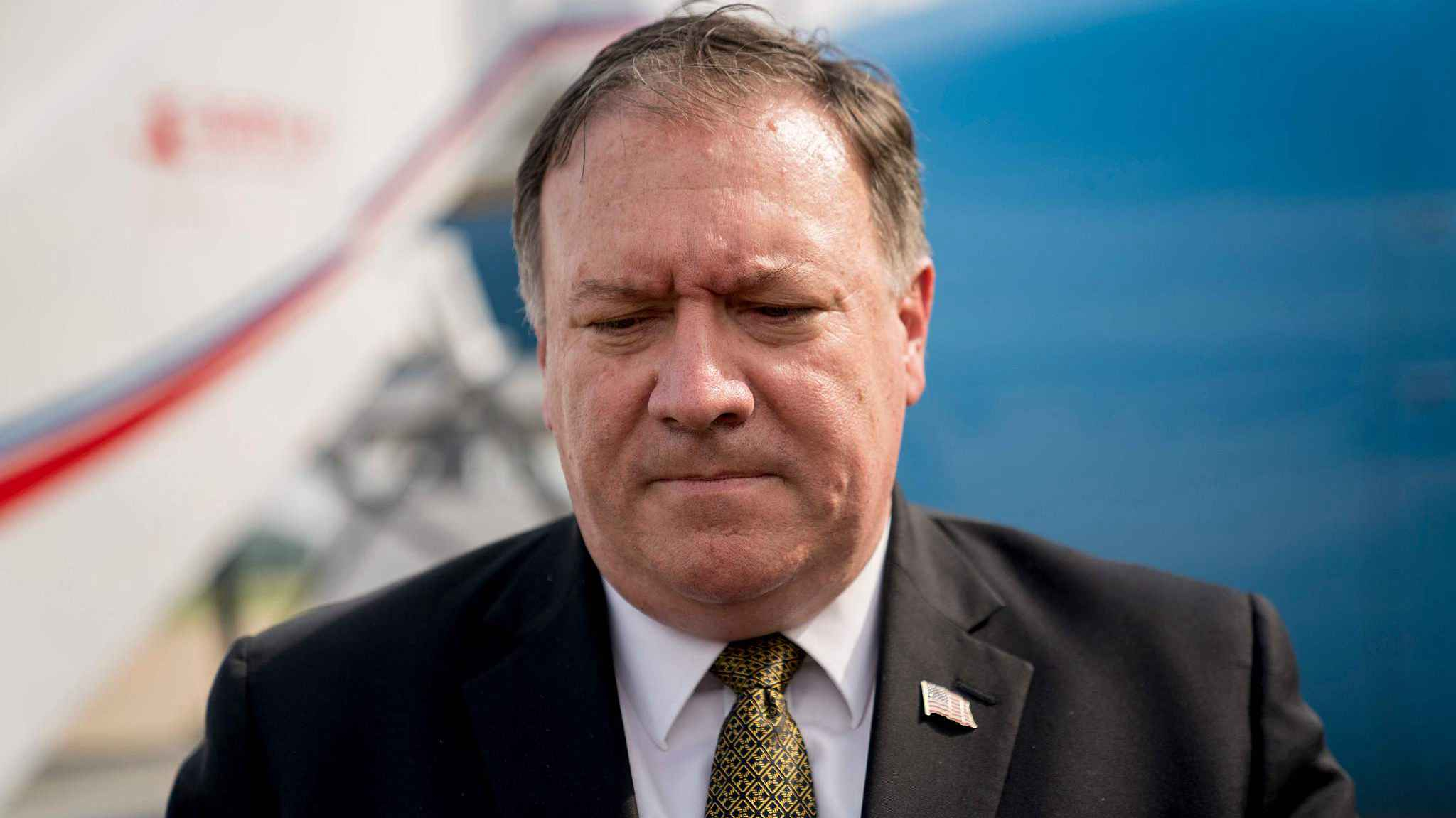
Mike Pompeo has finished his third Pyongyang visit within three months. The Secretary of State was welcomed personally by Chairman Kim on his previous two visits but last week he only got a letter from the top leader of the Democratic People’s Republic of Korea (DPRK) to his US counterpart.
It surprised many when the DPRK didn’t arrange a meeting between Pompeo and Kim Jong Un. But it was expected that the two sides would hold different attitudes towards the negotiations. As a matter of fact, the above outcomes just reflect the current situation on the Korean Peninsula.
Just like the roller-coaster Singapore summit between Kim and Trump, the peace talks between the US and DPRK are destined to go through a winding road.
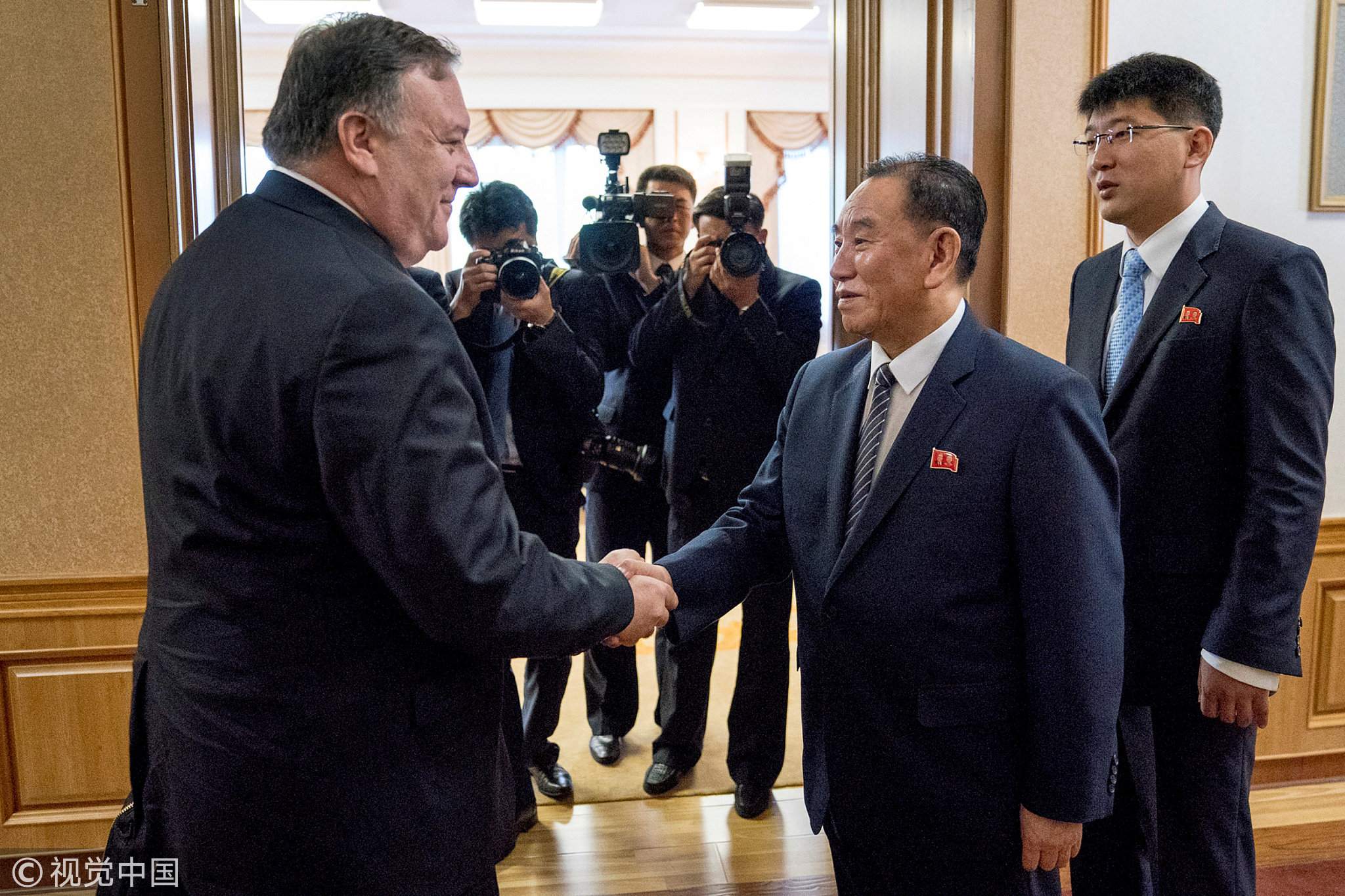
Secretary of State Mike Pompeo shakes hands with Kim Yong Chol, a DPRK senior ruling party official and former intelligence chief, for the second day of talks at the Park Hwa Guest House in Pyongyang, on July 7, 2018. /VCG Photo.
Secretary of State Mike Pompeo shakes hands with Kim Yong Chol, a DPRK senior ruling party official and former intelligence chief, for the second day of talks at the Park Hwa Guest House in Pyongyang, on July 7, 2018. /VCG Photo.
A final truce manifesto has not yet been issued by both sides as outsiders expected before the meeting. On the one hand, this result is due to the fragility of the mutual trust and on the other hand, the two sides are not satisfied with a hollow and solitary armistice.
Without the basis and specific timetable for “complete denuclearization,” any manifesto or agreement is prone to collapse and prove to be a piece of valueless paper in case of any setback.
Undoubtedly, it’s a tough job to build up the faith of trust between the longtime foes and not mention pushing the essential progress of destruction of nuclear weapons on the peninsula.
The fulfillment of the joint statement the two leaders signed in Singapore is far harder than the statement itself and meanwhile, the difficulties and obstacles will result in zig-zag progress during the practical period.
The determination of the two leaders does matter without any doubt, and it would take honesty and patience for the policymakers in Pyongyang and Washington to make a “bargain.”
There are many issues involved in denuclearization like the lifting or softening of economic sanctions, the return of the remains of US soldiers during the Korean Civil War in the early 1950s, the normalization of the relations between the US and DPRK and so forth.
It’s beyond a bilateral issue from a regional or global perspective. In other words, the US and DPRK can’t solve the peace issue of the peninsula without the involvement of China, the Republic of Korea and other influential countries in the region.
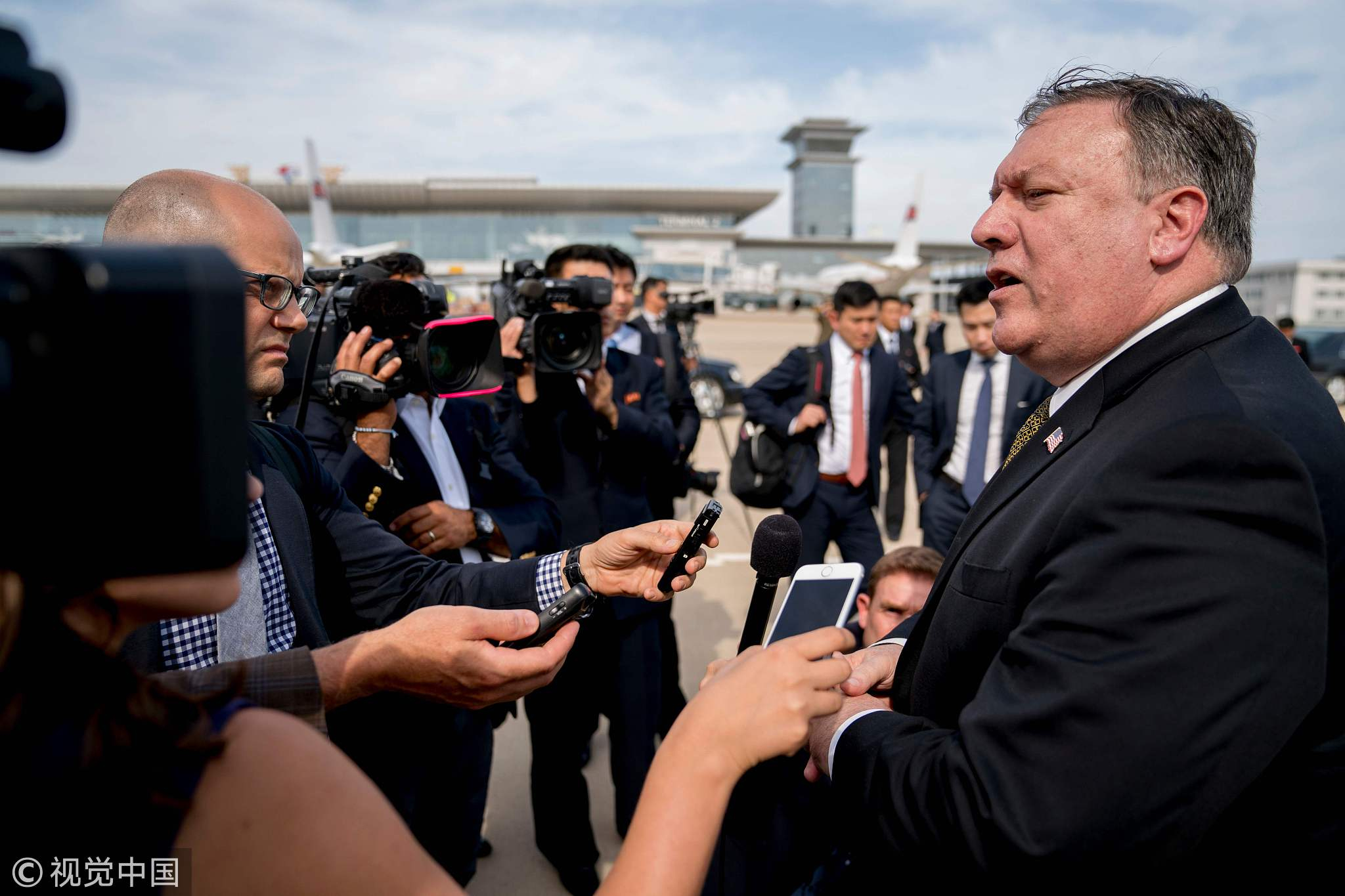
US Secretary of State Mike Pompeo speaks to members of the media following two days of meetings with Kim Yong Chol, a DPRK senior ruling party official and former intelligence chief, before boarding his plane at Sunan International Airport in Pyongyang on July 7, 2018. /VCG Photo.
US Secretary of State Mike Pompeo speaks to members of the media following two days of meetings with Kim Yong Chol, a DPRK senior ruling party official and former intelligence chief, before boarding his plane at Sunan International Airport in Pyongyang on July 7, 2018. /VCG Photo.
China would play an indispensable part in providing a Pyongyang security guarantee, its greatest issue of concern, and endorse the DPRK’s promise to defuse its atomic arsenal to the US. Without China’s assurance, neither will likely take the crucial step to undertake what they promise.
As a president who is good at “art of the deal,” Donald Trump won’t make the negotiating process a smooth one, even if both sides reach the consensus on the final target.
As the US midterm elections are approaching, Trump and his party are now eager to secure an achievement on the Korean issue for the supporters of his engagement policy and opponents as well after his controversial overtly high-profit decision on the suspension of joint military drills with the Republic of Korea.
Currently, the time is on the side of Pyongyang and if Trump would like to get a helpful push, he would prepare a “mirror reciprocal” chip for DPRK.
In spite of the tremendous gap between US and DPRK, it’s not impossible to realize the “reciprocal” principle as so many participants are in such a complicated situation.
The core is to find a balanced point to undertake America's “complete, verifiable and irreversible” denuclearization and Korean “in-stage” resolution.
Pyongyang still has faith in Trump notwithstanding saying it found the American stance and attitude on the issue "regrettable."
Kim Jong Un's comments in his letter to his US counterpart that his and Trump's good relations would bolster his confidence in the American president through the just-finished and future high-level talks.
Therefore, both sides are still on the right track since the basis of confidence is unchanged. Given the decades of confrontation between the two sides, the current situation is not a bad result.