
Opinions
17:28, 25-Sep-2018
Cooperation is the only solution to the US-China trade friction
Updated
16:58, 28-Sep-2018
 ["china"]
Share







Copied
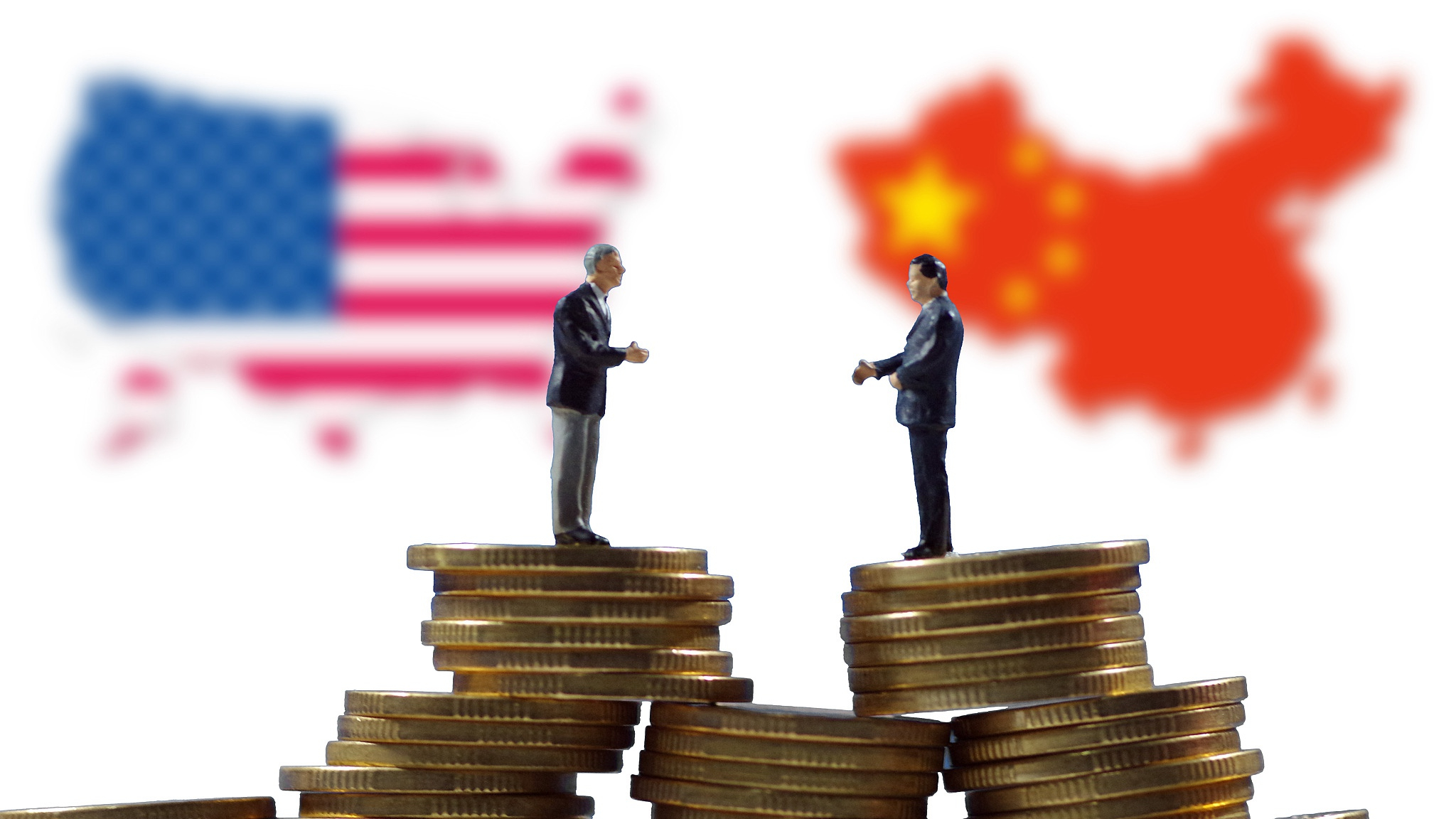
Editor's note: The following is an edited translation from the People's Daily.
Economic and trade relations have always been regarded as the ballast and propeller of Sino-US relations.
However, as the US government has recently started, and then continuously escalated, trade friction with China, this long-lasting relationship has been severely damaged and thus the multilateral trading system and the principles of free trade are facing serious challenges.
On Sept. 24, the State Council Information Office published a White Paper on the Facts and China's Position on China-US Trade Friction. The Paper lists facts and quotes a lot of data to make a comprehensive account of the economic and trade relationships between China and the US.
It emphasizes that the basic principle of this trade relationship is to achieve mutual benefits and create a win-win situation. In addition, it is pointed out in the Paper that the US is actually employing protectionism and bullying trade practices.
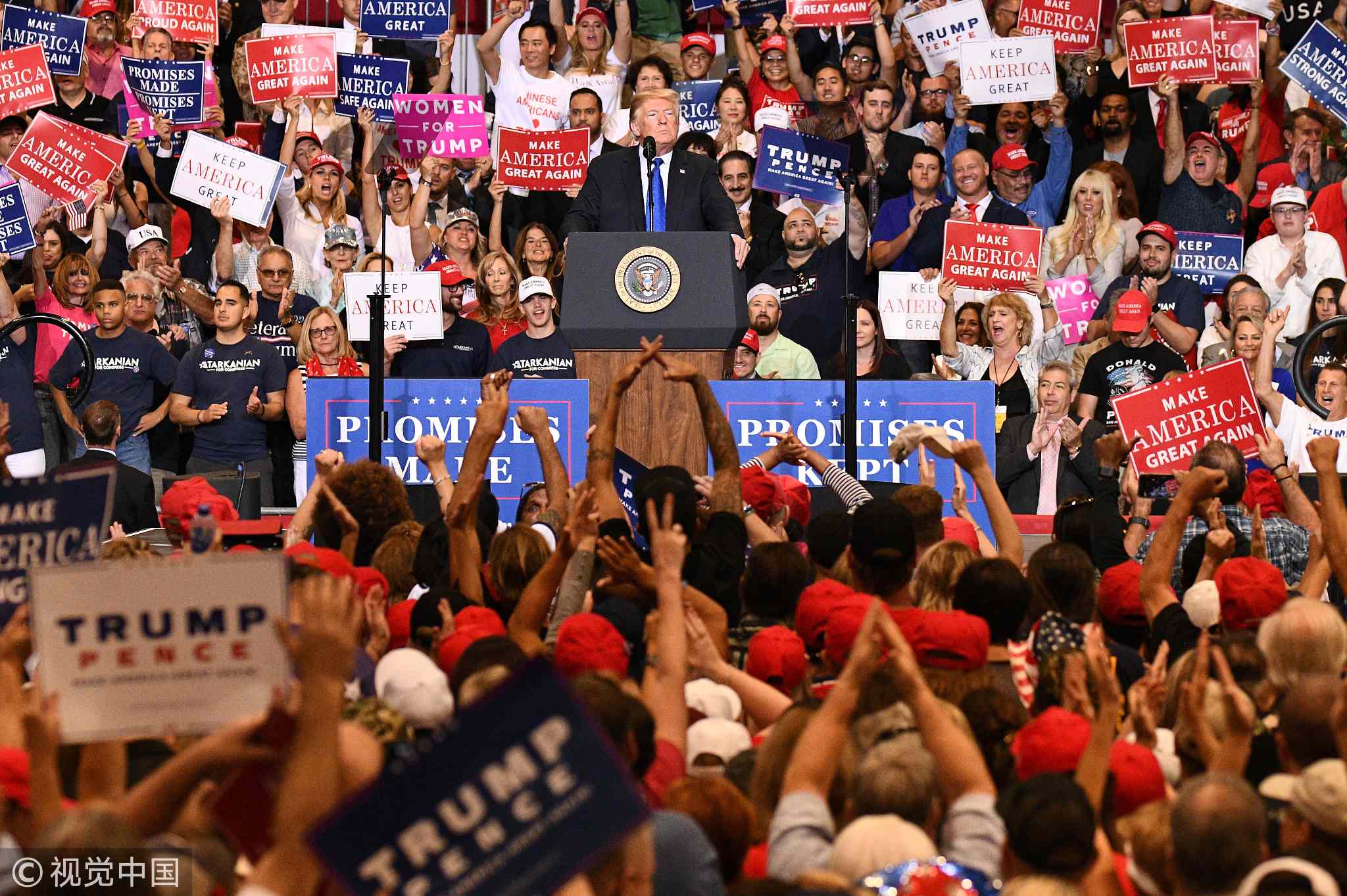
US President Donald Trump pauses during a speech at a rally in Las Vegas, US, Sept. 20, 2018. /VCG Photo.
US President Donald Trump pauses during a speech at a rally in Las Vegas, US, Sept. 20, 2018. /VCG Photo.
The Paper reiterates China's stance and expresses its determination to seek a reasonable solution, to maintain healthy and stable economic development between the two countries and to firmly defend the multilateral trading system.
In 2017, the bilateral trade in goods between China and the United States reached 583.7 billion US dollars, 233 times the figure in 1979 when diplomatic relations were first established.
History and reality have repeatedly proved that Sino-US economic and trade cooperation is a win-win relationship, not a zero-sum game. It not only promotes China's economic development and improvement of people's livelihood but also gives tangible benefits to American enterprises and people.
Sino-US economic and trade exchanges are complex enough that it is inevitable that some level of friction would arise. The two countries should properly handle their differences and seek to resolve the friction in a pragmatic manner.

Nightscape of Guangzhou, Guangdong Province, China, Sept. 13, 2018. /VCG Photo.
Nightscape of Guangzhou, Guangdong Province, China, Sept. 13, 2018. /VCG Photo.
However, the current US government made a series of accusations against China in issues such as economic aggression, unfair trade, theft of intellectual property rights and state capitalism by issuing the Section 301 Investigation Report on China.
The report seriously distorts the facts of Sino-US economic and trade relations and ignores the great achievements of China's reform and opening up, as well as the hard work of the Chinese people.
Such accusations are disrespectful, not only for the Chinese government and people but also for the real interests of the American people, as they will only lead to increased differences, an escalation of friction and ultimately damage the fundamental interests of both sides.
China and the US stand to gain from cooperation and lose from confrontation. In the face of an uncertain, unstable and insecure international situation, China has always followed global trends, pursued justice, and taken the right path.

Soybeans are harvested with a Deere & Co. combine harvester in Tiskilwa, Illinois, US, Sept. 18, 2018. /VCG Photo.
Soybeans are harvested with a Deere & Co. combine harvester in Tiskilwa, Illinois, US, Sept. 18, 2018. /VCG Photo.
China has pledged its commitment to firmly safeguarding national dignity and core interests, promoting the healthy development of Sino-US economic and trade relations, advocating the reform to improve the multilateral trading system, protecting property rights and intellectual property rights, safeguarding the legitimate rights and interests of foreign business people in China, deepening reform and expanding opening up, enhancing mutually beneficial and win-win cooperation with other developed countries and developing countries, and building a community with a shared future for mankind.
China does not want a trade war, but is not afraid of one and will fight one when it is necessary. We are confident, determined, and capable of responding to various risks and challenges, and no external factors can prevent China from development.
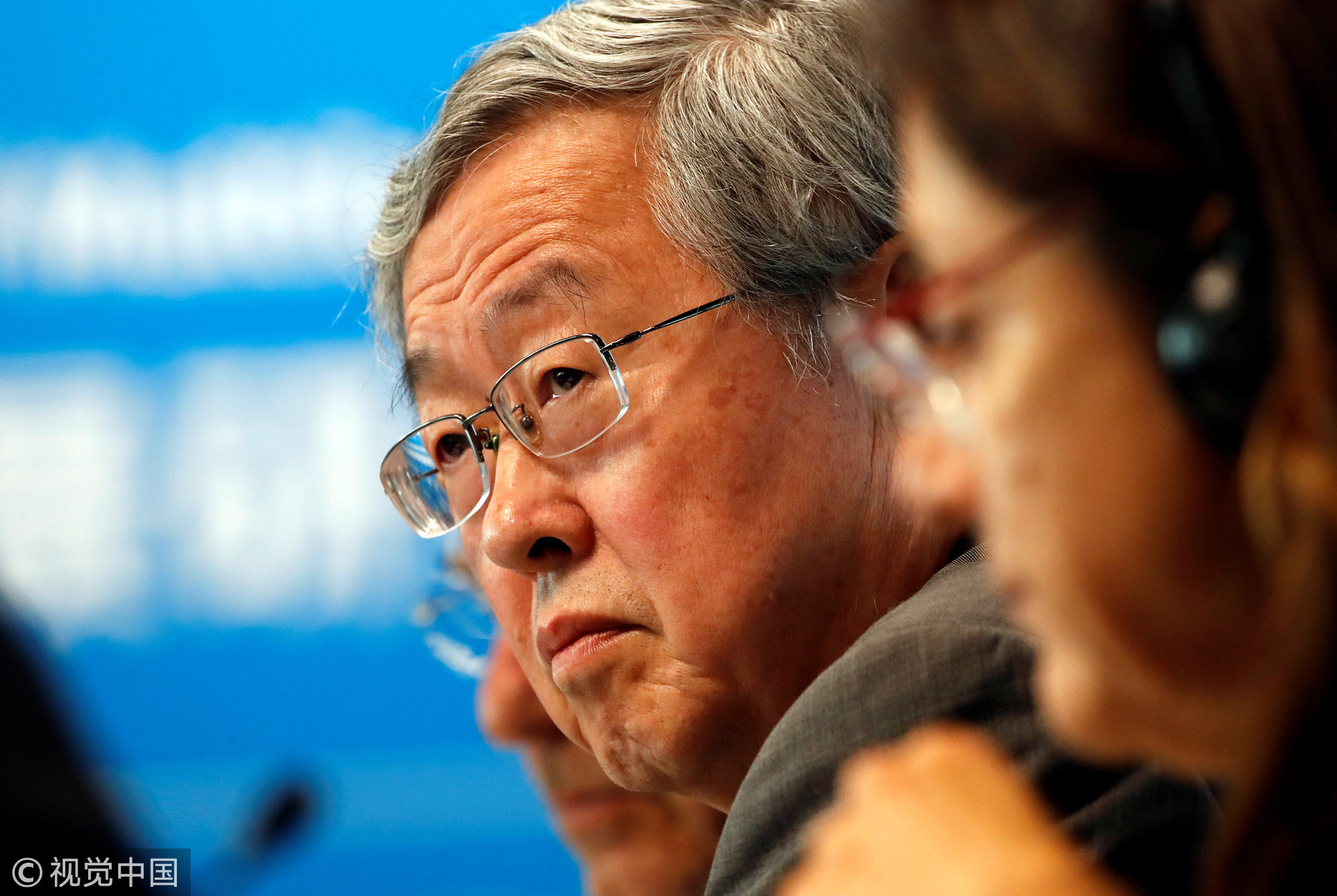
Zhou Xiaochuan, president of China Society for Finance and Banking and former governor of the People's Bank of China (PBOC), attends a meeting on China-US-EU trade and economic relations in Geneva, Switzerland, September 19, 2018. /VCG Photo.
Zhou Xiaochuan, president of China Society for Finance and Banking and former governor of the People's Bank of China (PBOC), attends a meeting on China-US-EU trade and economic relations in Geneva, Switzerland, September 19, 2018. /VCG Photo.
The door to negotiations has always been open, but negotiations must be based on mutual respect, equality, trust, consistency of words and actions, and cannot be carried out under the threat of imposing tariffs, or at the expense of China's right to development.
In approaching Sino-US relations, one should see the larger picture and not just focus on differences, just as a Chinese saying tells us: "When important things are addressed first, secondary issues will not be difficult to settle."
China is the largest developing country in the world and the United States the largest developed country. The Sino-US economic and trade relations are related to the well-being of the two peoples and to the world peace, prosperity, and stability.
Both sides need to enhance mutual trust, promote cooperation, and manage differences when dealing with the trade friction and finding a reasonable resolution. In such circumstances, cooperation is the only correct choice, and a win-win situation can lead both countries to a better future.
(If you want to contribute and have specific expertise, please contact us at opinions@cgtn.com.)