
Opinions
13:15, 19-Jul-2018
Opinion: Japan, EU strike free trade deal in the face of challenges from US
Updated
12:46, 22-Jul-2018
 ["china"]
Share







Copied
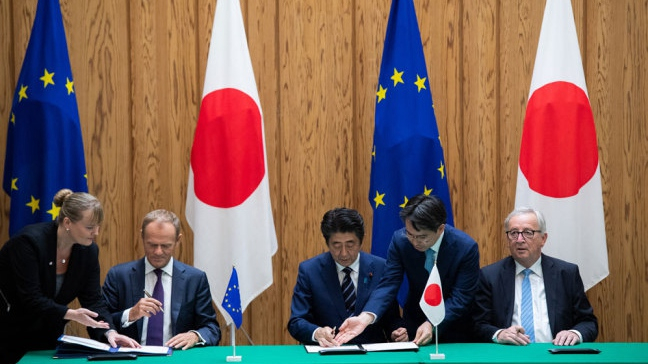
Editor's note: The article was originally published in China Plus.
The European Union and Japan on Thursday came together to sign a major free trade deal: the "Economic Partnership Agreement". Expected to go into effect in 2019, the agreement is one of history's largest free trade deals. When it comes into force, it will create the world's largest free-trade bloc that will account for around 30 percent of the world's GDP and cover a population of about 600 million.
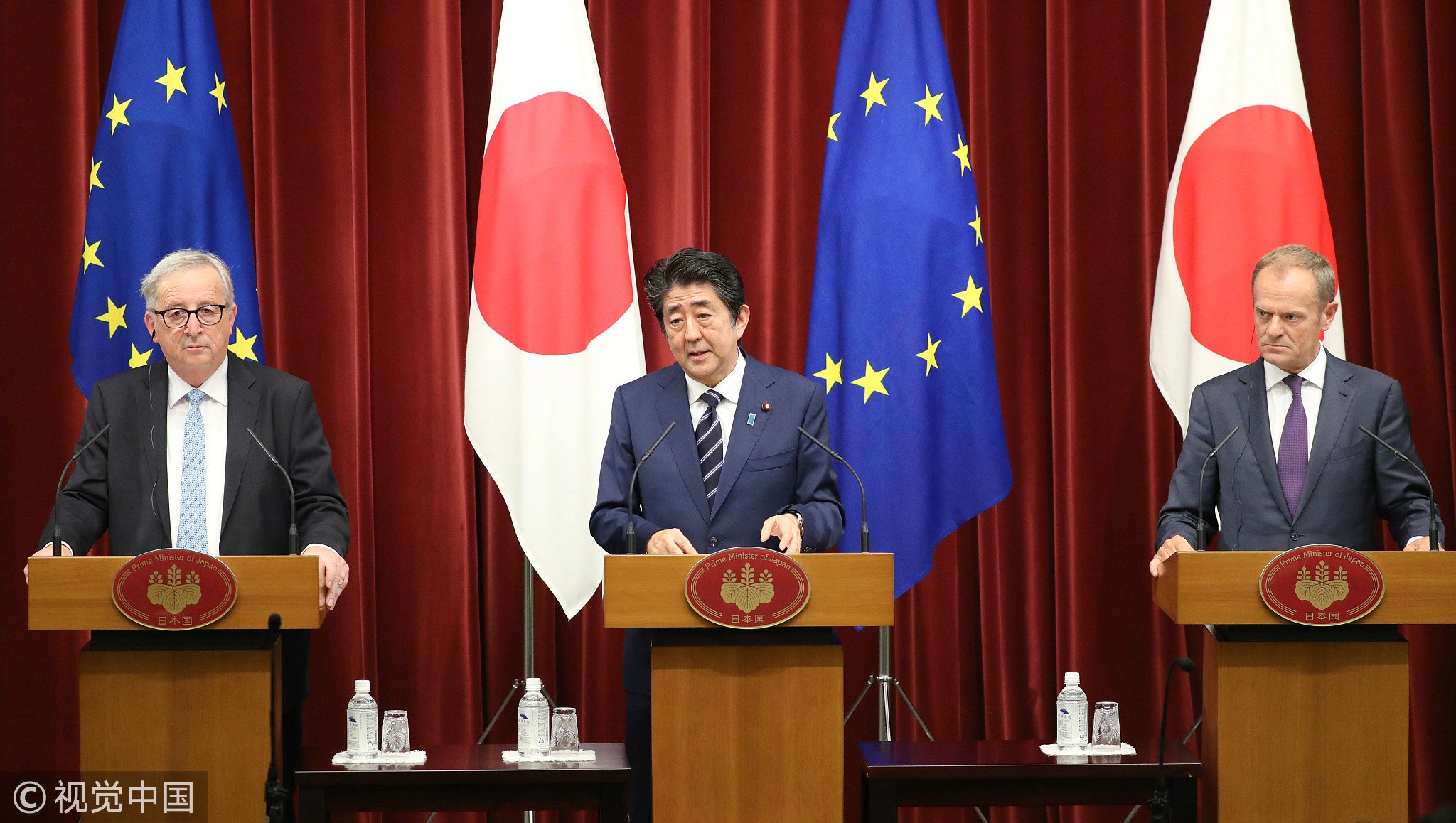
From left to right, European Commission President Jean-Claude Juncker, Japanese Prime Minister Shinzo Abe and European Council President Donald Tusk attend a joint press conference after the signing of an EPA between Japan and the EU at the prime minister's office in Tokyo on Jul 17, 2018./VCG Photo
From left to right, European Commission President Jean-Claude Juncker, Japanese Prime Minister Shinzo Abe and European Council President Donald Tusk attend a joint press conference after the signing of an EPA between Japan and the EU at the prime minister's office in Tokyo on Jul 17, 2018./VCG Photo
Japan and the EU held many rounds of negotiations, and for a time the two sides kept failing to reach an agreement because the deal involves issues that are sensitive in Japan, such as those related to its agricultural products. But Brexit increased the necessity of the two sides to reach an agreement, as did the withdrawal of the United States from the Trans-Pacific Partnership – it seems that US President Donald Trump, to some extent, contributed to the determination of Japan and the EU to seal a deal.
This month, 16 countries including China, Japan, India, and members of the Association of Southeast Asian Nations held a ministerial meeting of the Regional Comprehensive Economic Partnership in Tokyo. Hiroshige Seko, Japan's minister for the economy, trade and industry, said he hoped a basic agreement could be reached by the end of the year. This followed the signing of the Comprehensive and Progressive Agreement for Trans-Pacific Partnership in March by the 11 participating countries, at the conclusion of negotiations that had been led by Japan.
Pursuing multilateral free trade is Japan's well-established national policy. As a nation founded on trade, Japan has sought to take the lead in multilateral trade and to take the initiative in developing its relationship with the US.
Since taking office, Trump has been making great efforts to promote his "America First" policy of unilateralism and has been rejecting multilateral deals and relationships. Japan was shocked when Trump announced that he would withdraw from the Trans-Pacific Partnership just days after he took office since it led to the sudden collapse of the trans-pacific economic and political system that had been painstakingly constructed by Japan and the administration of former US President Barack Obama. Japan's Prime Minister Shinzo Abe tried in vain to persuade the Trump administration to return to the negotiating table. In the end, it cut a deal with its partners in the Asia-Pacific region that excluded the US.
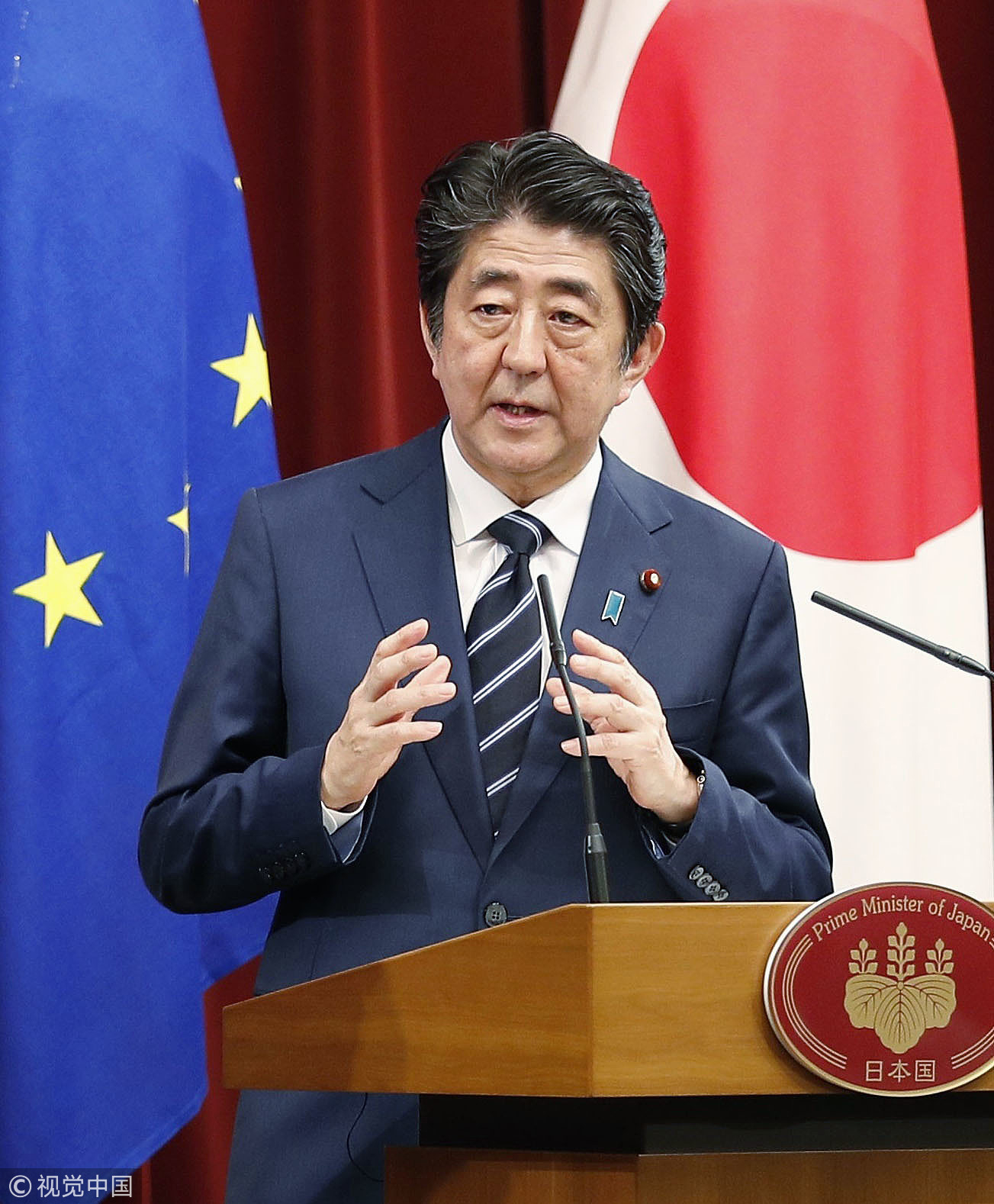
Japan's Prime Minister Shinzo Abe speaks during a press conference at his office in Tokyo on Jul 17, 2018./VCG Photo
Japan's Prime Minister Shinzo Abe speaks during a press conference at his office in Tokyo on Jul 17, 2018./VCG Photo
With this agreement, Japan hopes to boost its economic and political strength through some of the small and medium-sized countries in the region. This is an important step for Japan. The message that it wants to convey is that it can be a leading player in international institutions without American support. From Japan's perspective, the Trump administration can only last for eight years at most, and Trump's successor will very likely want to join their Asia-Pacific trade deal.
The pressure the US has exerted through economic sanctions and hard-line bilateral trade negotiations has pushed Japan to further its economic relationships with other countries. During his presidential campaign, Trump accused Japan of taking advantage of America on trade and vowed never to allow it to maintain its huge trade surplus with the US. After he took power, Trump forced Japan into bilateral trade talks, demanding that the country trim its trade surplus.
So it seems there are two reasons for the Abe government to push so adamantly for the Economic Partnership Agreement with the EU. First, it is an answer to the Trump administration's apparent snub of its long-standing ally. And second, it is part of Japan's efforts to create and expand the space for its economic activities on the world stage, giving the country more room to maneuver in the promotion of its exports, in line with its long-term goal of establishing economic and political ties in a way that is conducive to its own interests.
Abe and European Council President Donald Tusk issued a joint statement after the signing the free trade agreement.
"The Economic Partnership Agreement demonstrates to the world the firm political will of the EU and Japan to keep the flag of free trade waving high, and to powerfully advance free trade," they said in a statement, hailing it as a historic step.
For the outside world, these remarks appear to be targeted at Trump. By striking out like a bully in its trade relationships, the US will only find itself further isolated from the rest of the Western world.