
Travel
20:05, 07-May-2019
Parents snap up summer study trips
 ["china"]
Share







Copied
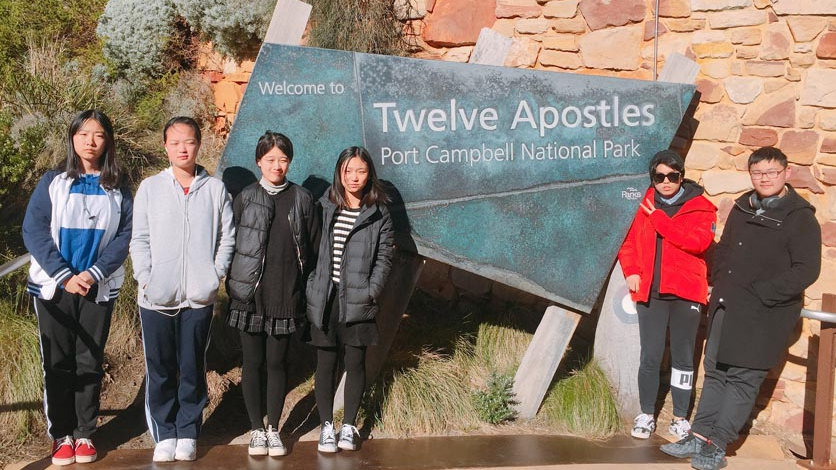
Chinese bookings for domestic and overseas educational tours during the seasonal school vacation are on the rise. With just two months to go for the much-awaited summer vacation, parents have already gone out of their way to plan ahead for their children.
Since April, many have beaten a path to several brick-and-mortar shops in Beijing that are owned by the major domestic online travel agency, Ctrip, the company reports.
"The online views of our summer-vacation study tour products increased by 120 percent in April as compared to previous month," said Zhang Jie, general manager of Ctrip's study-tour operations.
Zhang expects the number of young travelers who take educational trips to grow by more than 50 percent compared to the same period last year.

Phoenix Island, Sanya, south China's Hainan Province. /VCG Photo
Phoenix Island, Sanya, south China's Hainan Province. /VCG Photo
Australia, Japan, the U.S., the UK and Canada are among the most popular foreign destinations for those inquiring about study tours abroad, while Beijing, Shanghai, Gansu Province's Dunhuang, Shaanxi Province's Xi'an and Jiangsu Province's Nanjing top the domestic-destination list.
Chinese parents have continued to invest more in their children's education, Zhang said.
Their kids' footprints have been left on hundreds of destinations in over 20 countries.
"Products that just scratch the surface, like simple tours of famous universities, have fallen out of favor with the market," Zhang said.
Language training, NASA's space camp, computer programming, homestays, wild animal care, and desert and museum experiences are among the most popular options.
"Certain volunteering and public-welfare routes have seen a rise in bookings," Zhang said.
During the recent winter vacation in February, study-trip bookings surged by 80 percent compared to the same period last year.
Domestic trips cost roughly 4,500 yuan (663 U.S. dollars) per capita on average, while expenditures hit 21,000 yuan for outbound experiences, the agency reports.
Parents from Shanghai, Beijing and Guangdong Province's Guangzhou and Shenzhen are the most willing to spend, according to Ctrip's data.
Wang Chunyan has managed to take her son on study tours since 2015.
"We've been to deserts, grasslands and (sections of) the Silk Road over the years," Wang said.
Wang has booked for her son, who is currently in the fifth grade, a two-week trip to Australia and the U.S. each in August.
"He will be sitting in local classes and studying with local children there," Wang said.
Although the outbound-study trips will cost her around 70,000 yuan, she believes it's money well spent.
"He will learn things while having fun in a foreign country, which will open his eyes to the world and enable him to make new friends," she said.
Speaking about the effects of taking those study tours, Wang said her son has a better understanding of different cultures and has become more confident in public and participating in academic and cultural events.
"I will keep sending him on such trips so that he can see more places and get to know their culture and history," she said.
Enthusiasm for study tours is likely fueled by the fact that some middle schools in China have already put them under consideration when evaluating a student's comprehensive performance.
So far, several provinces, including Sichuan, Hunan and Guangdong, have integrated study travel into teaching programs for primary and middle schoolers.
A number of middle schools in Beijing have already developed study tours that cover Jiangsu Province's Nanjing and Zhejiang Province's Hangzhou, as well as Canada and Australia, for their students.
"The original purpose of bringing study tours into students' comprehensive performance evaluation is good, because the tour will broaden their knowledge and stimulate their interests," said Zhang.
"It's a good complement to closed-classroom education."
The education systems of many developed countries have schools that encourage study tours.
In Japan, numerous schools have well-established study tours for their students, while a considerable number of private schools in the UK, the U.S., Australia and New Zealand have arranged for students to take themed education tours.
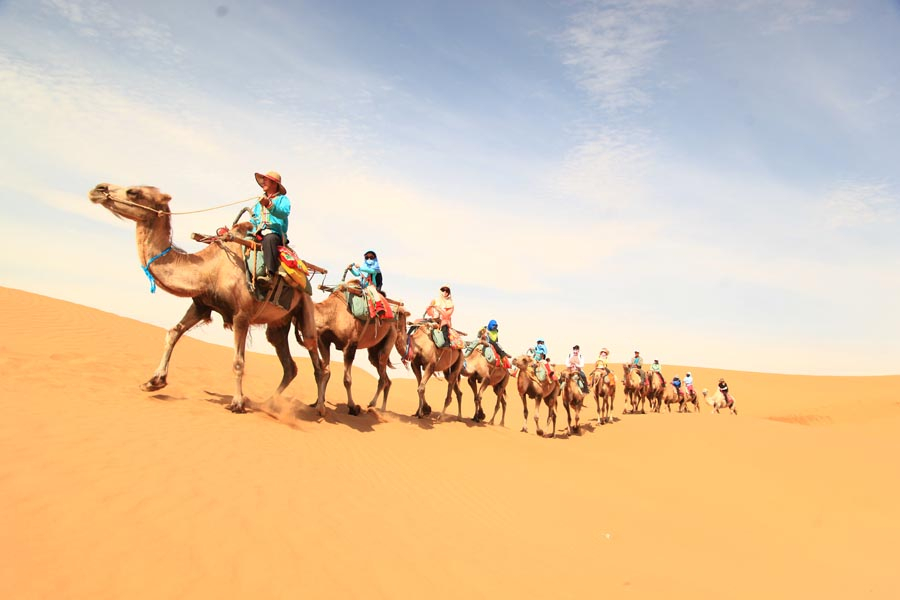
Children ride on camels on the Tengger Desert in Zhongwei, northwest China's Ningxia Hui Autonomous Region, during summer vacation. /China Daily Photo
Children ride on camels on the Tengger Desert in Zhongwei, northwest China's Ningxia Hui Autonomous Region, during summer vacation. /China Daily Photo
However, Zhang cautions that it has to be voluntary on the students' part and parents should choose products based on their children's interests and the family's financial circumstances.
"In fact, study-tour prices are not necessarily all steep, and it is also not a case of the more expensive, the better the tour," Zhang said.
Many travel products that cost just a few hundred yuan can be very educational and well within the reach of ordinary families, she added.
One of Ctrip's most popular museum tours in Shanghai costs just 168 yuan for a child, and is led by a scholar from Shanghai-based Fudan University's School of Life Science.
The tour is open to children older than the age of five during weekends and exposes them to fossils and specimens.
Ctrip has developed 12 themed study tours, such as scientific exploration, outdoor survival and sports, to meet the growing needs of the market.
Each product has been divided to suit different age groups and learning goals, so customers can more easily choose the one that best suits their needs, Zhang explained.
For the fast-approaching summer, a series of tours covering both Eastern and Western civilizations in such destinations as Henan Province's Luoyang and Shaanxi Province's capital, Xi'an, have been developed for children to better understand the Silk Road.
For those who want to trek further afield, a 12-day trip to Greece is available for students to savor local history.
Scholars specializing in Greek studies, archaeologists and artists offer professional guidance.
To ensure that they get the most out of the study tours, students are asked to do relevant reading before the trip and then write a paper or deliver a photography project afterward to demonstrate what they have learned, according to Zhang.
Immersion classes, such as studying ancient Greek opera or replicating a pottery antique, can also be arranged.
"The idea is to ensure that children actually learn something," Zhang said.
(Cover: Chinese students take study tours in Australia. /China Daily Photo)
Source(s): China Daily