
Space
18:10, 16-Aug-2018
NASA detects hydrogen 'wall' surrounding solar system
Updated
17:16, 19-Aug-2018
 ["china"]
Share







Copied
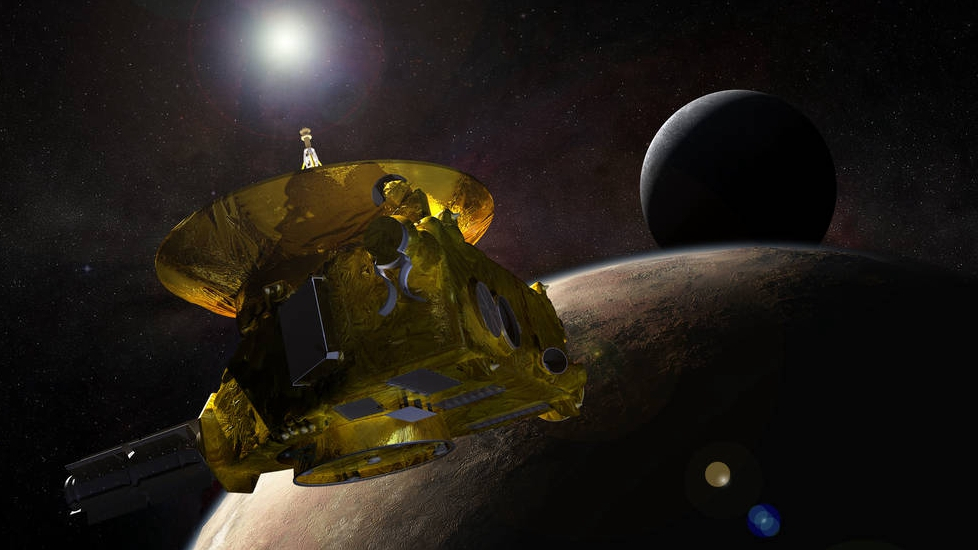
NASA's New Horizons spacecraft has found new evidence of a "wall" of hydrogen at the edge of the solar system encircling all the planets and objects orbiting the Sun.
The "wall" is actually a vast amount of trapped hydrogen atoms caught up in the solar wind. They produce waves of ultraviolet (UV) light and have been detected by the sensors aboard New Horizons, according to NASA.
The phenomenon was first noticed by astronomers around 30 years ago and was called heliosphere. However, evidence supporting the theory has remained murky.
New Horizons has been using its onboard detector, known as "Alice," to look for traces of celestial interaction. It picked up UV rays with "Alice" seven times from 2007 to 2017 and finally found evidence to verify earlier observations.
"We're seeing the threshold between being in the solar neighborhood and being in the galaxy," astronomer Leslie Young of the Southwest Research Institute and New Horizons team said.
New Horizons will continue to look for the "wall" about twice a year until the mission reaches its conclusion, which is expected to be around 10-15 years from now on, NASA said.
If the levels of UV light detected ever take a nosedive, it could mean the spacecraft has left the "wall."
(Top image: NASA's spacecraft New Horizons. /NASA Photo)
Source(s): Xinhua News Agency