
Opinion
20:57, 02-Mar-2019
Opinion: Moon's bid to salvage the Korean peninsular peace process
 ["china"]
Share







Copied
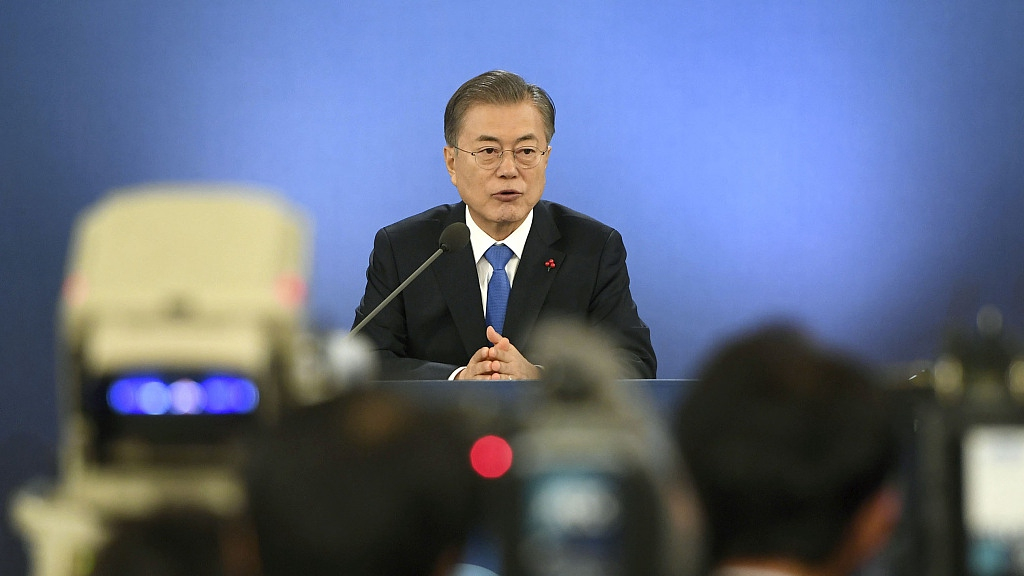
Editor's note: Tom Fowdy graduated with an Msc. in Chinese Studies from Oxford University after previously majoring in Politics at Durham University. He has published a number of pieces on the international relations of China and the Democratic People's Republic of Korea. The article reflects the author's views, and not necessarily those of CGTN.
Friday marked a historic anniversary on the Korean peninsula. The 1st of March 2019 marked 100 years since the emergence of the Korean independence movement. Millions of ordinary people throughout the peninsula, in protest of the Japanese occupation of their country, would proclaim Korea's right to self-determination and embark on mass demonstrations against their Meiji rulers. As Korea celebrated the centenary of this event, Seoul was filled with elaborate displays of patriotism, national pride and the rousing chorus of the country's national anthem, the Aegukka.
But it didn't quite go according to plan. President of the Republic of Korea (ROK) Moon Jae-in commenced with a pre-scheduled speech at Gwanghuamun, but he had been forced to make some last minute adjustments. Initially planning to declare what he described in briefings as a “new regime on the Korean peninsula,” the dramatic shortfall of the summit in Hanoi the previous day saw his hopes painfully extinguished.
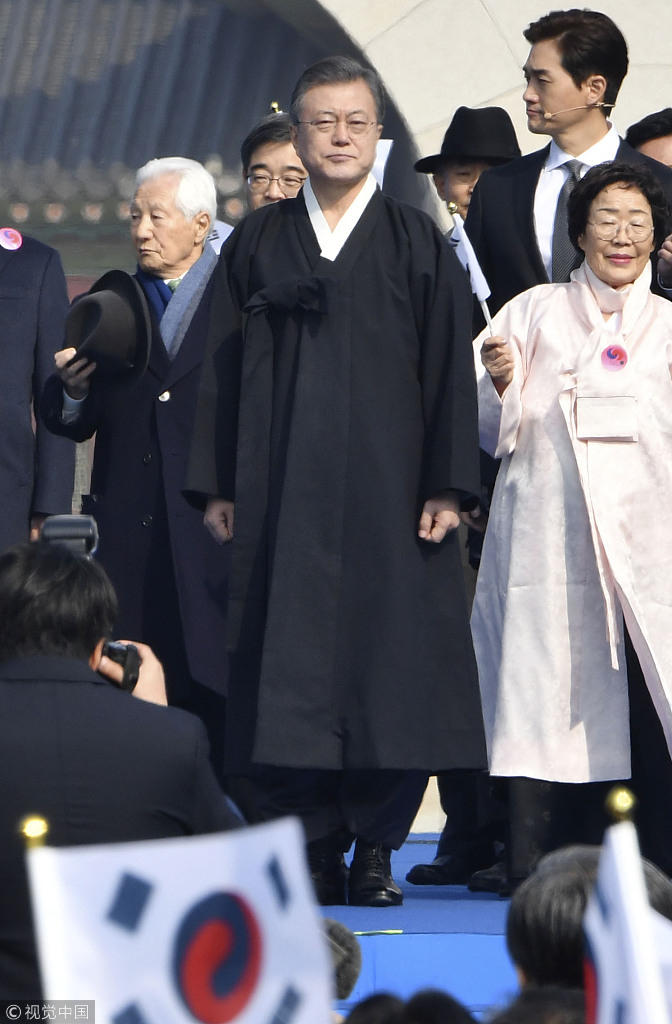
ROK President Moon Jae-in (C) attends a ceremony in Seoul on March 1, 2019, marking the 100th anniversary of a Korean independence movement. /VCG Photo
ROK President Moon Jae-in (C) attends a ceremony in Seoul on March 1, 2019, marking the 100th anniversary of a Korean independence movement. /VCG Photo
No longer was he able to link this once in a lifetime commemoration with new hopes for peace and reunification on the Korean peninsula. Instead he spent the dialogue scrambling to defend and uphold the process of which he had created. Make no mistake about it, the demise of Hanoi places enormous pressure on President Moon.
As the man who has placed great political stakes on achieving reconciliation between Pyongyang and Washington, the prospects of any stalemate between the two may prove disastrous for his administration. He has a mission now: to twist the arms of both the other parties and rekindle progress in bringing the two sides to an agreement.
Moon Jae-in may be described as a “middle man” in the DPRK denuclearization talks. He has sought to position himself midway between the DPRK and the United States, utilizing shrewd diplomacy to build bridges between the two. Doing so, he has been able to make a considerable difference to Washington's own foreign policy on the matter.
It was Moon's early summits and engagement with DPRK the year previously which ultimately made it possible for the countries to initiate talks and pave the way for the Kim-Trump summits. Moon essentially went about extracting commitments from Pyongyang, of which were then relayed to Washington. In doing so, he has repeatedly championed that the DPRK has been willing to denuclearize, and he has utilized concurrently the prospect of peace and inter-Korean engagement as incentives to win cooperation from Kim Jong Un.
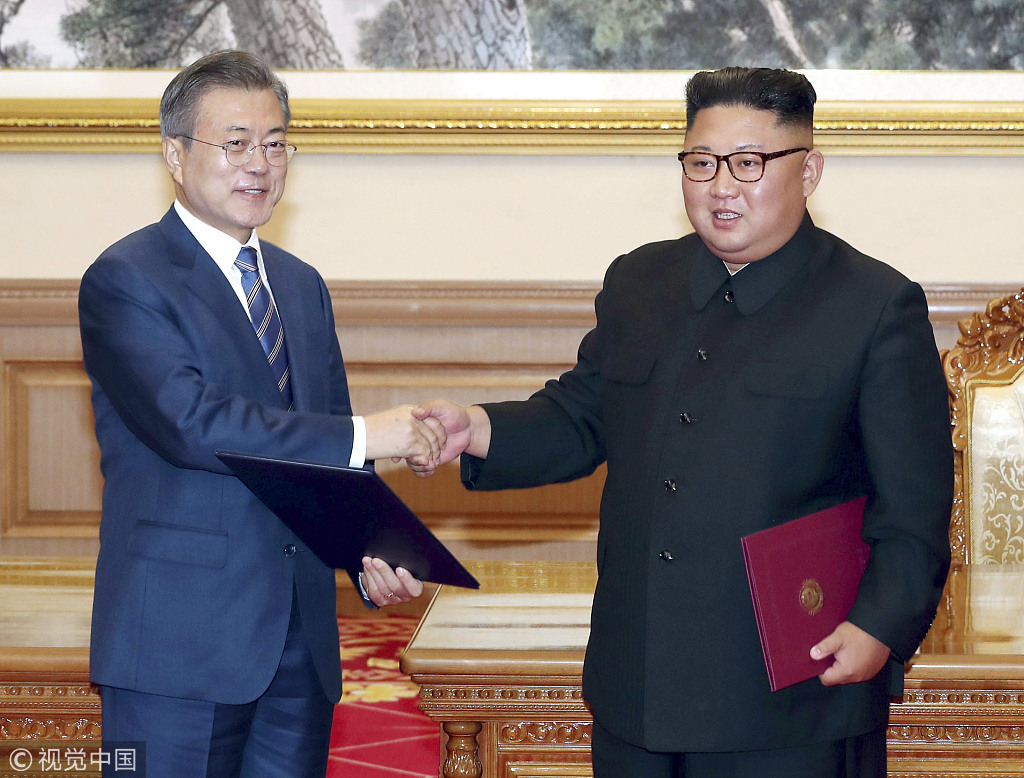
DPRK leader Kim Jong Un (R) and ROK President Moon Jae-in shake hands at the Paekhwawon State Guest House in Pyongyang September 19, 2018. /VCG Photo
DPRK leader Kim Jong Un (R) and ROK President Moon Jae-in shake hands at the Paekhwawon State Guest House in Pyongyang September 19, 2018. /VCG Photo
Unlike the United States, achieving these outcomes have had an additional dynamic for Moon. That is, a tangible impact on his domestic political priority and standing. The United States is far away from the Korean peninsula -- what goes on there is largely irrelevant to the everyday citizen and only of concern to a select military and foreign policy elite.
This poses a huge contrast for Koreans themselves, where inter-Korean relations could pose enormous repercussions for everyday life. Thus, whilst Trump's DPRK policy is largely unimportant for domestic popularity, for Moon Jae-in, it seriously matters. People will directly judge him on its merits and failures.
Therefore, achieving meaningful success is crucial. Moon must live up to his promises of achieving peace and to an extent, denuclearization on the peninsula. This is made ever more significant as owing to the poor performance of ROK's economy. He has also tied economic goals in with the resumption of future projects with Pyongyang, thus requiring a lifting of sanctions, something he has not been quiet over.
Therefore, for the Trump-Kim summit which he placed so many political stakes on, to go wrong, is almost crisis territory for Moon. It places his entire political platform in a state of limbo. It corners him. If things cannot recover and in the worst case scenario, his policy achieves nothing, then it serves to discredit meaningful engagement with Pyongyang as a worthwhile option and empowers Conservative political rivals who have sought to portray him as selling the country out to the DPRK.
As a consequence, the Blue House has only one direction to go in, to rescue the process. It is true to say that diplomacy has not collapsed yet. Since Hanoi, Washington has already announced the cancellation of a major military exercise, a demonstration that they seek to remain on cordial terms with Pyongyang.
However, Moon's goal now will be to frantically lobby both sides and twist their arms into finding common ground. He will ask both the U.S. and DPRK to be willing to give more. To facilitate this, it is highly likely on this note that another meeting with Kim Jong Un will emerge, as has normally been the trend to keep Washington going. Nevertheless, he has a mountain to climb. For Moon, this is not just about foreign policy, but rescuing and keeping alive his entire domestic agenda as well.
(If you want to contribute and have specific expertise, please contact us at opinions@cgtn.com)