
Opinions
13:51, 29-Apr-2018
Opinion: Xi-Modi Summit − a new starting point for China-India relations
 ["china"]
Share







Copied
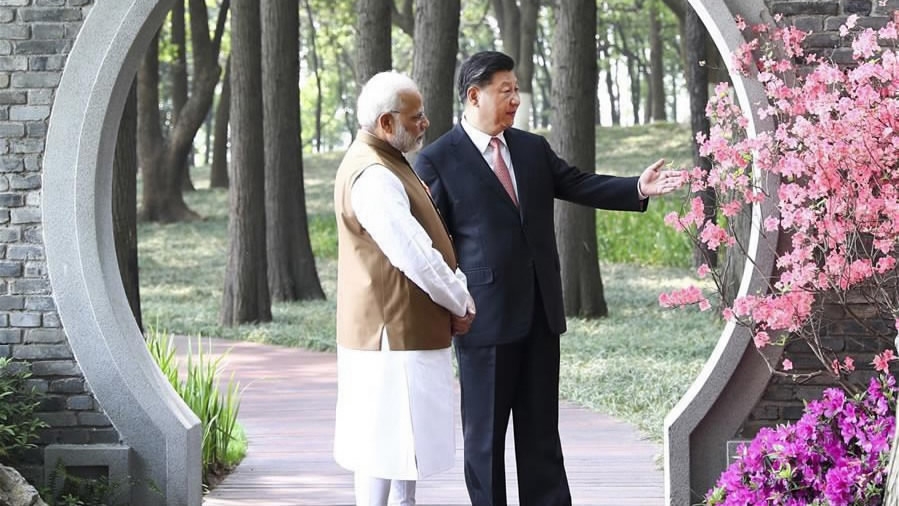
The just concluded informal meeting between the Chinese President Xi Jinping and the Indian Prime Minister Narendra Modi represents a new starting point for China-India relations. It happened at a time when the China-India relations are challenged by growing mistrust, and the international order suffering from various uncertainties.
Obviously, the meeting has set a tone for the future development of China-India relations, reconfirming the fundamental consensus that they are partners rather than rivals, and reassuring a constructive course for mutual engagement both bilaterally and multilaterally.
The China-India relationship has entered into a new era, characterized not by the nature of the relationship itself but by the complexity of the regional and global landscapes.
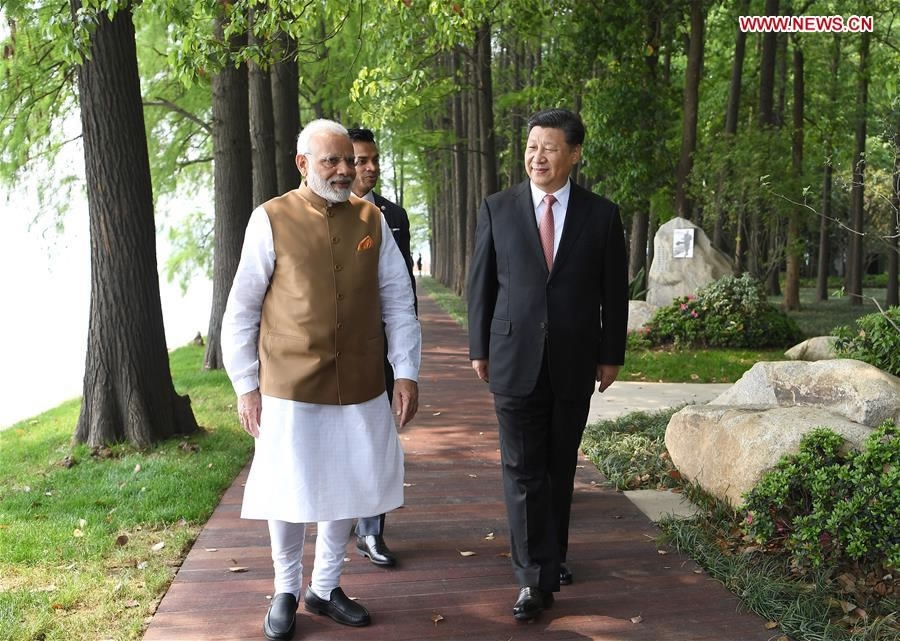
Chinese President Xi Jinping (R) walks with Indian Prime Minister Narendra Modi in Wuhan, capital of central China's Hubei Province, April 28, 2018. /Xinhua Photo.
Chinese President Xi Jinping (R) walks with Indian Prime Minister Narendra Modi in Wuhan, capital of central China's Hubei Province, April 28, 2018. /Xinhua Photo.
On one hand, based on their respective economic achievements, both China and India have put the national rejuvenation as a priority strategic objective.
With a long-lasting unresolved border dispute, it is natural that each side asks the same questions as follows: What if the other side keeps growing and becomes much stronger? How will it affect the final resolution of the border issue as well as one’s own traditional influence in its immediate neighborhood?
On the other hand, the international power structure is experiencing a profound transformation, with China and India being part of the driving forces. What kind of role will the other side will play is another question, currently asked by the strategic communities on both sides.
Each is alert to the other’s interactions with major players, believing that it may lead to a new balance of power not so friendly to itself. It is against this backdrop that the Donglang (Doklam) standoff happened last year.
Notwithstanding, common interests still overtake differences between them. Some recent developments have illustrated that fact.
First, the bilateral trade volume reached a new high of 84.4 billion US dollars in 2017, despite of the border friction. Moreover, the increasing Chinese investment, represented by smart phone companies (such as Xiaomi, Vivo and Oppo) and the digital giant Alibaba, has indicated the new scopes as well as the great potential for China-India economic ties.
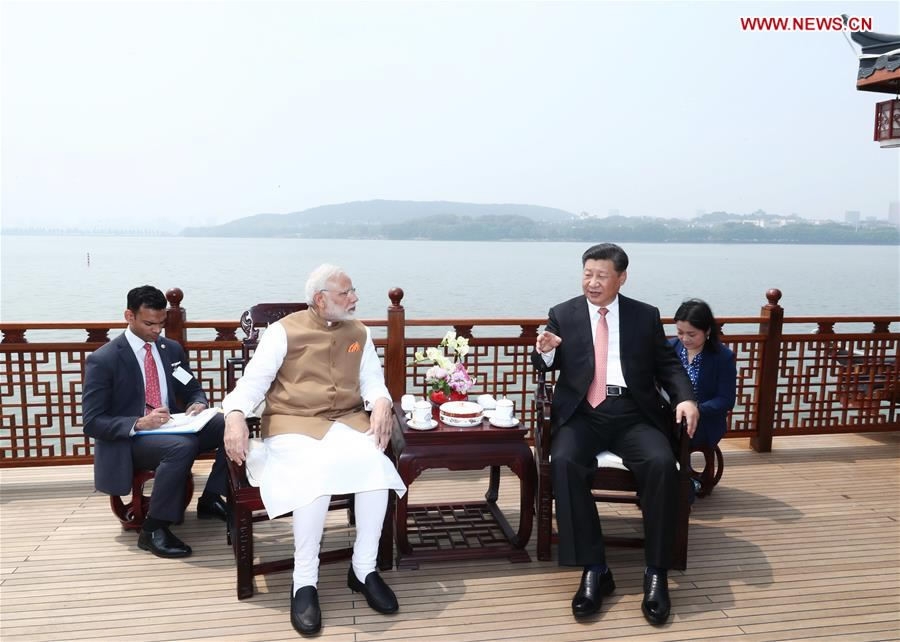
India's Prime Minister Narendra Modi (L) speaks with Chinese President Xi Jinping as they take a boat ride on the East Lake in Wuhan, China, April 28, 2018. /Xinhua Photo.
India's Prime Minister Narendra Modi (L) speaks with Chinese President Xi Jinping as they take a boat ride on the East Lake in Wuhan, China, April 28, 2018. /Xinhua Photo.
Second, the growing people-to-people contacts are transforming mutual perceptions at the public level. Through Dangal, a Bollywood movie earning nearly 1.3 billion yuan in box office receipts last year in China, the Chinese people saw a “different,” but familiar India with shared values of the Oriental civilizations.
Apart from the affordable Chinese products, new job opportunities created by the Chinese investment help improving many Indian people’s living conditions.
Third, the rising protectionism poses challenges especially to emerging economies like China and India. It is in their interests to make joint efforts to promote economic globalization and maintain the current open and free international trade order.
The informal summit is timely and important. In spite of not clinching any official agreement, the meeting itself has sent a strong message that they are dedicated to a stable and constructive relationship, by increasing cooperation while well managing differences.
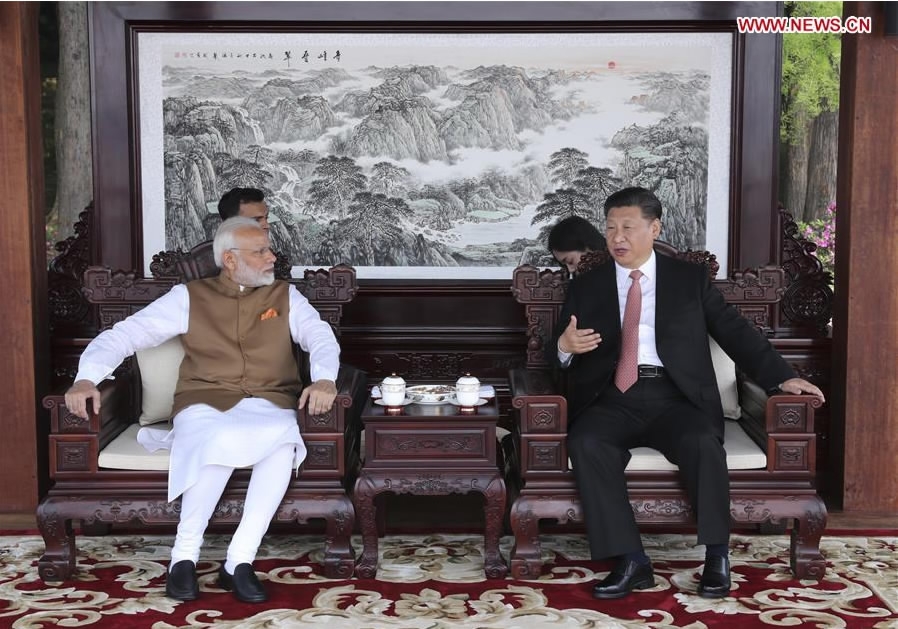
Chinese President Xi Jinping (R) talks with Indian Prime Minister Narendra Modi in Wuhan, capital of central China's Hubei Province, April 28, 2018. /Xinhua Photo.
Chinese President Xi Jinping (R) talks with Indian Prime Minister Narendra Modi in Wuhan, capital of central China's Hubei Province, April 28, 2018. /Xinhua Photo.
To translate this consensus into actions, here are suggestions:
First, practical expectations should be observed. And the complexity of the new era of China-India relations should be understood. Meeting between the top leaders cannot solve all the problems once and for all. At the same time, we cannot paint all the differences with the same brush.
Take India’s attitude to the Belt and Road Initiative (BRI) for an example. While India openly opposes to the China-Pakistan Economic Corridor due to its territorial dispute with Pakistan, it was one of the first to join the Asian Infrastructure Investment Bank and a party of the Bangladesh-China-India-Myanmar Economic Corridor.
It indicates again that, despite of differences, there is room for China and India to explore practical cooperation.
Second, economic links and people-to-people exchanges at the provincial level should be encouraged. If the two leaders’ strategic consensus is the framework of the mansion of China-India relations, they are the pillars and bricks.
Last but not the least, both sides should increase strategic communications on the changing regional and global landscapes, strengthen coordination and cooperation in multilateral fora such as the BRICS, SCO, and G20, promote regional economic integration through the RCEP negotiation process, and jointly bring more fairness and justice to the world order.
(Dr. Li Li is a senior fellow at the Institute for International Relations in Tsinghua University of China. The article reflects the author's opinion, and not necessarily the views of CGTN.)