
Opinion
07:59, 02-Apr-2019
More attention for World Autism Awareness Day, at a critical time
 ["china"]
Share






Copied

Editor's note: Mollie Tang is a consultant of the One Foundation. The article reflects the author's views, and not necessarily those of CGTN.
With April 2 coming, you can hardly ignore the emerging activities both online and offline, advocating for World Autism Awareness Day.
Five years ago, most people may have to google the definition of autism, but as a growing number of autism-themed charity affairs popped out, it has become a topic well-known, at least in cities. Last year, an online gallery, raising fund by selling a digital version of paintings by children with autism, has drawn tremendous attention to both the activity itself and children with autism.
World Autism Awareness Day is an internationally recognized day on April 2 every year, encouraging the Member States of the United Nations to take measures to raise awareness about people with Autism Spectrum Disorder throughout the world. It is the twelfth annual World Autism Awareness Day this year. After so many years advocating for the rights of people with autism, how does this develop now?
In China, where the social supporting system is not complete, the time following the diagnosis of autism is overwhelming. It is not easy for families to accept the diagnosis. Most of them travel from a hospital to a bigger hospital to confirm the result, hoping there is a mistake. But the anxiety and confusing are getting more serious when the families are trying to figure out what to do next and where to get proper support.
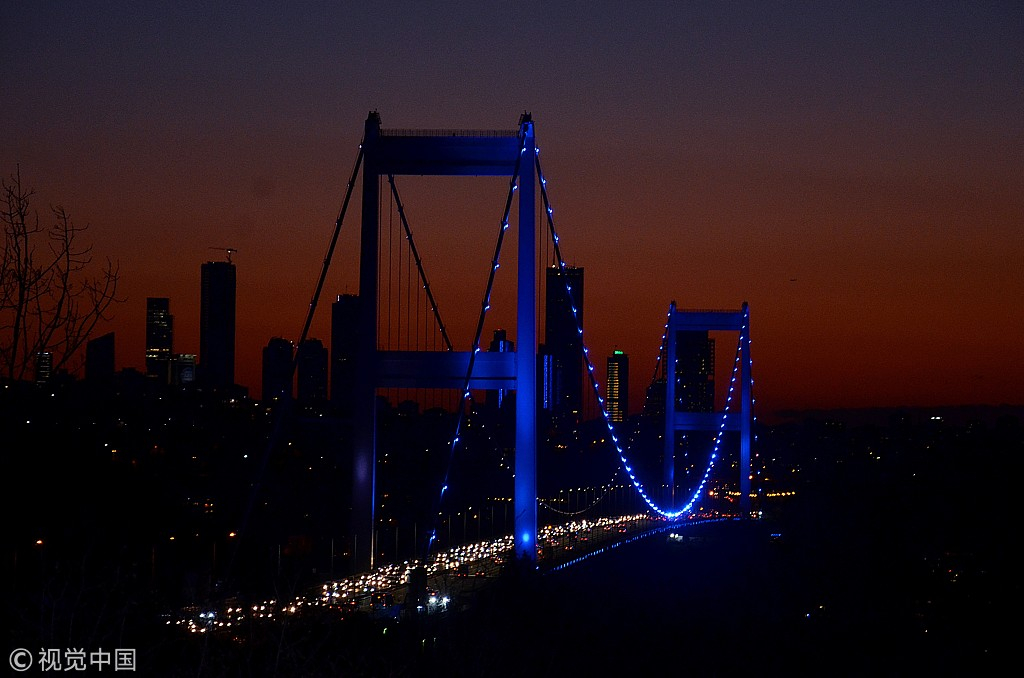
Fatih Sultan Mehmet Bridge light-up blue for the World Autism Awareness Day in Istanbul, Turkey, April 2, 2018. /VCG Photo
Fatih Sultan Mehmet Bridge light-up blue for the World Autism Awareness Day in Istanbul, Turkey, April 2, 2018. /VCG Photo
This situation is likely to maintain or even get worse as they go through different life stages, because the older people with autism grows, the less information and support are available in this country. There is no official statistic showing how many people with autism we have in China, where one in 150 children is with autism, which means, after the diagnosis of each child, at least two adults' lives are changed from then on. The whole family is suffering from both financial burden and continuous anxiety.
According to an investigation launched by a related association in 2014, 52.4 percent of the families interviewed said that one of the parents quit their job to take care of the child, leaving the family an unpromising financial situation. The family income of 47 percent of the families interviewed is below 3,000 yuan per month, while for 65 percent of the families, rehabilitation fee is around 3,000-8,000 yuan per month. At the beginning after diagnosis, 43.8 percent of the families refuse to accept the fact, and 44 percent hope to keep it a secret.
Even though families are striving to keep their young children in rehabilitation institutions, the most ideal option, however not agreed by professionals, is to send their children to a kindergarten and a primary school when they are at a proper age. Under the law, no child of proper age should be rejected from schools.
But it has always been a tough task to accomplish for the parents. Some parents with non-autistic children find it hard to accept that their children are going to have classmates with autism or any intellectual disability. Going to school is such a challenge, let alone going to work. Related matters include independent living and aged services and so on.
It is believed that the earlier a child get intervention, the better he/she is going to develop.
China's first non-governmental educational organization focusing on autism intervention, Beijing Xingxingyu, was set up in 1993 by a mother with a son with autism. More mothers with children with autism, following Xingxingyu's path, founded more than half of the autism rehabilitation institutions in China, most of which are located in cities because the residents there are more likely to afford the fee, but also because it requires the parents to have certain knowledge to notice a child's uncommon development and get diagnosed.
Even so, most of the institutions are voluntary ones with limited resources. The three main income resources are: public donation, government subsidies and fee from service.
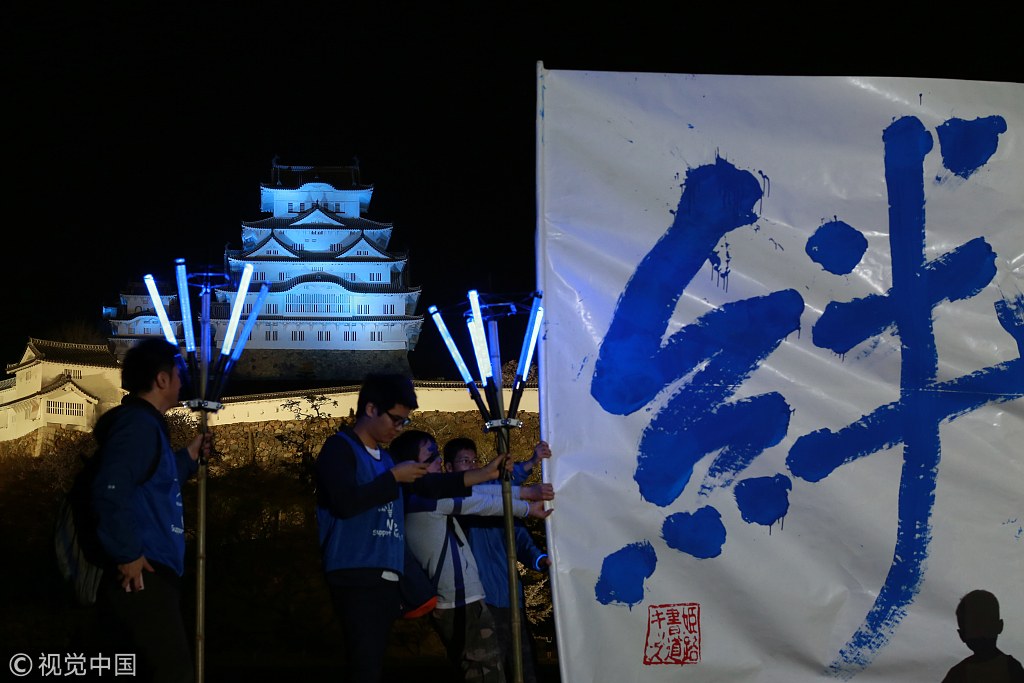
Japanese people hold LED light torches as they hold a banner with "Kizuna, Bond" on it and stand in front of the World Heritage Himeji Castle illuminated in blue light to mark World Autism Awareness Day in Himeji, Japan, April 2, 2018. /VCG Photo
Japanese people hold LED light torches as they hold a banner with "Kizuna, Bond" on it and stand in front of the World Heritage Himeji Castle illuminated in blue light to mark World Autism Awareness Day in Himeji, Japan, April 2, 2018. /VCG Photo
It requires big efforts to raise money from the public, especially in a country where the definition of autism is not known by the public; Government subsidies have certain criteria such as Hukou of the child. As mentioned above, most rehabilitation fee is beyond parents' income, which is also not stable. It seems, the rehabilitation institutions need to worry not only about its professional capacity, but also, if not prior, its survival.
Yet it is not all depressing news as the government is making efforts to improve the welfare of people with impairment by increasing rehabilitation subsidies and encouraging school acceptance.
Guidelines for institutions from the government could be helpful, ensuring the service quality and saving families' time of selection. Tax reduction and subsidies can be used to improve the unbalanced development in regions and lifespan services. It is also delightful to notice that people with autism are gaining attention and acceptance due to the work of many philanthropic activities, such as the Shenzhen One Foundation.
And more is needed to be done. A system is needed to track the services of an individual with autism, from rehabilitation support after diagnosis to education and aged services. Making the individual profile a complete and continuous case helps the service providers of different life stages to work with each other.
The color blue is chosen to stand for people with autism. With increasing attention paid to the once behind group, are you willing to go blue this year?
(Cover photo: A running activity celebrating the coming of the twelfth annual World Autism Awareness Day is held in Jinhua, Zhejiang Province, March 31, 2019. /VCG Photo)
(If you want to contribute and have specific expertise, please contact us at opinions@cgtn.com.)