
Business
18:32, 10-Jul-2018
AIIB: Arab states to play a more significant role in portfolio
Updated
17:35, 13-Jul-2018
 ["china"]
Share







Copied
02:51
The Asian Infrastructure Investment Bank (AIIB) – which began operations in January 2016 and which China has a 26.6 percent voting share – has approved over half a billion US dollars’ in funding in Arab states thus far.
Pang Yee Ean, the director general of AIIB’s Investment Operations Department, said the bank is “fairly confident” of this figure hitting close to a billion by year-end, with an additional 1.5 billion to boot within two years.
“Considering that we have only started engaging the [Arab] region less than two years ago, I think we are building up quite fast, and that is a reflection of our confidence in the region,” said Pang.
As of May 2018, AIIB’s total loans approved since inception amounted to 4.4 billion US dollars, of which the three projects – two in Oman and one in Egypt – collectively accounted for 627 million.
“The Duqm port project [in Oman] is progressing very fast and we are looking at investing more perhaps within the next year,” said Pang, adding, that the port is significant because it targets to help Oman diversify beyond its hydrocarbon based economy.
According to Pang, it is a strategic move for Oman to move into an industrial and mineral-based economy with the inter-land support from this Duqm port.
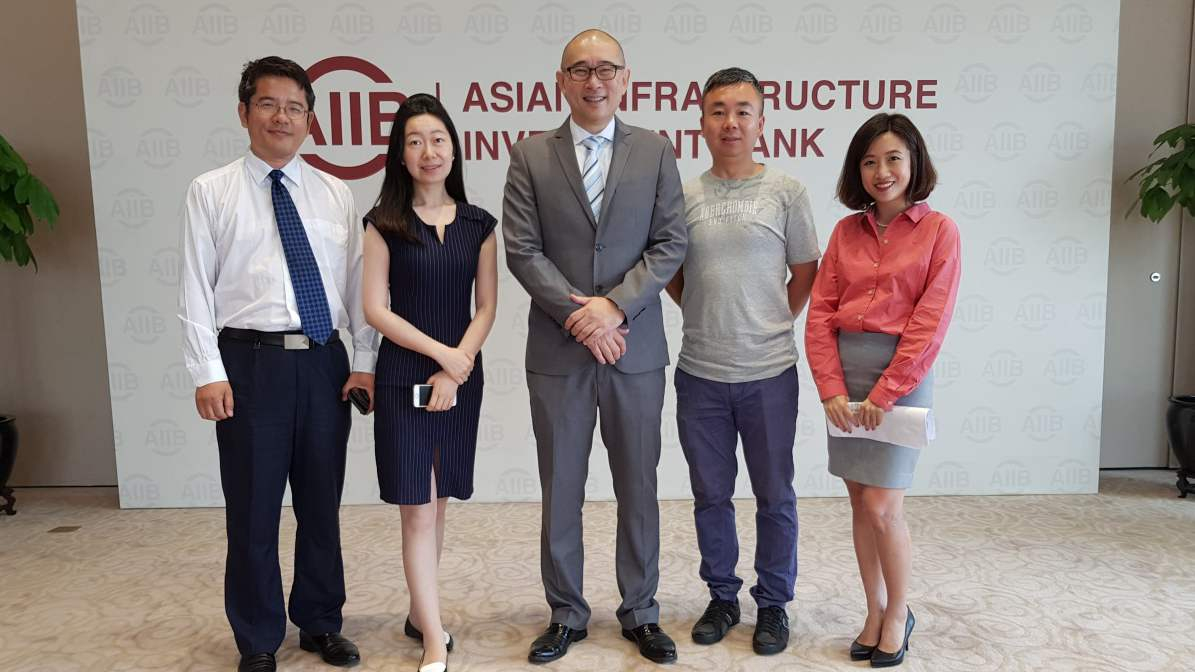
Pang Yee Ean (C), the director general of AIIB’s Investment Operations Department. /CGTN photo
Pang Yee Ean (C), the director general of AIIB’s Investment Operations Department. /CGTN photo
Besides the Duqm port commercial terminal project in Oman, the AIIB has also invested in a broadband infrastructure project in Oman as well as a Round II Solar PV Feed-in Tariffs Program in Egypt.
What next for AIIB in Arab states?
Pang said AIIB is now focusing up North in the region, where it believes it can contribute to strategically building a more robust economy in its energy and connectivity sector.
“For example in UAE we are looking at railway and metro systems, and in Saudi, we are looking at energy-based solar programs that they are making up as priorities,” he said.
Other Arab countries AIIB is eyeing opportunities include Qatar and Kuwait, Pang added.
That said, Pang noted that the region is a diverse one with each country having its own unique situation, and hence this warrants the multilateral development bank to take a country view before it sees it on a regional basis.
“Also keep in mind that the AIIB is still a start-up. It takes time to engage the government in making sure that the projects are of high quality, and that these are priorities of the country before we proceed.”
How has China-Arab financial cooperation been?
Pang said the AIIB sees significant Chinese participation in the eleven projects that it is involved in in the Egyptian solar program.
“This means we are looking at companies who are sponsors, and who are taking an equity position in these projects. To take an equity position in these countries where the economy is transforming speaks good endorsement for the countries,” he said.
“For example, we have Chinese institutions participating with us in our Oman broadband project, syndicating with us alongside, enabling us to mobilize private sector money into infrastructure at the same time.”
While Pang is happy that there is private sector interest inter-region, he said it is not sufficient.
“We believe the high capital expenditure of infrastructure should not fall on the government’s shoulders only,” he said.
“The government needs to initiate more projects that the private sector can take ownership by having bankable projects that have reasonable commercial value and good governance.”
In return, Pang also said the private sector needs to spend more effort understanding the Arabic situation.
Of the AIIB’s 87 members now, ten are from Arab states. This includes Saudi Arabia, Kuwait, Bahrain, Qatar, UAE, Oman, Jordan, Lebanon, Egypt and Sudan. Pang deems as a “huge endorsement” for the multilateral development bank.