
02:42, 18-Aug-2017
Solar Energy: US industry eclipsed by rivals and policies
 []
[]
Share







Copied
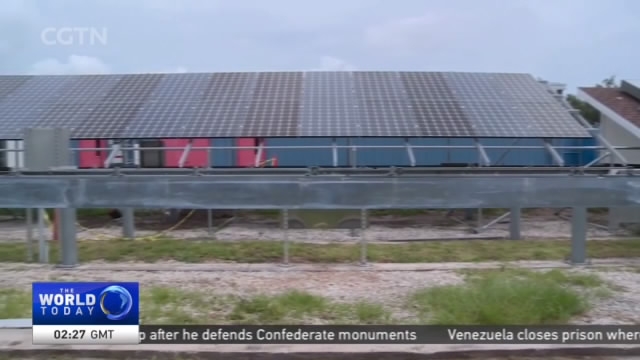
According to a recent report by accounting giant Ernst and Young, the US is falling behind China and India in its ability to attract investment in solar energy. The report blames Trump's roll-back on climate policies and boosting of the coal industry. As the UN predicts, the US will spend more than 360 billion dollars on renewable capacity by 2020. But a handful of US cities say they're trying to redress the balance. CGTN's Steve Mort has more in Miami.
Up on the roof checking his solar array Philip Stoddard says these panels have helped slash his home energy bill.
PHILIP STODDARD MAYOR, SOUTH MIAMI "This is the best fixed income return you can possibly get."
Stoddard is the major of South Miami where, beginning next month, most new home construction must be fitted with solar panels. He says it's his answer to President Trump's withdrawal from the Paris climate agreement.
PHILIP STODDARD MAYOR, SOUTH MIAMI "You've got mayors across the country saying 'we are going to support the Paris climate accord if we can figure Out how to do it,' and so this is one of the ways you can do it."
The US government says a system similar to this costs about 8,000 dollars in Florida after a tax rebate. Despite trailing China, Solar installation in America, like elsewhere, is growing rapidly amid a steep decline in the cost of solar-panels.
STEVE MORT SOUTH MIAMI "While the city of South Miami wants to increase the amount of solar energy generated within the community, it's here at the Florida Solar Energy Center where experts are looking into the science behind creating the most efficient solar energy home."
Director James Fenton estimates it'll take him just eight years to recoup the cost of his own solar panels at home. But he fears US threats to impose tariffs on imported panels could hinder efforts to boost solar capacity.
JAMES FENTON, DIRECTOR UCF FLORIDA SOLAR ENERGY CENTER "Because what that means is that people that buy the solar are now paying a higher price."
In Florida, only large utilities can sell electricity. Solar companies are banned from selling power directly to consumers from the panels they install. Some critics of South Miami's mandate say permitting competition would be more effective at promoting solar.
AMY COOKE, DIRECTOR INDEPENDENCE INSTITUTE ENERGY POLICY CENTER "A government mandate is the worst way to go. You should allow markets to work, individuals to innovate, technology to work, that's how we're going to get a cleaner environment and people in control of their own homes."
While solar panels are expected to account for less than three percent of US electricity generation over the next five years, Philip Stoddard hopes to help increase that number. And he predicts more cities will adopt similar measures in the near future. Steve Mort, CGTN, Miami.