
Opinions
12:16, 13-Jul-2018
Opinion: A tale of copyright in 19th century America
Updated
11:22, 16-Jul-2018
 ["china"]
Share







Copied
Editor's note: Zhang Nan is a researcher in Comparative Intellectual Property Law at the China University of Political Science and Law. The article reflects the author’s opinion, and not necessarily the views of CGTN.
Charles Dickens has always been one of my favorite writers during the British Industrial Revolution. When I start to read his work, characters jumped out of the books immediately and I could even imagine how Dickens spent ages walking up and down the old London town to observe and absorb the vivid appearances and conversations among people on the street.
Famous characters such as Oliver Twist and David Copperfield have been popular in the hearts of English literature lovers for nearly two centuries. However, very few acknowledge that the great author suffered tremendous disillusionment during his life, fighting against the lack of copyright protection in America.
In January 1842, he visited America for the first time. At first he was longing for this journey, but later on, he fell out of love for America. In his travel journal American Notes, he wrote:
"Did I see among them, the intelligence and refinement, the true, honest, patriotic heart of America? Here and there, were drops of this blood and life, but they scarcely colored the stream of desperate adventures which sets that way for profit and pay. It is the game of these men, and of their profligate organs, to make the strife of politics so fierce and brutal, and so destructive of all self-respect in worthy men, that sensitive and delicate-minded persons shall be kept aloof, and they, as such as they, be left to battle out their selfish views, unchecked.” (Volume I, Chapter the Eighth, American Notes)
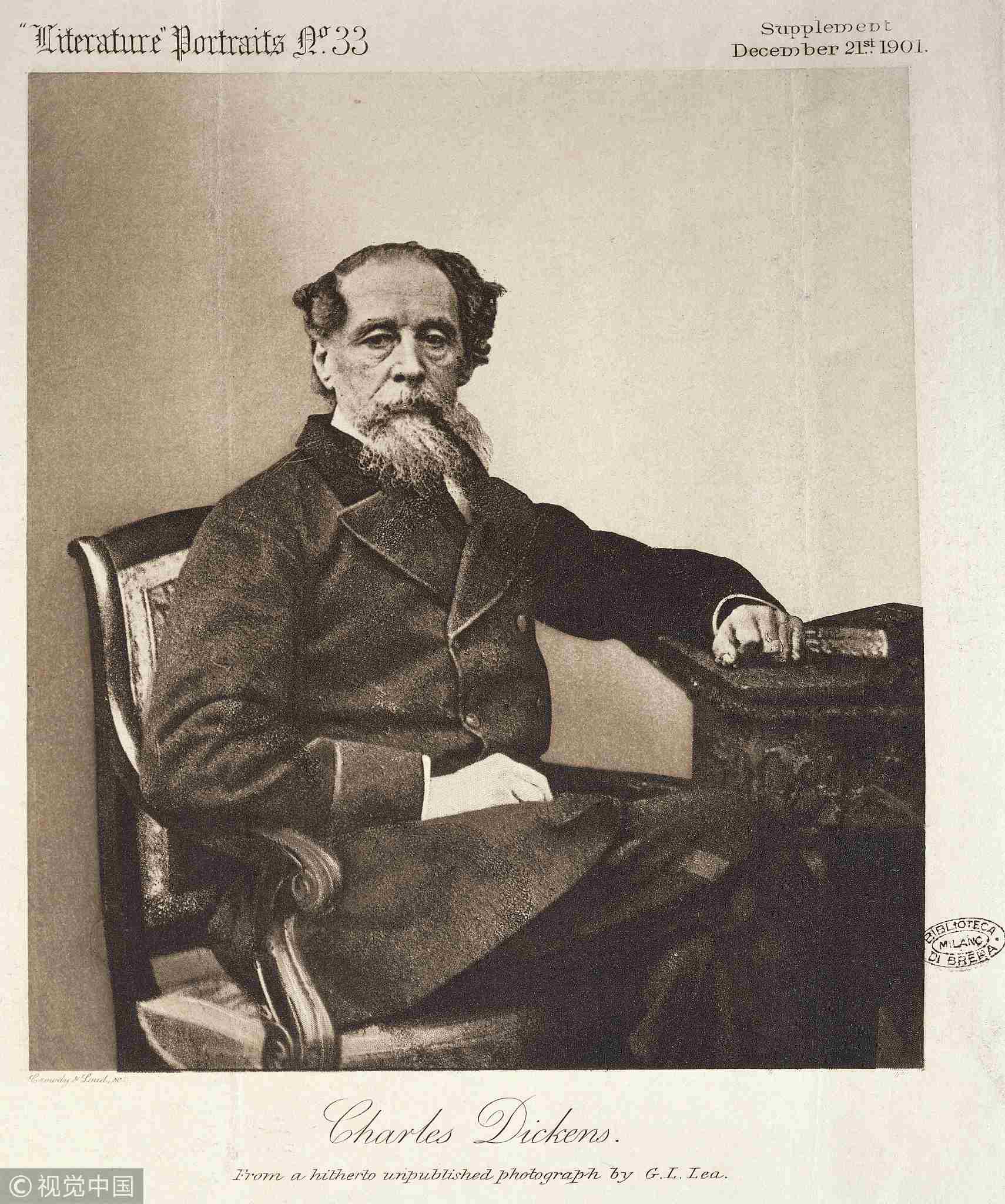
Portrait of English writer and journalist Charles Dickens (Portsmouth, 1812 - Gadshill, 1870) /VCG Photo
Portrait of English writer and journalist Charles Dickens (Portsmouth, 1812 - Gadshill, 1870) /VCG Photo
What had he seen at that time?
Dickens surprisingly found his work had not been protected at all in America due to the lack of an international copyright law. Thus, he was not able to receive any royalties or payment and the American publishers heartlessly pillaged his works.
For instance, an illuminated library owned by Peter Parley purchased and re-edited Dickens’s A Christmas Carol two weeks after its first publication and sold them in New York for a penny a piece. Dickens had to fight back by requesting a court injunction to stop the publication and the sales of his book. The library then filed for bankruptcy and he was forced to pay litigation fees of nearly 700 pounds.
The Berne Convention for the Protection of Literary and Artistic Works has been first accepted in 1886. However, America did not join the international agreement for copyright protection until March 1, 1989, 119 years after Dickens’ death. Until the WWII, America had resisted joining the Berne Convention to avoid paying royalties to foreign authors and to enjoy the free copying of their works. This situation did not change until it became a member of the World Copyright Convention in 1955 because more and more US writers were willing to collect royalties from their foreign readers.
Time flies, history runs and we shall not forget the past. As America adopts trade instruments on different nations, a quote from Dickens' tenth novel Hard Times could come in handy: "Have a heart that never hardens, and a temper that never tires, and a touch that never hurts."
Countries are no longer isolated islands; working together for a better human race is the ultimate goal for every nation.