At their much-anticipated presidential summit, US President Donald Trump and Russian President Vladimir Putin were eager to talk up reconciling fractured ties between the US and Russia. But Trump's failure to condemn the Kremlin's alleged role in directing a campaign of manipulation in the 2016 US elections triggered outrage in Washington.
Here are four takeaways from the news conference that followed their first summit, in the Finnish capital Helsinki:
Trump backs Putin on election meddling
Russia did not meddle in the 2016 US elections, Putin said, rejecting the verdict of US intelligence chiefs that Moscow hacked the Democrats' emails and leaked them to help propel Trump to the White House.
Standing side by side with Putin, Trump refused to blame the Russian leader, casting doubt on the findings of his own intelligence agencies and sparking a storm of criticism at home.
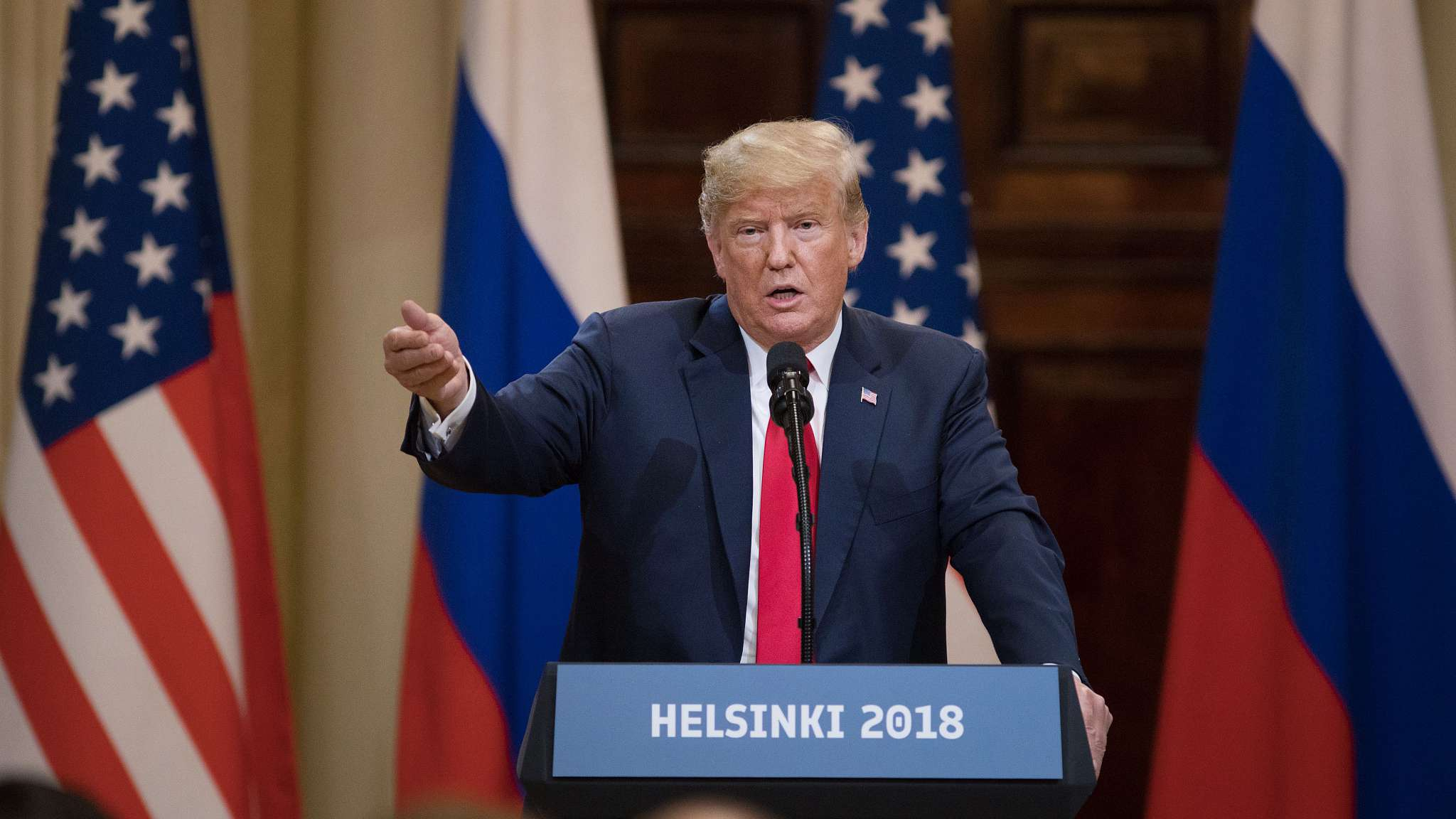
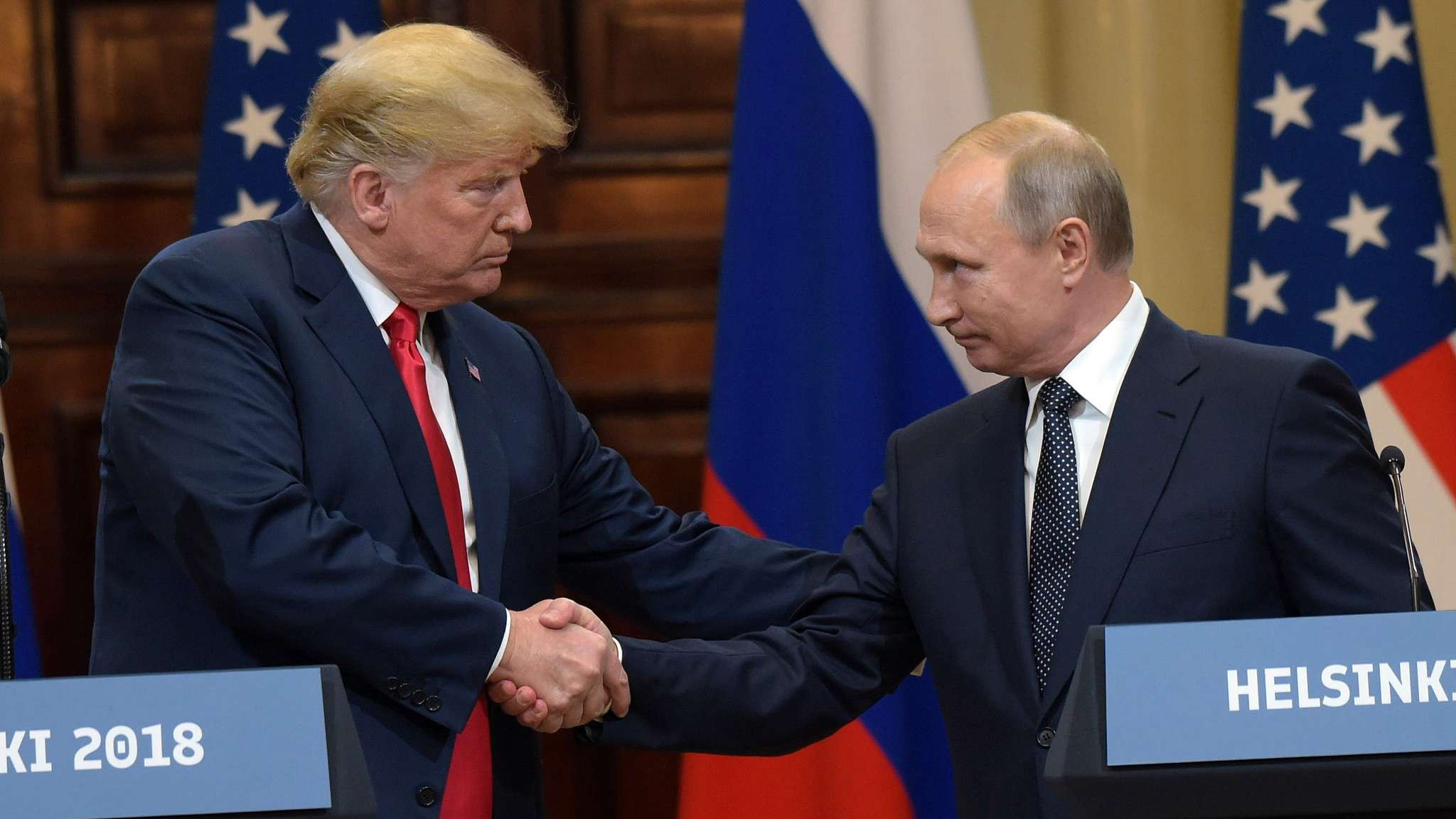
US President Donald Trump speaks during a news conference with Vladimir Putin in Helsinki, Finland, July 16, 2018. /VCG Photo
US President Donald Trump speaks during a news conference with Vladimir Putin in Helsinki, Finland, July 16, 2018. /VCG Photo
Putin's denial was "powerful," Trump said. "I have President Putin. He just said it is not Russia. I will say this: I don't see any reason why it would be."
Putin suggested US investigators could possibly travel to Russia to participate in questioning Russians accused by Washington of US election meddling as long as Russian investigators would be allowed to do the same with US spies operating in Russia, an idea Trump’s critics dismissed as ludicrous.
Both leaders rejected any talk of pre-election collusion, and Putin also dismissed the idea that his government holds compromising material on Trump.
"Please get this rubbish out of your heads," Putin told the press.
People attend “Helsinki Calling” protest ahead of meeting between US President Donald Trump and Russian President Vladimir Putin in Helsinki, Finland, July 15, 2018. /VCG Photo
People attend “Helsinki Calling” protest ahead of meeting between US President Donald Trump and Russian President Vladimir Putin in Helsinki, Finland, July 15, 2018. /VCG Photo
Trump denounced the "stupidity" of his own country's policies, especially the decision to investigate Russian interference in the 2016 election.
Just three days ago, the US Justice Department announced an indictment of 12 Russian spies for hacking into the computer networks of the Democratic Party.
Trump's handling of a joint news conference with Putin in Helsinki stirred a wave of condemnation, with lawmakers calling the Republican Trump "weak" and "cowardly."
Senator John McCain said the summit was "a tragic mistake." The former Republican presidential nominee, a frequent critic of the president, said Trump "failed to defend all that makes us who we are – a republic of free people dedicated to the cause of liberty at home and abroad."
Trump will meet with members of Congress on Tuesday, the White House said without giving further details.
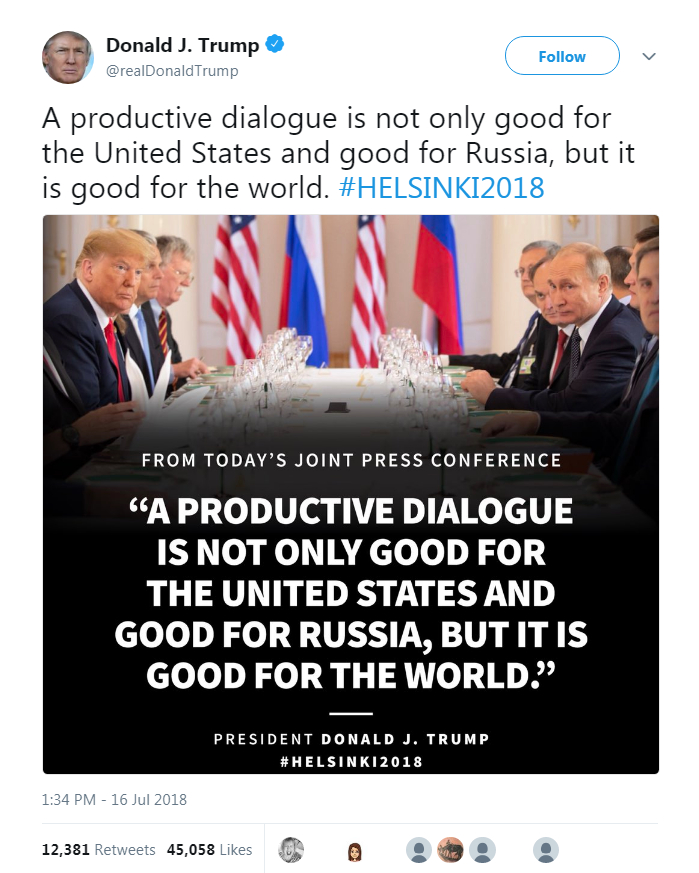
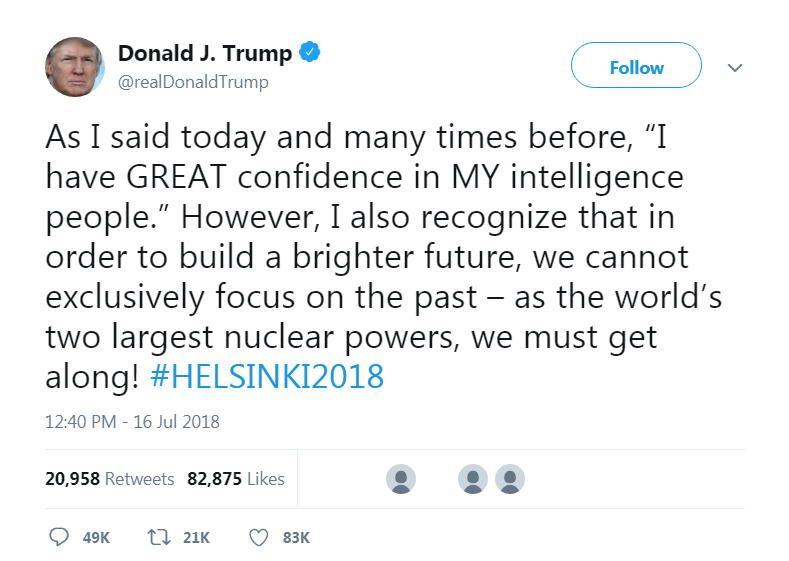
Screenshot of US President Donald Trump's tweet
Screenshot of US President Donald Trump's tweet
After the Helsinki summit, Republican Pat Toomey and Senate Democratic Leader Chuck Schumer raised the possibility of imposing new punishments on Russia.
Toomey said in a statement that unless Putin helps the US prosecute Russians accused in the hacking, "the United States should impose tough new sanctions on Russia."
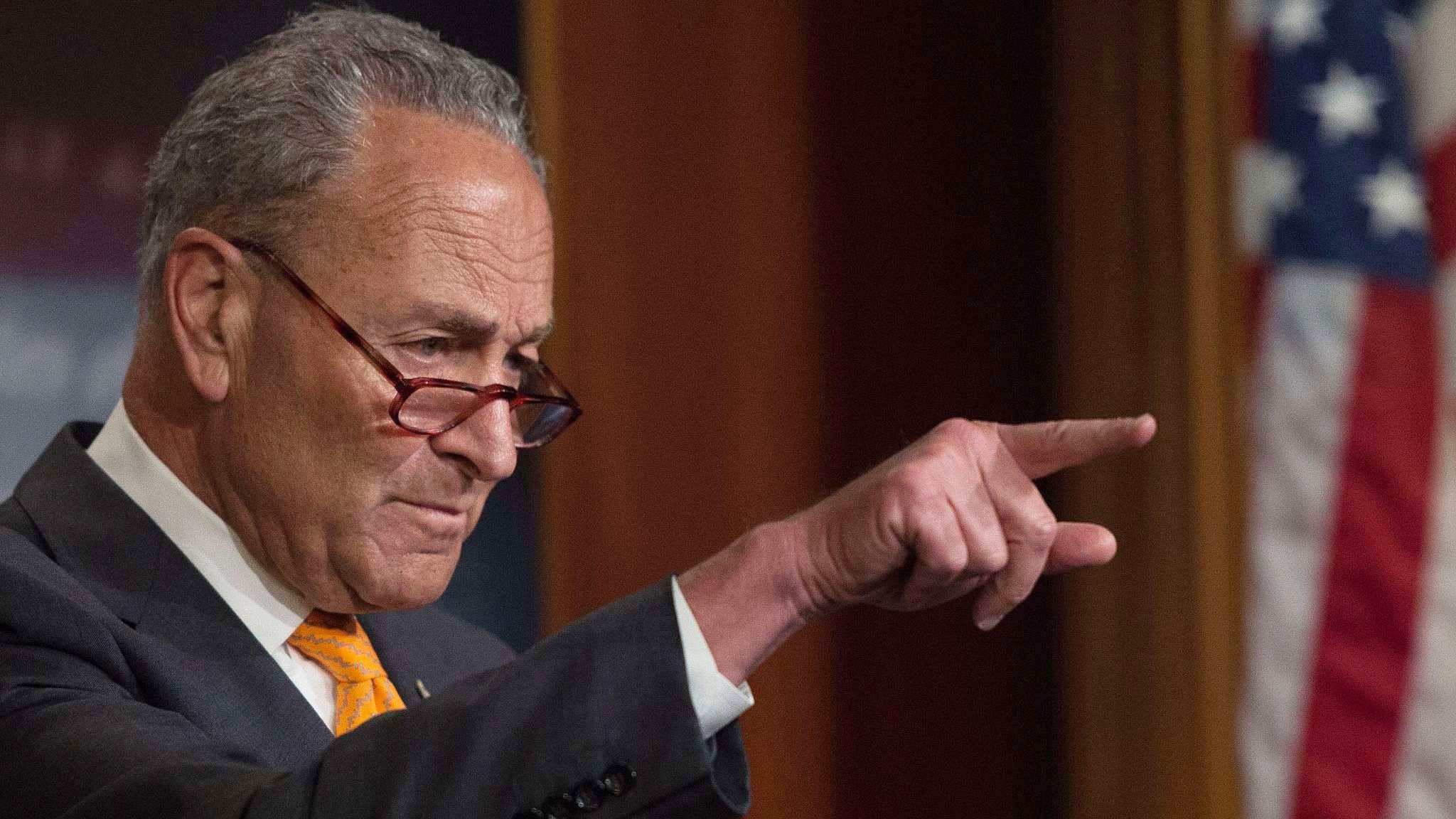
Schumer said Trump's approach in Helsinki was unprecedented.
01:55
"For the president of the United States to side with President Putin against American law enforcement, American defense officials, and American intelligence agencies is thoughtless, dangerous, and weak," Schumer said.
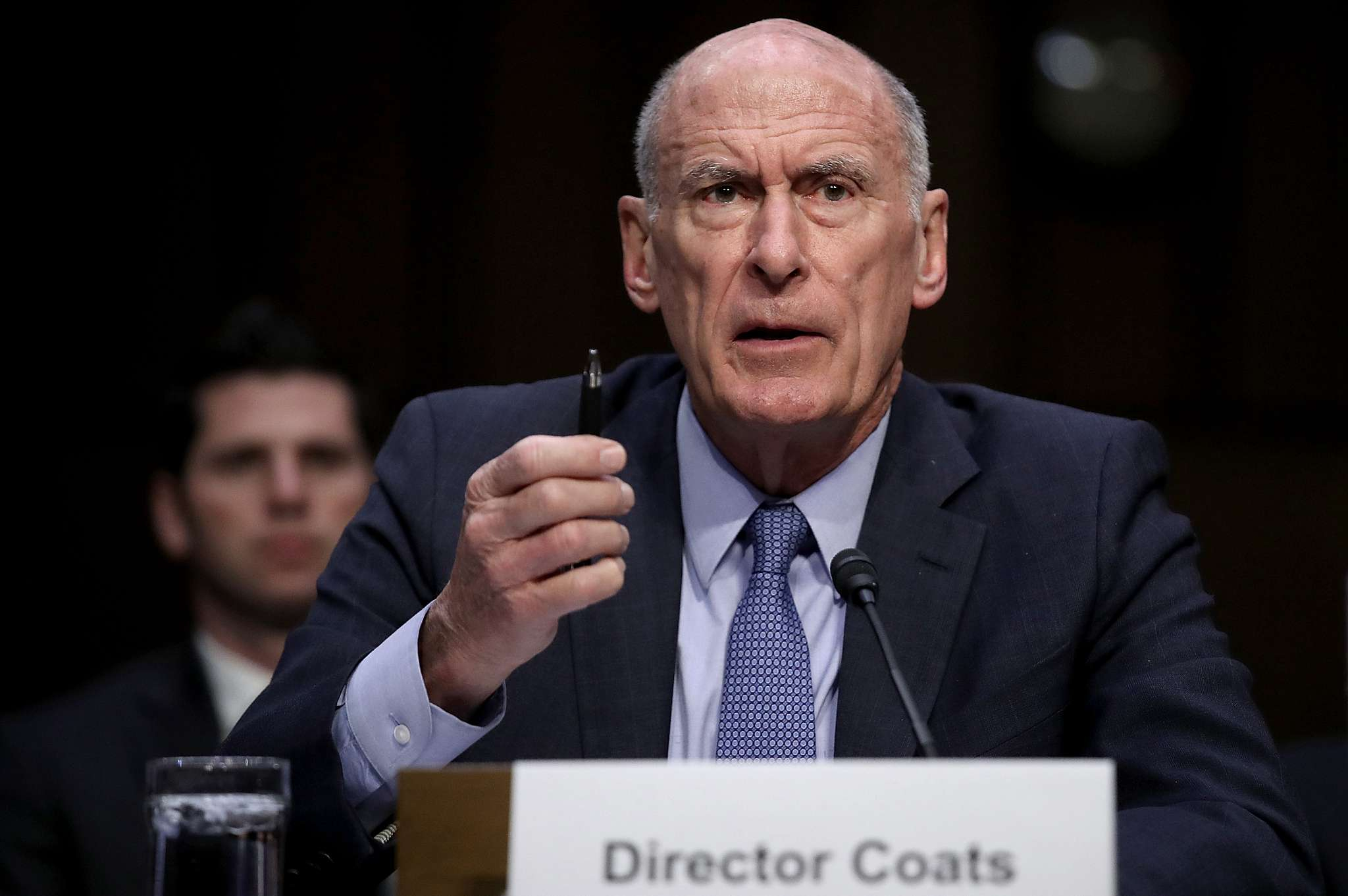
Director of National Intelligence Dan Coats, a Republican and a Trump appointee, responded to Trump's remarks and stood by the US agencies.
"We have been clear in our assessments of Russian meddling in the 2016 election and their ongoing, pervasive efforts to undermine our democracy," Coats said.
Director of National Intelligence Daniel Coats answers questions during a hearing held by the Senate Armed Services Committee March 6, 2018 in Washington, DC. /VCG Photo
Director of National Intelligence Daniel Coats answers questions during a hearing held by the Senate Armed Services Committee March 6, 2018 in Washington, DC. /VCG Photo
Hours after the Helsinki summit, Trump tweeted: "I have GREAT confidence in MY intelligence people. However, I also recognize that in order to build a brighter future, we cannot exclusively focus on the past – as the world's two largest nuclear powers, we must get along!"
Reset in US-Russian relations
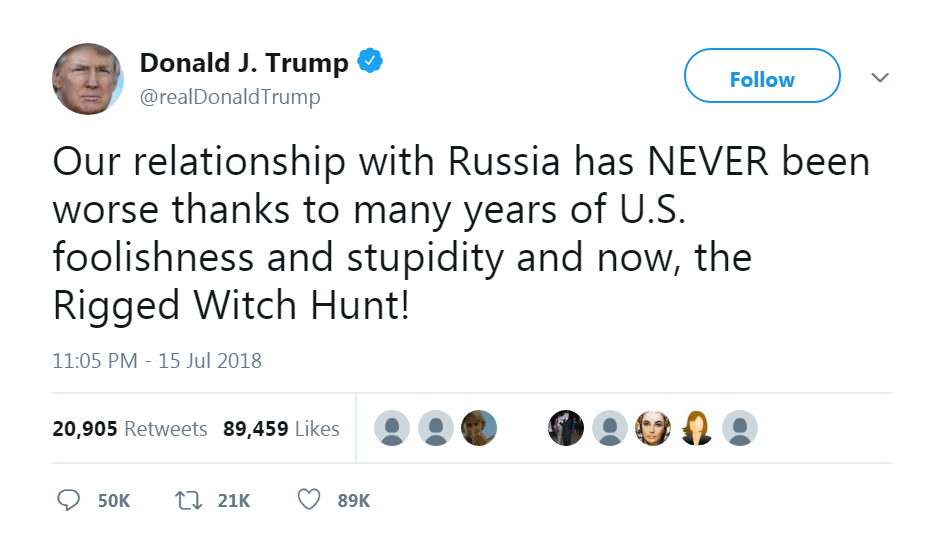
Before the summit even began, Trump blamed his own country for the deterioration in relations.
"Our relationship with Russia has NEVER been worse thanks to many years of US foolishness and stupidity and now, the Rigged Witch Hunt!" he said on Twitter.
The Russian Foreign Ministry tweeted back: "We agree."
At the news conference, Trump was invited by reporters to offer any criticism of Russia, but he repeatedly declined. Asked if Russia was at all to blame for the poor ties, he said: "I hold both countries responsible. I think the US has been foolish. We've all been foolish."
Asked if Putin was an adversary, he said: "Actually I called him a competitor, and a good competitor he is, and I think the word competitor is a compliment."
02:49
The summit was "only the beginning," the US president said. "Our relationship has never been worse than it is now. However, that changed as of about four hours ago."
Putin praised the "frank and business-like atmosphere" of the talks. "I consider them very successful and useful," he said.
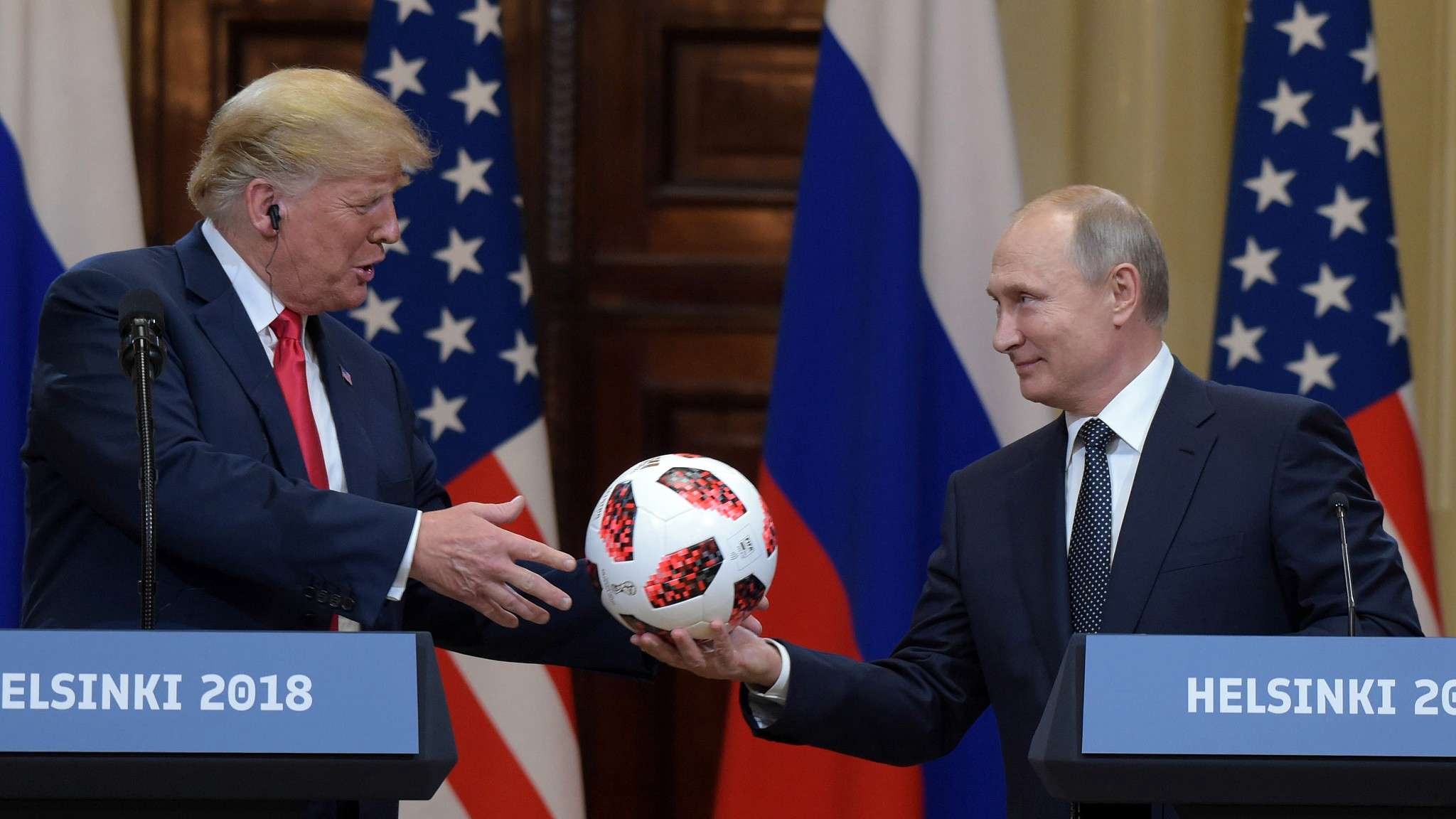
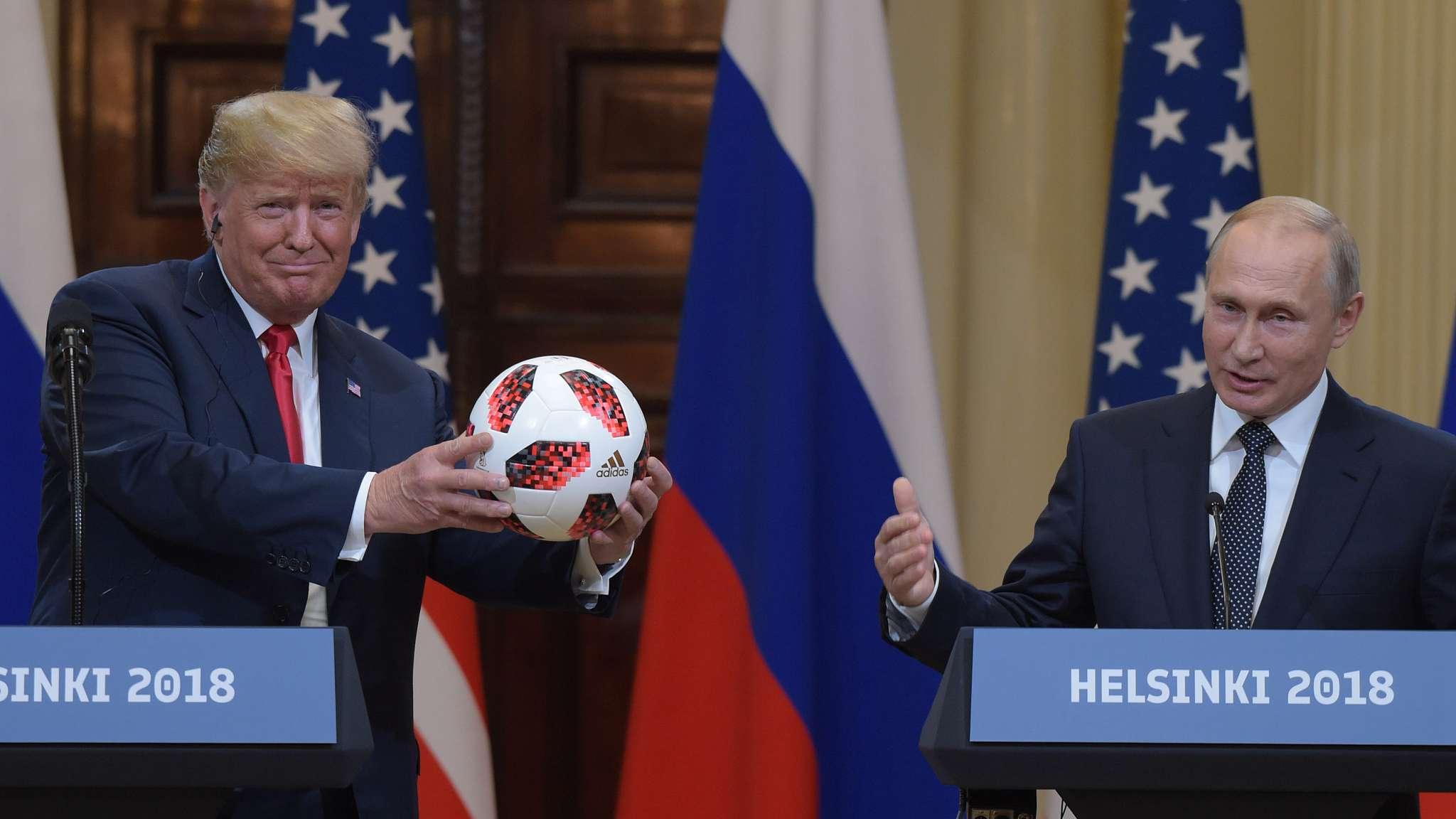
Putin spoke of the importance of the two countries working together and praised Trump, at one point interrupting the news conference to give the US president a soccer ball.
Russian President Vladimir Putin gives US President Donald Trump a soccer ball during their joint press conference in Helsinki, Finland, July 16, 2018. /VCG Photo
Russian President Vladimir Putin gives US President Donald Trump a soccer ball during their joint press conference in Helsinki, Finland, July 16, 2018. /VCG Photo
Nuclear disarmament
Heading into the summit, Trump emphasized his wish to tackle a developing race between the two countries to modernize their nuclear arsenals.
Putin said it was "necessary to work together to interact on the disarmament agenda," including a return to existing treaties to limit long-range and intermediate nuclear forces.
For his part, Trump said nuclear proliferation was "one of the most critical challenges facing humanity" while lauding his own role in bringing Pyongyang to the table.
But the election collusion probe was a distraction as it undermined relations between two countries that wield 90 percent of the world's nuclear arsenal, Trump said.
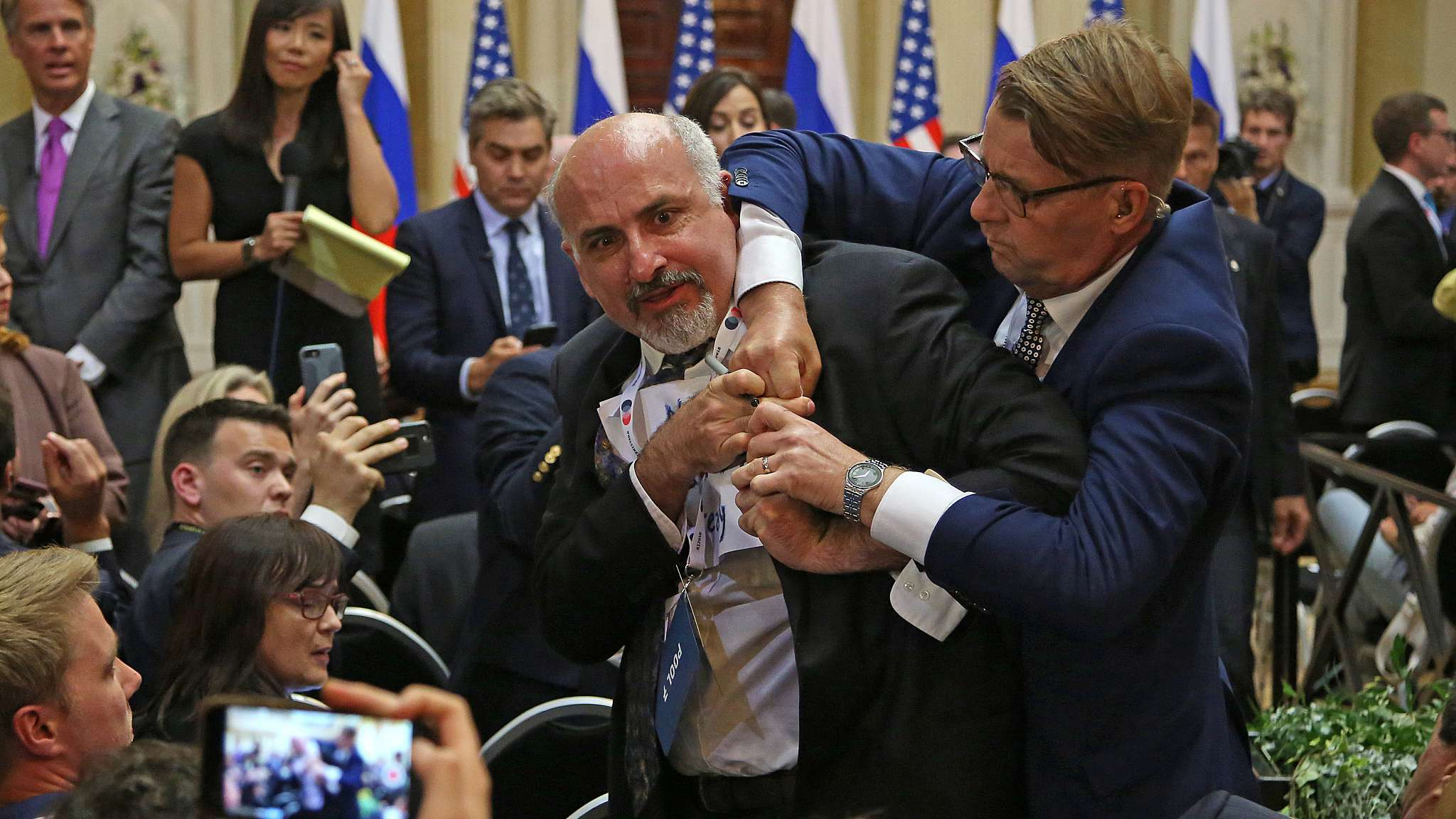
A self-identified journalist holding a sign saying "Nuclear Weapons Test Ban" is ejected during the joint press conference between US President Donald Trump and Russian President Vladimir Putin at the Presidential Palace in Helsinki, Finland, July 16, 2018. /VCG Photo
A self-identified journalist holding a sign saying "Nuclear Weapons Test Ban" is ejected during the joint press conference between US President Donald Trump and Russian President Vladimir Putin at the Presidential Palace in Helsinki, Finland, July 16, 2018. /VCG Photo
Putin said in an interview broadcast after the summit that he told Trump that Russia is prepared to extend the New START nuclear treaty that expires in 2021.
"I reassured President Trump that Russia stands ready to extend this treaty, to prolong it, but we have to agree on the specifics at first, because we have some questions for our American partners," Putin told Fox News.
"We think that they are not fully compliant with the treaty, but this is for experts to decide," Putin added.
The New START treaty, signed on April 8, 2010, calls for deployable nuclear warheads and bombs to be capped at no more than 1,550. It limits deployed intercontinental ballistic missiles, submarine-launched ballistic missiles and nuclear bombers to 700 and non-deployed ICBMs, SLBM and bombers to 800.
Putin said they had also agreed to differ on Iran, after Trump pulled out of an international pact designed to curb the Islamic republic's nuclear ambitions.
Cooperation in Syria, anti-terrorism
Trump and Putin agreed to cooperate in issues concerning conflict in Syria and anti-terrorism.
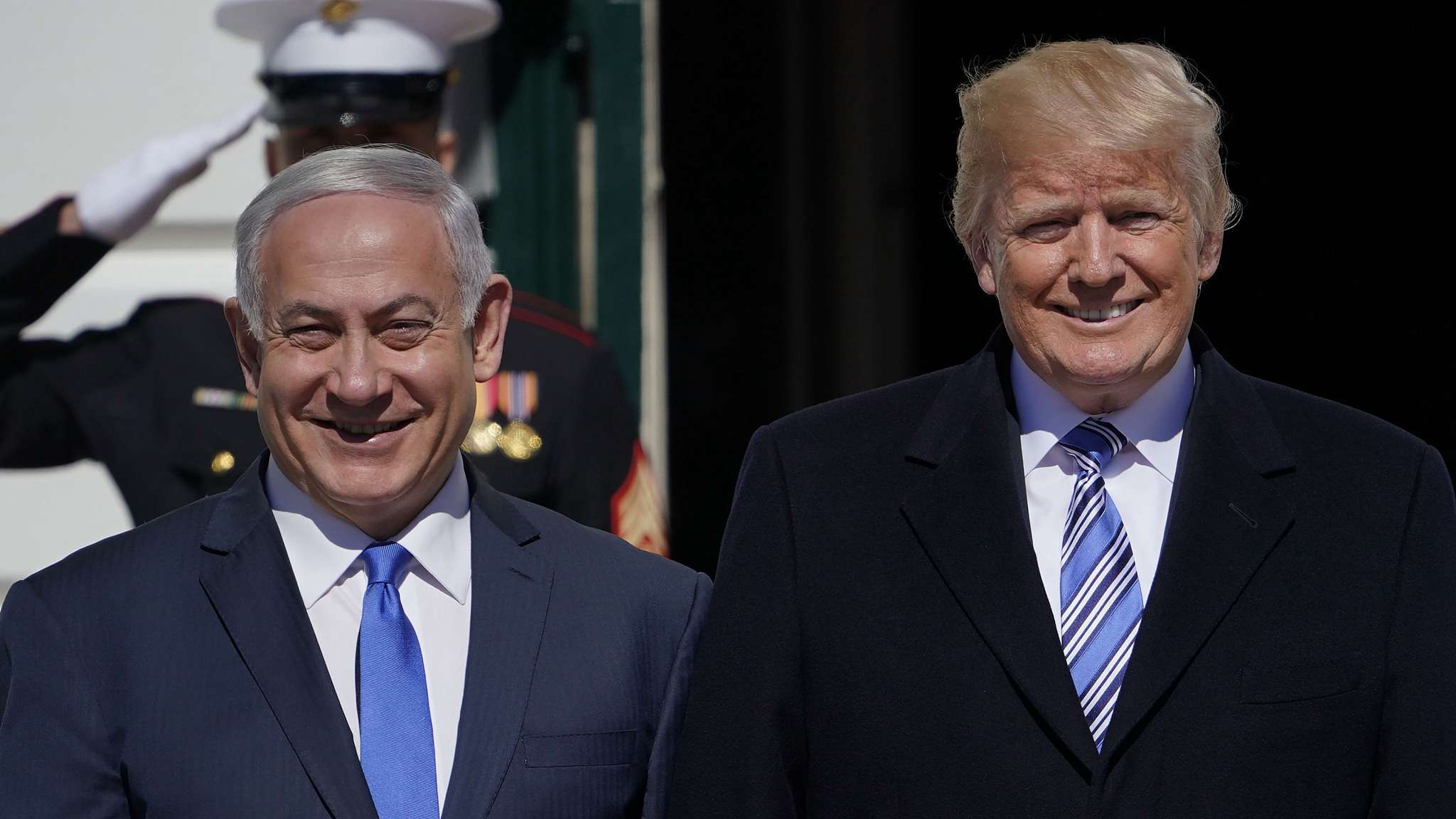
Trump said both he and Putin had spoken to Israel's Prime Minister Benjamin Netanyahu "and would like to do certain things with respect to Syria having to do with the safety of Israel".
US President Donald Trump welcomes Israeli Prime Minister Benjamin Netanyahu to the White House on March 5, 2018 in Washington, DC. /VCG Photo
US President Donald Trump welcomes Israeli Prime Minister Benjamin Netanyahu to the White House on March 5, 2018 in Washington, DC. /VCG Photo
Putin called on the US to work together to resolve the Syrian conflict. "Russia and the US can take the lead on this issue in this country and work together to overcome the humanitarian crisis."
"As we have discussed, the crisis in Syria is a complex one. But our cooperation between the two countries has the potential to save hundreds of thousands of lives," Trump said.
The "scourge of radical Islamic terrorism" was also discussed at the meeting, Trump said at the press conference, adding they agreed to work together to deal with the issue.
Trump said radical Islamic terrorism made both countries suffer. They have agreed to maintain open communication between security agencies to protect their citizens from this global menace.

 ["china"]