
Climate
16:39, 08-Aug-2018
Heatwave persists in southern China as the north cools
Updated
15:56, 11-Aug-2018
 ["china"]
Share







Copied
02:10

China's National Meteorological Center maintained its yellow alert for high temperatures on Wednesday. Heatwaves have scorched northern China for the past week. Now as the north starts to cool off, southern Chinese provinces will see the mercury rise.
According to Chinanews.com, 22 counties and cities in southwest and northeast regions experienced their hottest July on record, affecting both human health and agricultural production.
The heat also created a surge in power consumption, with 18 provinces showing strains on the power supply.

A hot day in Shanghai. /CGTN Photo
A hot day in Shanghai. /CGTN Photo
Shanghai isn’t among the worst hit by the extreme heat this year, thanks to two typhoons, but the on-and-off heatwave nonetheless generated a boost in air conditioner sales. Yang Dong, an AC installer, told CGTN that direct orders from Tmall – China’s online retail giant – had nearly doubled, and he hardly had time to do them all.
The rising temperature and use of air conditioning are also taxing the power grid and creating pressure for daily maintenance, says Wan Yilun, a substation engineer with the State Grid Shanghai Pudong Electric Power Supply Company.

Wan Yilun (C) and his colleague conducting an infrared inspection of equipment. /CGTN Photo
Wan Yilun (C) and his colleague conducting an infrared inspection of equipment. /CGTN Photo
China is not alone in the heat, as record-high temperatures have also been observed in neighboring Japan and South Korea, as well as in Europe, North America and the Arctic.
“There’s been more disruption to atmospheric circulation these years and this has exacerbated extreme weather,” explained Xin Fei, a climate expert at the Shanghai Climate Change Research Center. "What's supposedly a tropical and subtropical system can easily move north and the whole polar vortex gets compressed. Consequently, cold air will flow south and that’s why we are also seeing more chilly winters."
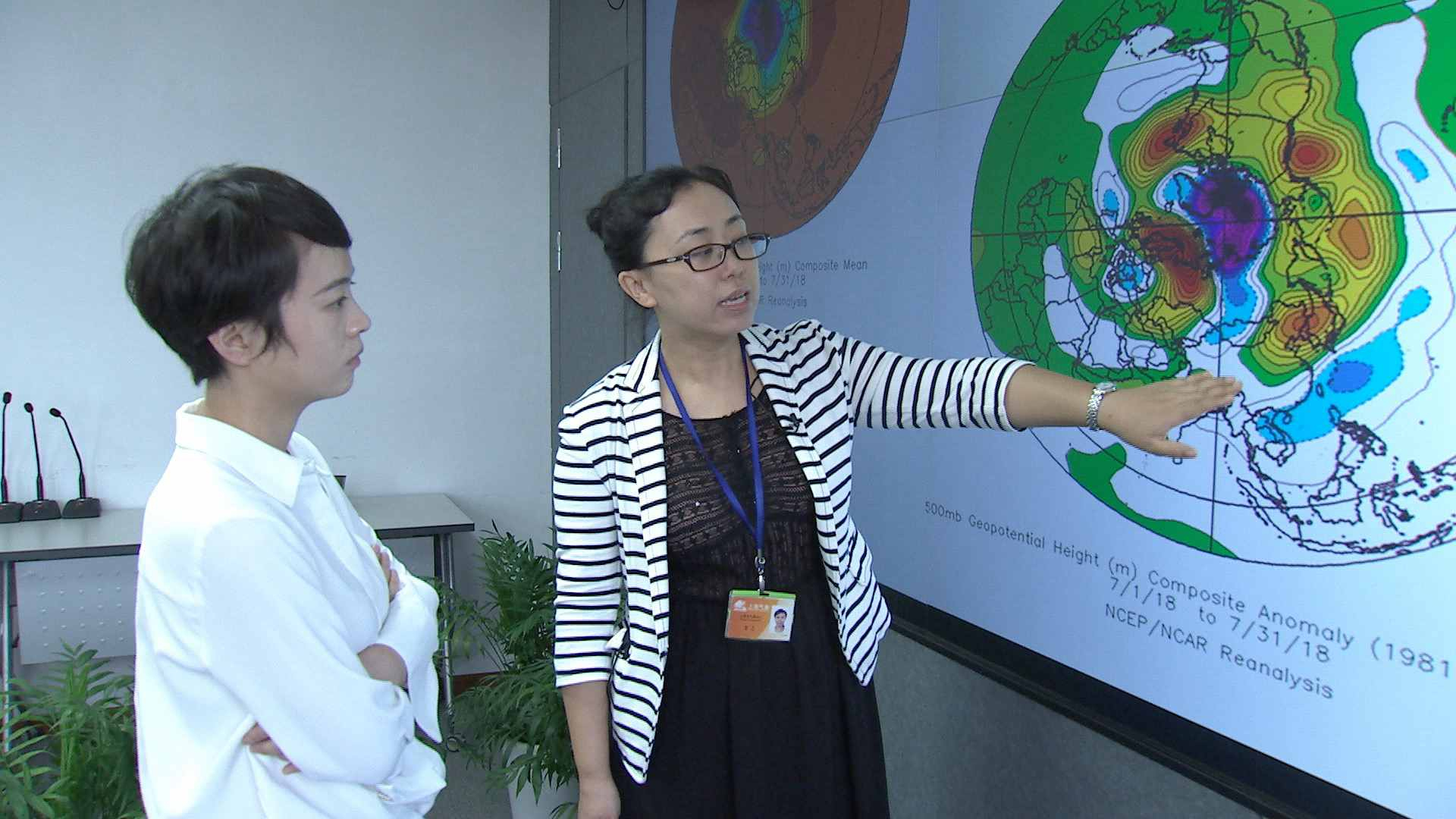
Xin Fei (R), a climate expert at the Shanghai Climate Change Research Center, illustrates the abnormalities of this year’s meteorological data compared to the average from 1981 to 2010. /CGTN Photo
Xin Fei (R), a climate expert at the Shanghai Climate Change Research Center, illustrates the abnormalities of this year’s meteorological data compared to the average from 1981 to 2010. /CGTN Photo
That means we may be in for more extreme weather down the road.