
Opinions
09:44, 31-Jul-2018
Opinion: Conte meets Trump: Can their initial chemistry last?
Updated
08:55, 03-Aug-2018
 ["china"]
Share







Copied
Editor's note: Cheng Xiaohe is an associate professor at the School of International Studies under Renmin University of China, as well as a senior researcher with Pangoal Institute. The article reflects the author’s opinion, and not necessarily the views of CGTN.
Italian Prime Minister Giuseppe Conte visited Washington, DC yesterday to pay his first state visit to the United States. A law professor with little political experience, Conte stepped into the spotlight after becoming a compromise candidate for the nearly formed populist coalition government in Western Europe.
The Washington visit provided a platform for him to demonstrate his diplomatic skills to one of the most mercurial and controversial leader Donald Trump.
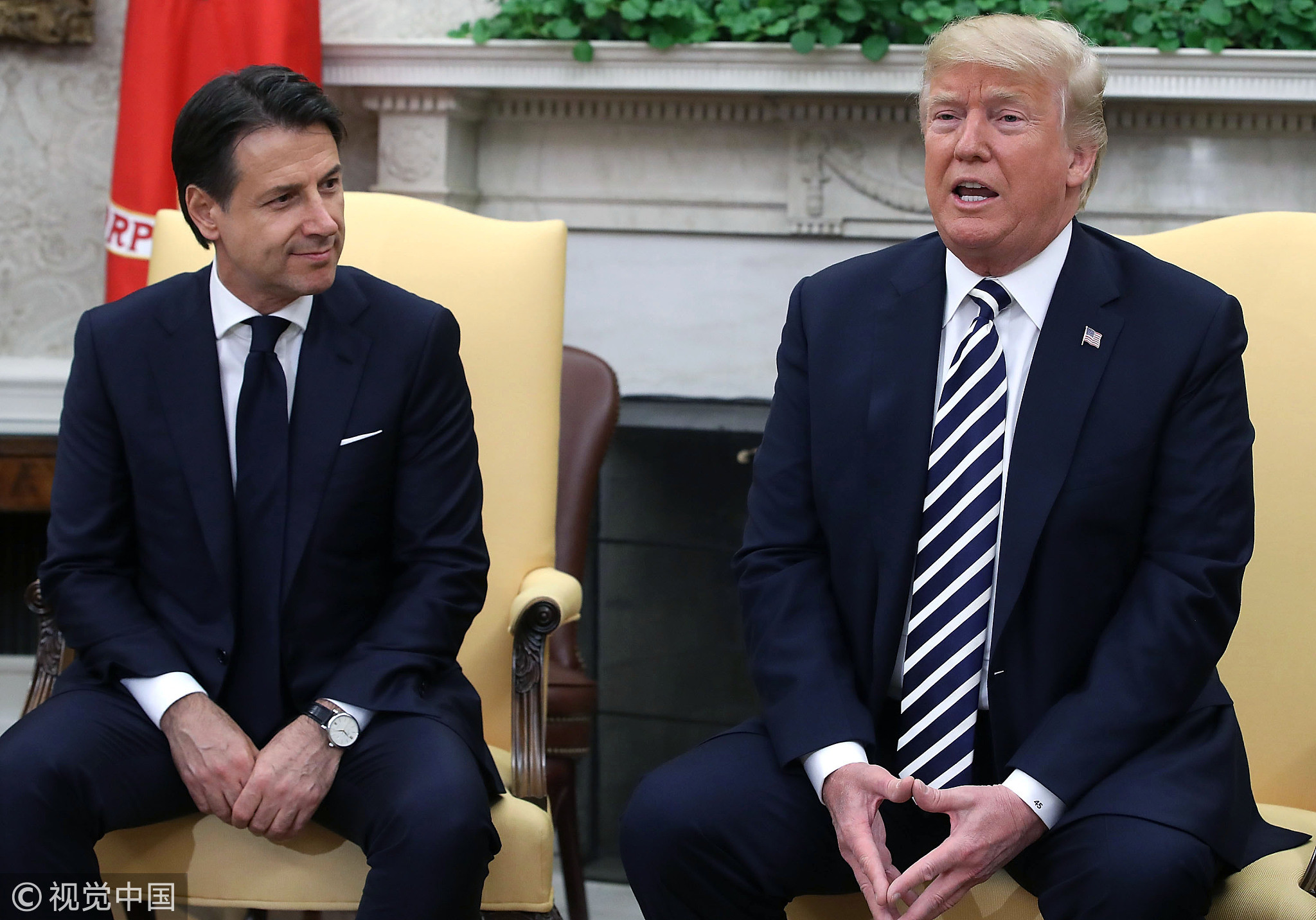
United States President Donald Trump (R) meets with Prime Minister of Italy Giuseppe Conte in the Oval Office in Washington, DC on Jul 30, 2018./VCG Photo
United States President Donald Trump (R) meets with Prime Minister of Italy Giuseppe Conte in the Oval Office in Washington, DC on Jul 30, 2018./VCG Photo
This was not the first meeting between Conte and Trump. They have already met twice in the G7 and NATO summits in the past two months and in true Trump style he expressed his views about Conte on Twitter following their initial encounter. Trump tweeted: “Just met the new Prime Minister of Italy, a really great guy. He will be honored in Washington, shortly. He will do a great job - the people of Italy got it right!"
As Trump has tense relations with some allies’ leaders, his praise for Conte demonstrates his willingness to break his diplomatic isolation and to build special relations with the new Italian government, whose radical governing platform bears a striking resemblance to Trump’s policies, including cutting taxes via a flat tax, and cracking down on migration. Conte’s visit to DC offers a chance for him to talk to Trump in depth on a one-on-one basis and seek common ground for some prominent issues.
On the military expenditure issue, even though Trump may have a low expectation of a promise of substantial military increase from Conte, he still needs Conte to do something in that regard.
It is no secret that Trump encourages all the member states of NATO to honor their commitment by increasing their military expenditure to 2% of their GDP as soon as possible. But he may fail to set Italy as a role model.
Italy’s economy has been in bad shape for years and Rome had to adopt austerity measures mandated by the EU. The Italian government was forced to reduce its budget deficit and public debt severely.
As Conte’s government is planning to seek more debt concessions from the EU, Trump may find it difficult to persuade Italy to reverse the declination of the military expenditure, let alone an increase.
A more pressing issue that Conte may need to persuade Trump on is the issue of immigrants who get to Italy through Libya. Since Qaddafi was toppled, Libya has been a mess and has become a haven for refugees and migrations.
Due to Libya's close geographic proximity to Italy, Italy has borne the major brunt of the migration exodus. As the migration issue becomes increasingly pressing, Conte’s coalition government has stepped up and promised to stop the migration inflow by targeting the mess in Libya.
But without the active engagement of the US, Italy can hardly do anything significant. Unfortunately, Trump has flip flopped on the US intervention in Libya in the past years, so Conte has a lot of persuasion to do to pull Trump to his side.
As Conte and Trump share the same desire to improve relations with Russia, talks on the subject may be relatively easy, providing room for them to forge a united policy towards Russia.
Since imposing sanctions against Russia, Italy registered a loss of 7 million Euro any single day. Conte made it clear that “We will be the advocates of an opening towards Russia.” He not only supported Trump’s idea of readmitting Russia into the G7, but also has a will to lift sanctions against Russia.
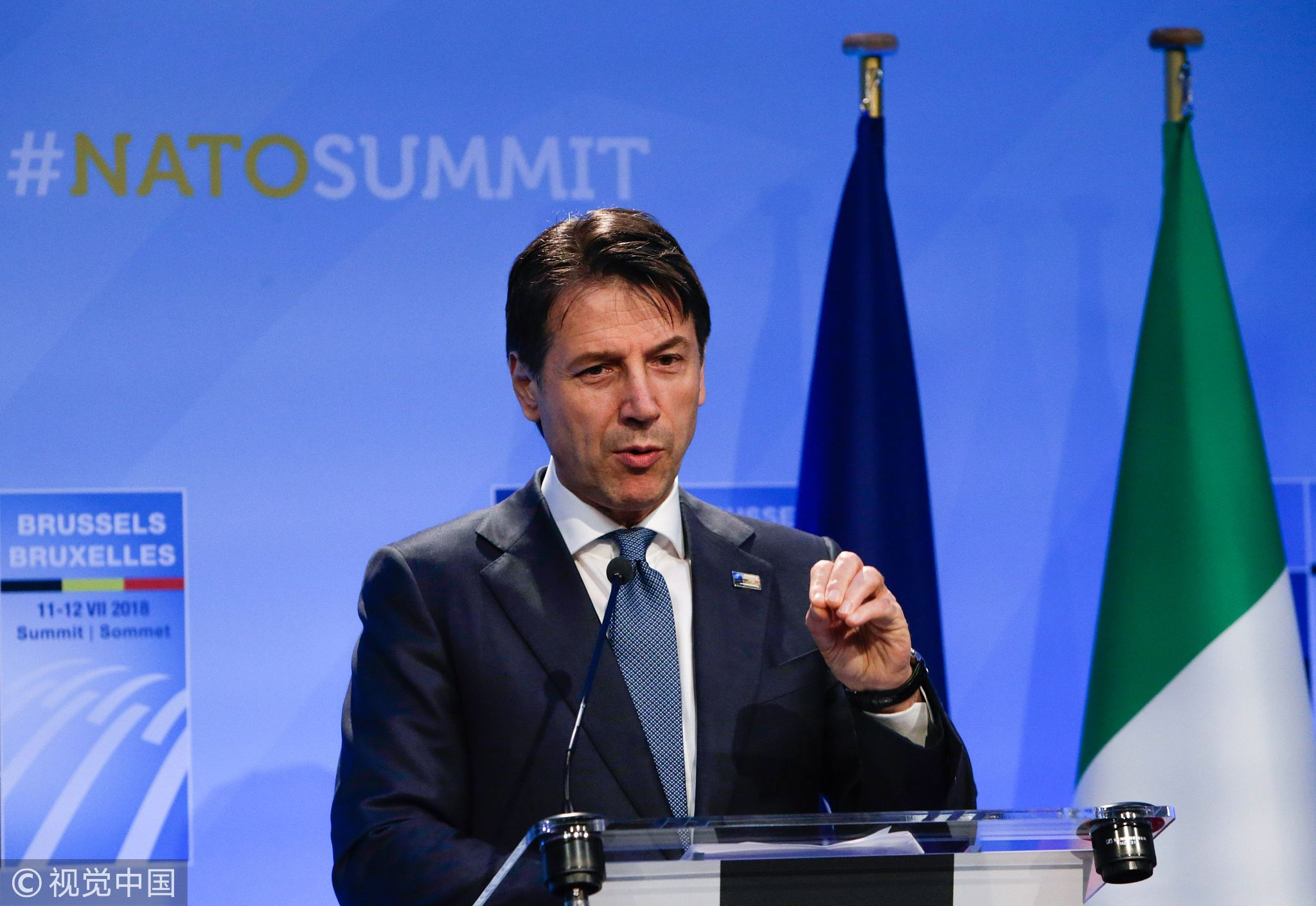
Italian Prime Minister Giuseppe Conte addresses a press conference on the second day of the North Atlantic Treaty Organization (NATO) summit in Brussels, Jul. 12, 2018. / VCG Photo
Italian Prime Minister Giuseppe Conte addresses a press conference on the second day of the North Atlantic Treaty Organization (NATO) summit in Brussels, Jul. 12, 2018. / VCG Photo
The united policy talks may help silence critics who attacked Trump following mistakes he made in his summit with Putin this month and the ongoing investigations into Russia's alleged meddling in the 2016 US Presidential elections.
While Conte and Trump may share similar views on some issues, they come from completely different backgrounds and it will be interesting to see how their relations work out in future.
Conte worked in academia for many years, passing on knowledge to students and training them to think and act in a consistent, rational and informed way.
Conte’s previous working experience stands in sharp contrast with Trump’s, which has been characterized by frequent contradictory tweets, vehement attacks against any critics who dare to challenge his authority, and inflammatory speeches that further fuel political polarization.
Conte and the businessman turned politician also share little similarities in their power base. Conte’s surprise ascendancy to the political arena was not his win in the national election, but a result of a compromise made between the Five Star Movement and the League.
We don’t know how long Conte can stay, given the fragile nature of the Italian political system and frequent changes of its governments.
Trump won his presidential election and has been bossing around for more than one and half a year. Even though he is facing tremendous criticism from mainstream media and liberals and is constantly engaged in fighting with allies and competitors, Trump still maintains his combative posture and his approval rating is seemingly rising.
Even though Conte has a clear vision of his governing in the future, conceivably, he will walk on a tightrope, and cannot embrace Trump in a way Trump expects.
Nonetheless, because Conte and Trump share a similar world outlook, their initial chemistry will last for a while. The two leaders have strong motives to cultivate special relations between themselves as well as their countries.
For Trump, the special relationship not only could alleviate his isolation in the G7 and NATO, it could render some legitimacy to his unpopular immigration policy back home.
For Conte, the trip would help establish his credentials as an able statesman who can apply theoretical knowledge accumulated in his academic career to practice. It may also strengthen his stand in the EU, which in turn may help to get more concessions from other EU members on two pressing issues: immigration burden-sharing and debt reduction.