
World
12:34, 03-Jul-2018
Latin America urged to digitize state services to save money
Updated
12:02, 06-Jul-2018
 ["other","Latin America"]
Share







Copied

Last week, the Inter-American Development Bank (IDB) announced the approval of a loan of 30 million US dollars to the Bahamas to encourage the "digital transformation" of the country's public sector.
It is a story that is unlikely to gain any attention beyond the confines of the archipelago that sits 72 kilometers southeast of Florida, but it has real significance within Latin American and the Caribbean.
That's because 89 percent of government transactions in the region are carried out face-to-face, according to information contained in a new report from the Inter-American Development Bank (IDB). That means people have no choice but to queue in line to request birth certificates, pay traffic tickets or register properties.
The report, titled "Wait No More: Red Tape and Digital Government in Latin America and the Caribbean," sets out how Latin America can save money and reduce red tape and corruption by digitizing transactional public services.
“This report outlines a path for reforms to simplify and digitize government transactions, focusing on the citizen experience and making strategic use of digital tools,” the IDB's Ana María Rodríguez-Ortiz was quoted as saying in a press statement that accompanied the release of the report. “These reforms promote competitiveness, trust in government and social inclusion through agile citizen-state interaction.”

Only seven percent of citizens in Latin America and the Caribbean report having carried out their last government transaction online. /VCG Photo
Only seven percent of citizens in Latin America and the Caribbean report having carried out their last government transaction online. /VCG Photo
Think of the time alone that can be saved by digitization. The report estimates that completing a government transaction currently takes an average of 5.4 hours – from about two hours in Chile to 11 hours in Bolivia.
And take into account that some citizens are required to travel long distances to government offices which tend not to have extended opening hours and are closed at weekends.
Not only the frustrated citizen loses, everyone does. "Businesses lose productive hours and, with them, their competitiveness," the IDB says. "The state gets bogged down in complex manual transactions and fails to connect public policies with target beneficiaries."
It is an untenable situation that the report says encourages graft, with people often being forced to pay bribes to public officers to obtain routine services.
"In fact, corruption is everywhere: 29 percent of Latin Americans report having paid a bribe in the context of a public service in the last year, equivalent to more than 90 million people in the region," the report says, citing a 2017 Transparency International survey.
One point highlighted is that the poorest are most hurt by inefficient state bureaucracy.
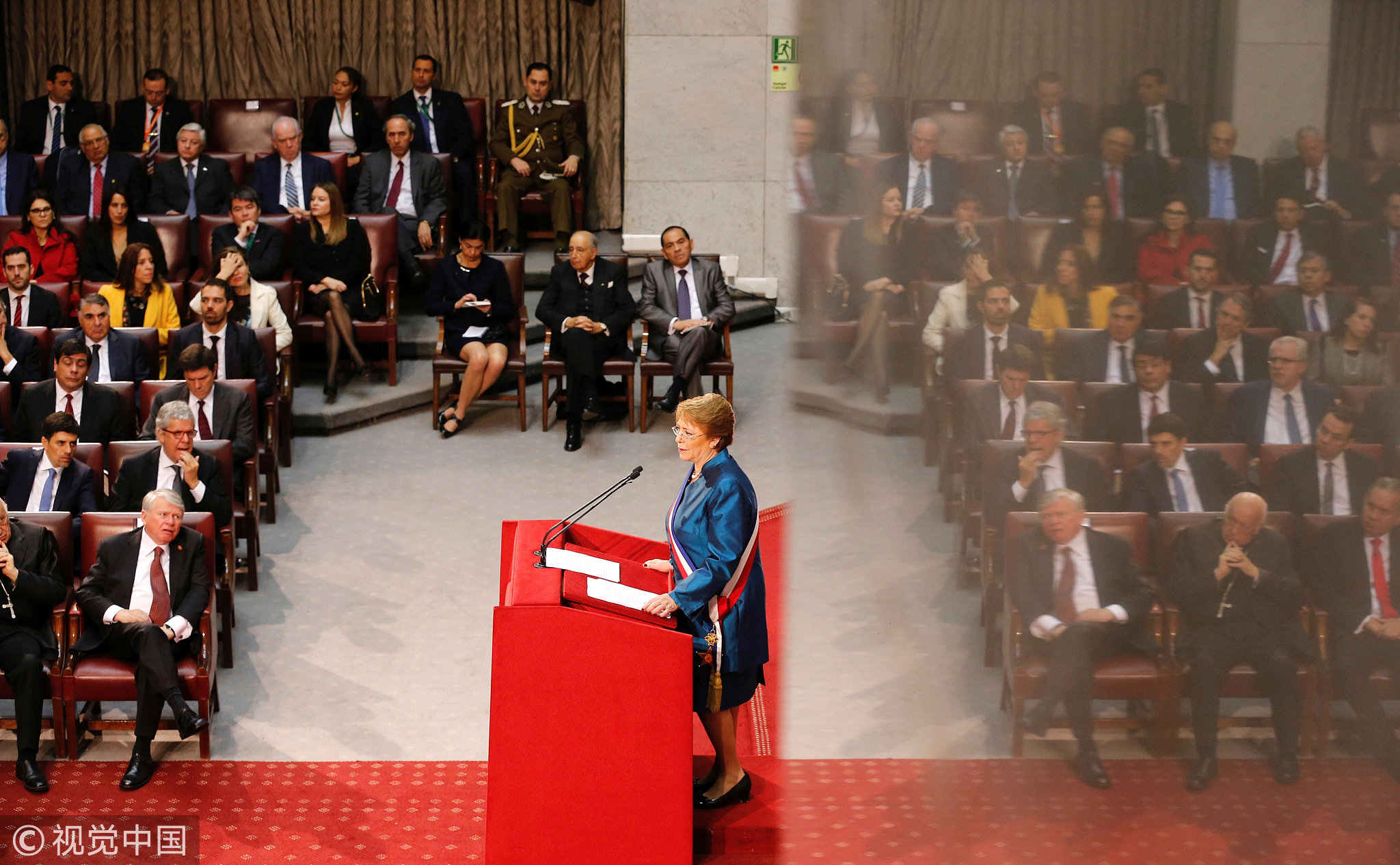
Chilean President Michelle Bachelet delivering the annual State of the Union address to Parliament on May 21, 2016. Chile is held up in the report as an example of a country that managed the transition to digitization on the back of strong political support. /VCG Photo
Chilean President Michelle Bachelet delivering the annual State of the Union address to Parliament on May 21, 2016. Chile is held up in the report as an example of a country that managed the transition to digitization on the back of strong political support. /VCG Photo
One external study cited found that 42 percent of college-educated people reported having completed a government transaction within the previous 12 months with the percentage falling to 16 percent among people lacking formal education. One reason for the disparity is that those with lower income tend to have less flexibility in their work schedules, making it difficult for them to get the hours they need to complete a transaction.
The present setup is also costly for governments, which have to employ thousands of counter staff to handle face-to-face business.
"For example, in Mexico, the state spends US$9 for each transaction provided in person at a government office," the report notes. "If this cost is assumed to remain constant for the approximately 360 million federal and state transactions carried out face-to-face throughout the country, the resulting bill is nearly US$3.3 billion per year, equivalent to 23 percent of federal expenditure on education."
As it stands, only in three countries in the region – Brazil, Mexico, and Uruguay – are more than half of government transactions available online. That's in contrast to 81 percent in the European Union. The loan to the Bahamas aims to get the country to 70 percent by 2025.
For most countries, it will be a long road to travel to digitization. Only seven percent of citizens as a whole report having carried out their last transaction online.
But the IDB says the change is worth it – as computerization makes the process 74 percent faster on average, is between 1.5 and 5 percent cheaper than face-to-face transactions and less vulnerable to corruption.
Recommendations for better transactions
The report acknowledges that implementation won't be easy as some countries don't have even the basic knowledge of how many transactions they undertake, while others have gaps in connectivity, with low fixed broadband take-up and usage of debit cards (40 percent) and credit cards (22 percent). It doesn't help that even when online facilities do exist, many find the experience disheartening because of technical and other issues.
The authors hold up Chile, Uruguay and Mexico, as well as Estonia, as examples of countries that have managed the transition on the back of strong political support.
To improve the situation, the report recommends that governments:
• Understand the true citizen experience with government transactions through surveys, direct observation or administrative data and use this information to redesign transactions with the citizen experience in mind.
• Eliminate unnecessary, redundant or obsolete transactions.
• Invest in broadening access to online transactions and building digital government with tools such as interoperability platforms, digital identity and digital signature, among others.
• Improve the quality of in-person provision of transactions through investment in qualified personnel and one-stop shops.