Editor’s note: Fan Jishe is the director for Strategic Studies Institute of American Studies at the Chinese Academy of Social Sciences.
The meeting between US President Donald Trump and leader of the Democratic People's Republic of Korea (DPRK) Kim Jong Un in Singapore on June 12 and the two-page joint statement that followed confirmed both countries’ political will to denuclearize the Korean Peninsula at the highest level and in a formal way.
By committing to establish new US-DPRK relations and build lasting and stable peace, Trump conveyed a clear message to the DPRK that he could do business in an unconventional way.
By committing to work towards the complete denuclearization of the Korean Peninsula, Kim partially met the necessary requirement for a possible rapprochement between the United States and the DPRK. And that is a welcomed development.
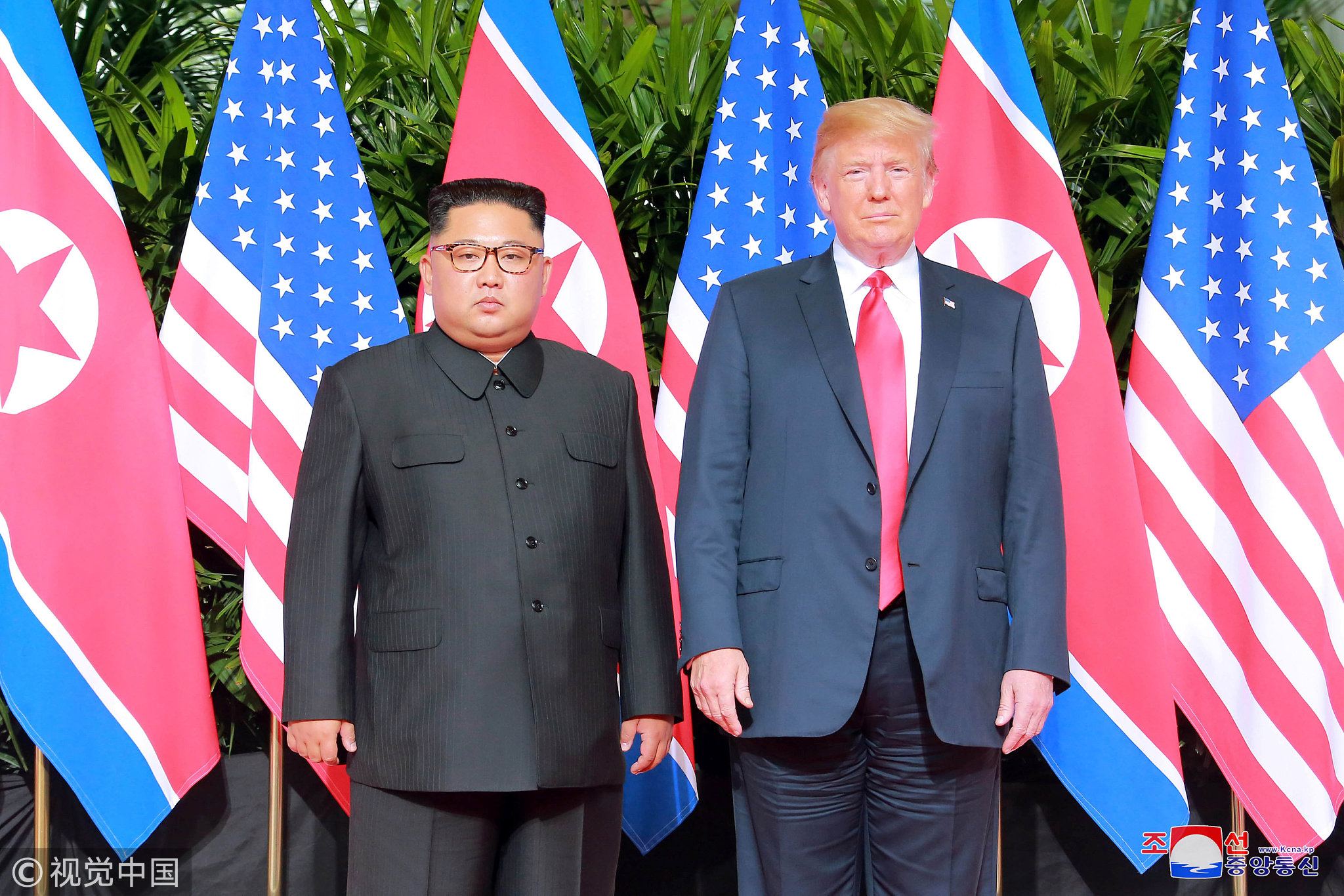
US President Donald Trump (R) and DPRK leader Kim Jong Un (L) pose at the Capella Hotel on Sentosa island in Singapore on June 12, 2018. /VCG Photo.
US President Donald Trump (R) and DPRK leader Kim Jong Un (L) pose at the Capella Hotel on Sentosa island in Singapore on June 12, 2018. /VCG Photo.
Both Trump and Kim have talked the talk, and now the time has come for them to walk the walk. Can they deliver what they promised in the joint statement? Can the momentum of the symbolic breakthrough last longer? Most observers are not very optimistic.
It is easy to fall in love, but difficult to maintain a marriage. The history of negotiations tells that the devil is in the details.
Denuclearization has been seen as a pie in the sky for more than two decades, and if the two countries want to reach it, they have to be extremely careful in handling the subtle process and maintaining progress.
Both the United States and the DPRK are genuine and sincere in improving bilateral relations so that denuclearization could be achieved.
The DPRK is shifting the strategic line from simultaneously developing nuclear capability and economy to putting economic growth first, which was clearly stated in the 3rd Plenary Meeting of the 7th Central Committee of the Workers' Party of Korea on April 20.
For the sake of economic development, the DPRK is ready to exercise restraint in its nuclear and missile programs by destroying its nuclear test site, withholding from nuclear proliferation and committing to not conducting tests.
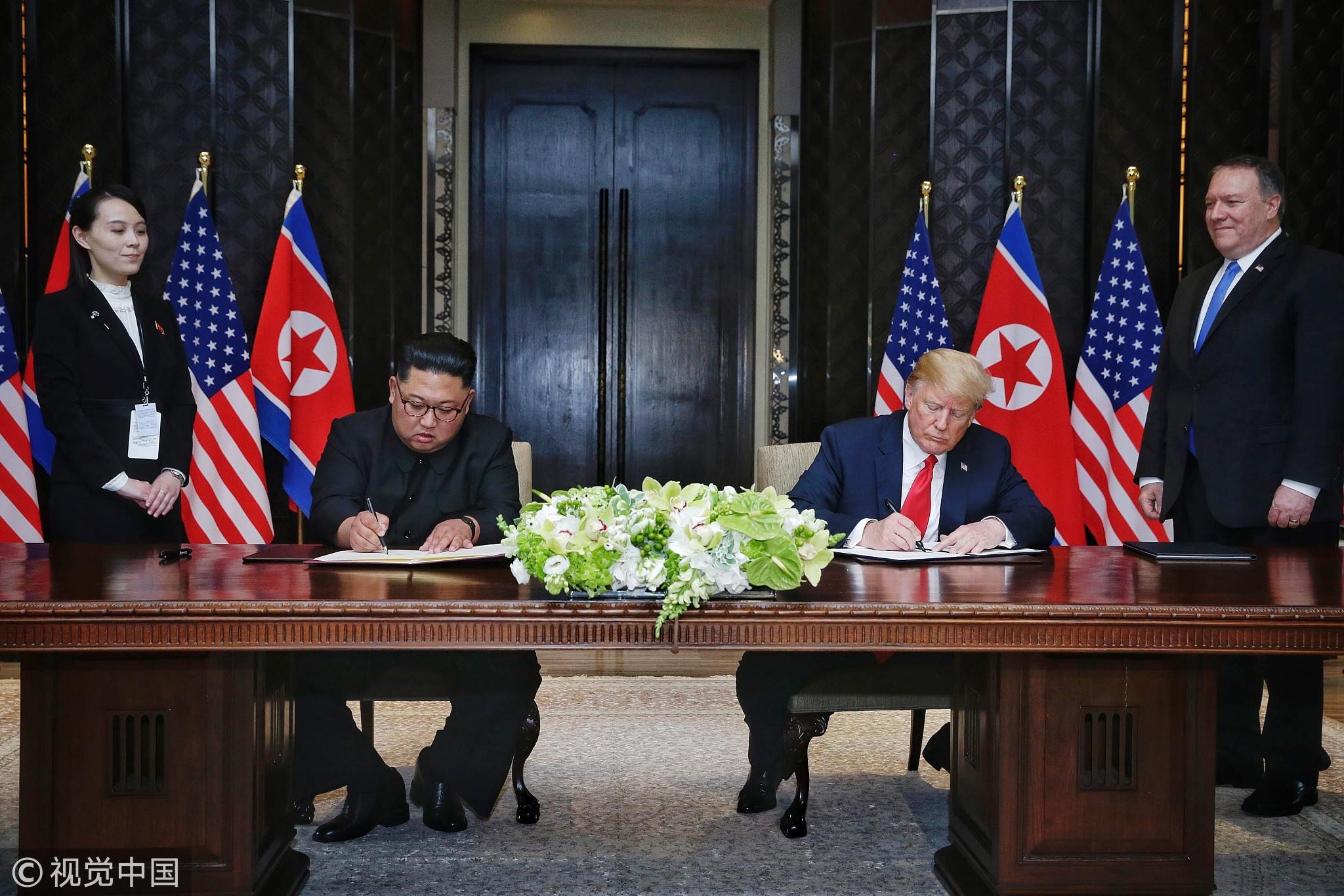
US President Donald Trump (R2) and DPRK leader Kim Jong Un (L2) participate in a signing ceremony as part of the US-DPRK summit, at the Capella Hotel on Sentosa Island in Singapore on June 12, 2018. /VCG Photo.
US President Donald Trump (R2) and DPRK leader Kim Jong Un (L2) participate in a signing ceremony as part of the US-DPRK summit, at the Capella Hotel on Sentosa Island in Singapore on June 12, 2018. /VCG Photo.
President Trump suspended the military drills directed at the DPRK without consulting with the Republic of Korea (ROK) and Japan first. Both want to move forward, and this momentum is precious considering the long lasting distrust.
Therefore, if they want to get the pie from the sky, they need to make sure that nobody will be let off the hook.
Last year witnessed both sides trading insults and threats, risking a possible war. Now by meeting in Singapore, reaching a joint statement, and taking initial moves, both the United States and DPRK have raised the expectations. If either side could not deliver, they cannot afford the consequences.
The conventional wisdom in denuclearization is that both sides have to translate the abstract framework reached in the Singapore Summit into workable timetable and roadmap. The timetable for denuclearization could be a tricky issue for both sides.
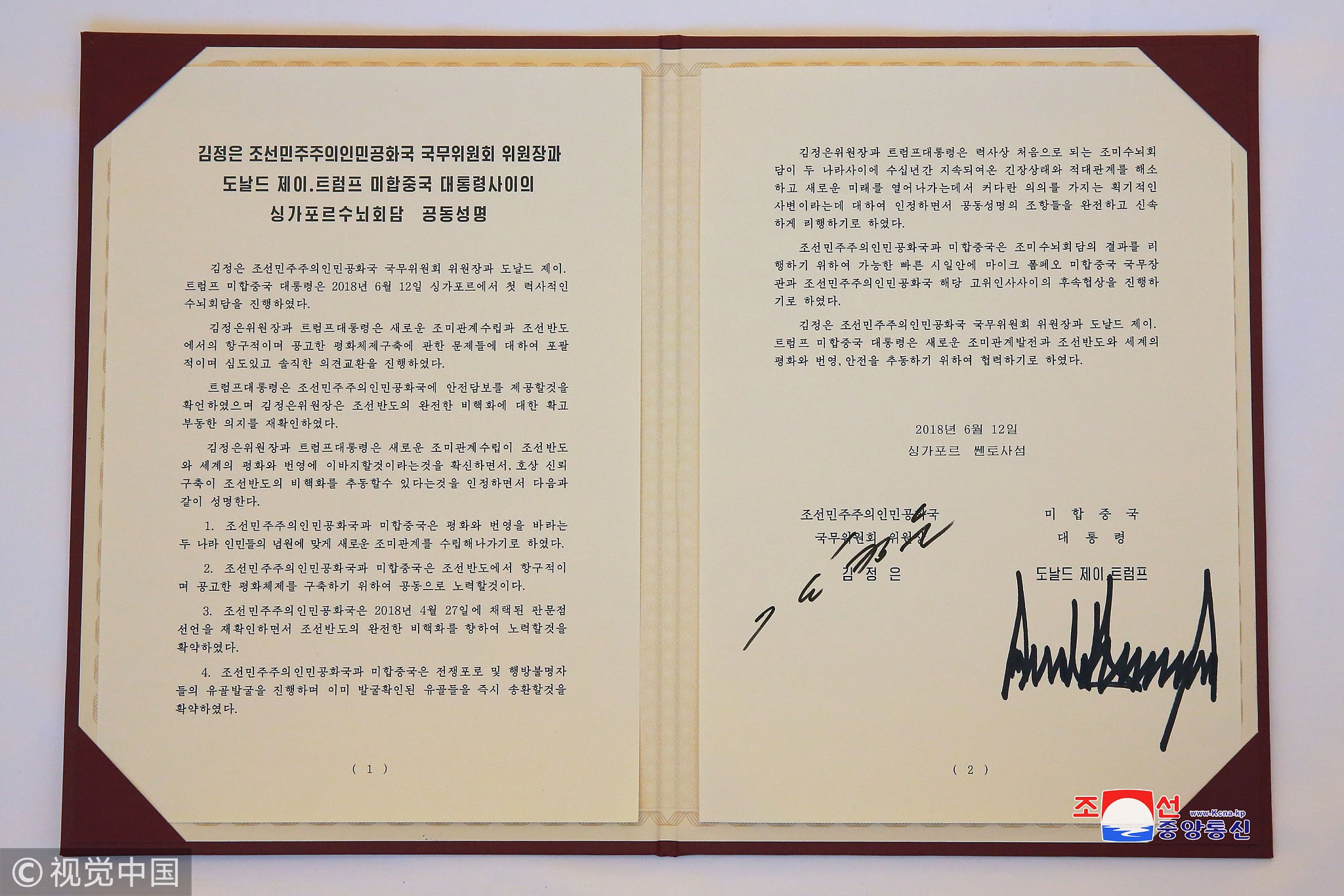
A document signed by US President Donald Trump and DPRK leader Kim Jong Un is seen in Singapore in this picture released on June 12, 2018, by DPRK's Korean Central News Agency. /VCG Photo.
A document signed by US President Donald Trump and DPRK leader Kim Jong Un is seen in Singapore in this picture released on June 12, 2018, by DPRK's Korean Central News Agency. /VCG Photo.
President Trump wants to get done with denuclearization fast, before he finishes his first term in January 2021, or even preferably overnight. The DPRK will not take any substantial moves in denuclearizing the Peninsula before it gets solid security guarantees.
Thus, denuclearization should be a long process accompanied by tangible and gradual concessions from the United States. Before the United States and the DPRK kick off their negotiations, they should have kept this in mind first. Meeting each other halfway is the only option left for both sides.
Then comes the tough issue of a roadmap, namely, what to address first, who takes the first step, and how to reciprocate. If the United States insists that denuclearization come first and the DPRK take the first step, it will have a better chance in ruining this whole thing.
The DPRK has been justifying its nuclear program as one way to deal with the US' “hostile policy”, that is, political isolation, economic sanctions, and military containment.
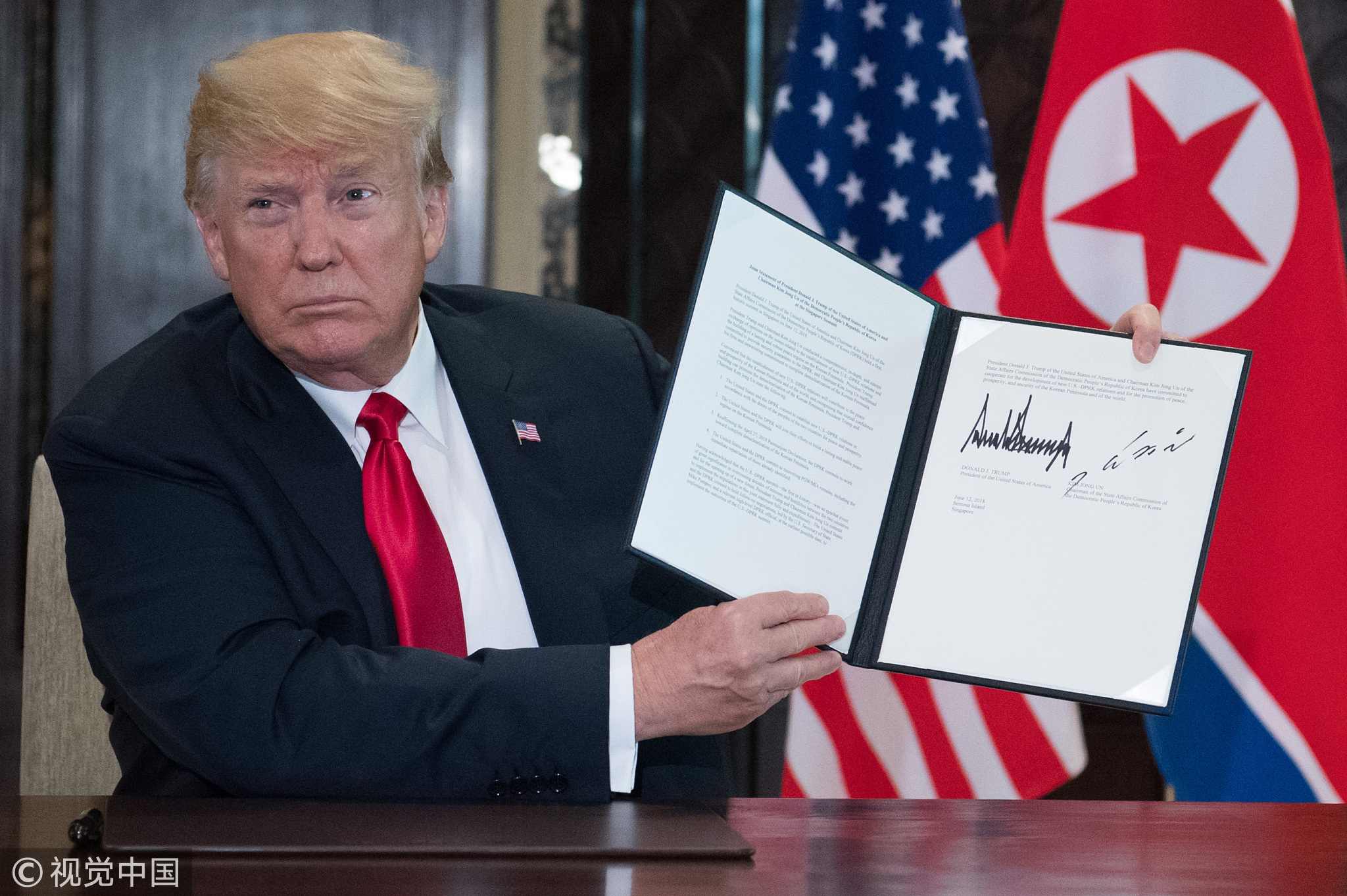
Donald Trump holds up a document signed by him and the DPRK leader Kim Jong Un following a signing ceremony during their historic US-DPRK summit, at the Capella Hotel on Sentosa island in Singapore on June 12, 2018. /VCG Photo.
Donald Trump holds up a document signed by him and the DPRK leader Kim Jong Un following a signing ceremony during their historic US-DPRK summit, at the Capella Hotel on Sentosa island in Singapore on June 12, 2018. /VCG Photo.
Establishing new US-DPRK relations and building a lasting and stable peace, as outlined in the joint statement, offer an answer to counter DPRK’s nuclear raison d'être. The United States is in a better position to take the first step in this regard without compromising its final goal of denuclearization.
If diplomatic relations with the DPRK are established, and the armistice agreement transformed into a peace arrangement, then it will be the DPRK’s turn to take substantial moves in denuclearization.
By taking these political steps, the United States does not have to make many concessions. In case the DPRK cannot deliver in denuclearization, the United States could place maximum pressure on the DPRK.
The DPRK nuclear issue has been around for more than two decades and with the improvement of both its nuclear and missile capability, the window for diplomacy in the denuclearization process is narrowing.
If both Trump and Kim are to create history, they should be bold enough and ready to take risks. This time, the usual practice is not going to work.

 ["china"]