
Opinions
13:26, 21-Jul-2018
Opinion: Why Sino-Africa co-operation is not neocolonialism
Updated
12:47, 24-Jul-2018
 ["china","africa"]
Share







Copied

Editor’s note: Francis Onditi is the dean of the School of International Relations and Diplomacy at Riara University. The article reflects the author’s opinions, and not necessarily the views of CGTN.
Ties between China and Africa are once again the subject of international discussion as President Xi Jinping began his trip to the African nations of Senegal, Rwanda, South Africa and Mauritius. He is also scheduled to attend the 10th BRICS Conference in Johannesburg from July 25 to 27.
Recently, renewed Africa-China cooperation has elicited policy and academic debate as to whether China is an alternative development partner for Africa or represents another form of neo-colonial domination in the global system.
Chinese engagement on the African continent has received a mixed reaction. On the one hand, the policy of "non-interference" has defined China’s success in boosting Africa’s infrastructure and micro-economic initiatives.

A member of the Chinese medical team to Liberia examines a local patient in Monrovia, Liberia, Oct. 23, 2014. /Xinhua News Agency
A member of the Chinese medical team to Liberia examines a local patient in Monrovia, Liberia, Oct. 23, 2014. /Xinhua News Agency
On the other hand, Western sympathizers view Chinese investment in Africa as "bait" from Beijing to start siphoning natural resources from the continent. The latter argument, however, does not hold, because through the Forum on China-Africa Cooperation (FOCAC) alone, China has extended funding of 60 billion US dollars to African states.
The investment by Chinese public and private corporations via both manpower and fiscal resources into infrastructure has transformed the continent’s transport and telecommunication architecture.
The success stories emerging from the FOCAC projects are anchored in the Chinese "win-win" strategy. This is in contrast to the Western models of development that have been described as archaic, grossly ineffective and too immaterial to foster Africa's developmental potential.
In fact, as strong feelings continue to grow regarding the political quandary and slow economic growth in Europe and the US, there is prospect for a stronger FOCAC. It is against this progressive feeling about the FOCAC that the development-conscious Africa seeks alternative models of development. What, then, makes China the global alternative source of a development model?

Performers pose for photos at the Nairobi Terminus of the Mombasa-Nairobi Standard Gauge Railway (SGR) in Nairobi, capital of Kenya, May 31, 2017. /Xinhua News Agency
Performers pose for photos at the Nairobi Terminus of the Mombasa-Nairobi Standard Gauge Railway (SGR) in Nairobi, capital of Kenya, May 31, 2017. /Xinhua News Agency
First, the Chinese development model is deeply rooted in the country’s political ideology of socialism with Chinese characteristics. The thinking around rejuvenating the ideals of socialism has progressively improved over the years, culminating in the historic 19th National Congress of the Communist Party of China (CPC) in October 2017.
Both political leaders and bureaucrats in China are focused on the most important development priorities: Poverty alleviation, anti-corruption, economic growth and people’s livelihoods. Most of these issues are still unresolved in many African states. The Chinese style of governance presents what President Xi Jinping calls a "shared future for mankind."
The philosophy of a global community is closely related to the FOCAC framework of development, which offers an alternative development model. As the frail "Western democracy" in Africa comes to an end, China might just be the timely "model" of how states struggling to achieve economic stability need to be governed.
Secondly, the art and thoughtfulness with which socialism with Chinese characteristics integrates development and politics gives Chinese governance a competitive advantage over the Westphalian neoliberal democracy.
It is disgusting that African nations remain tethered to some remote Western models of governance, that they themselves seem to be less capable of executing. Neoliberal democracy models have been described as "hollow" because they are "cut and pasted" onto the African context without due regard to the parallel complexities that distinguish African states from European nations.
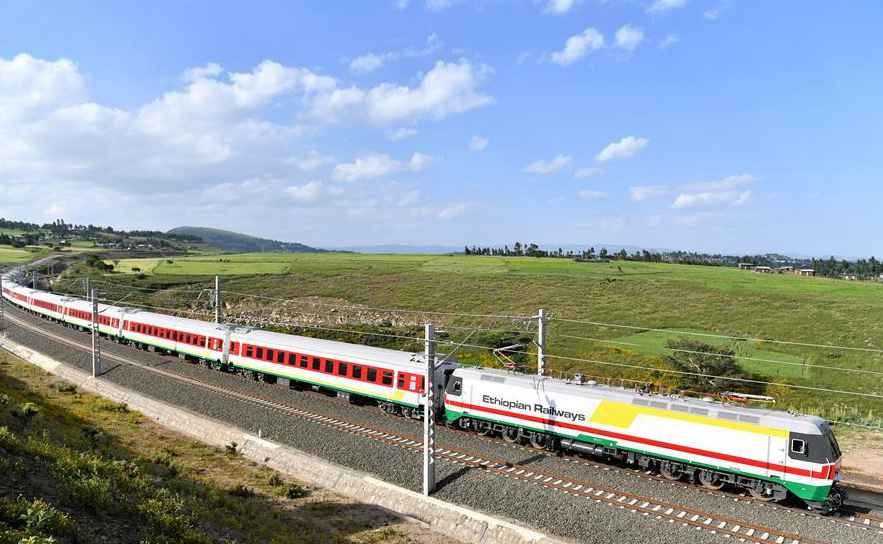
A train runs on the Ethiopia-Djibouti railway during an operational test near Addis Ababa, Ethiopia, on Oct. 3, 2016. /Xinhua News Agency
A train runs on the Ethiopia-Djibouti railway during an operational test near Addis Ababa, Ethiopia, on Oct. 3, 2016. /Xinhua News Agency
Thirdly, while the "cut and paste" Western neoliberal democracy model provides for people’s participation in important decision-making processes, the politics of patronage and remote, clandestine governance structures end up promoting exclusivity.
It is for this reason that I contrast neoliberal democracy with socialism with Chinese characteristics. For socialism with Chinese characteristics, those who call it the "Real People’s Forum" can be forgiven.
For example, during the Two Sessions in 2018, many proposals were received from various groups focused on providing basic needs for young people in areas that would be regarded as marginalized. Cities such as Macao and Hong Kong were beneficiaries of this model of development politics.
Finally, Western powers will continue to consider the balance of power with China’s economic heavyweight as a threat. A worrisome response from the US on several aspects of Chinese engagement on the FOCAC, including the advice to African states to shun Chinese loans, needs to be interrogated objectively. African states should evaluate which way to go: socialism with Chinese characteristics anchored on "win-win" policy or the "hollow" neoliberal Western model of development?