
Business
15:58, 22-Jul-2018
Wharton dean: Trump’s zero-sum thinking is dangerous
Updated
15:45, 25-Jul-2018
 ["china"]
Share







Copied
03:42
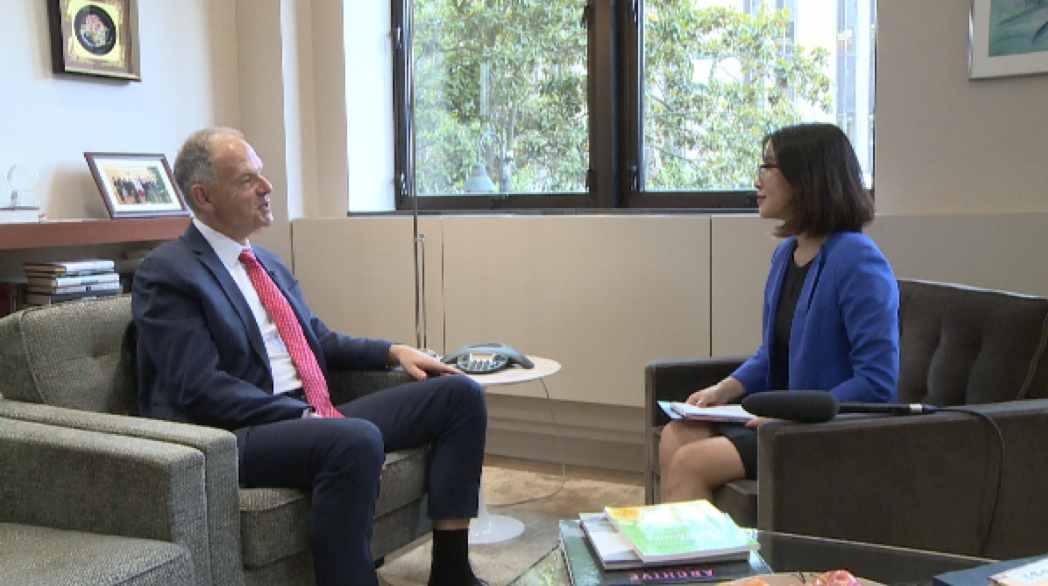
With hefty tariffs, President Trump is building a higher economic barrier to untangle the US from a profoundly globalized market to address some of America’s domestic concerns. Geoffrey Garrett, the Dean of Wharton School of Business, also a renowned political scientist, does not stand with their school’s notable alumnus on this issue.
“The global economy is very complex today. But in politics, trade and particularly trade deficit, are the most salient feature. So what Donald Trump has been saying is, America runs a trade deficit with the European Union and China. Therefore, trade is unfair. That works politically, but it is not consistent with how the global economy works, "said Garrett in an exclusive interview with CGTN’s US correspondent Cao Qingyun.
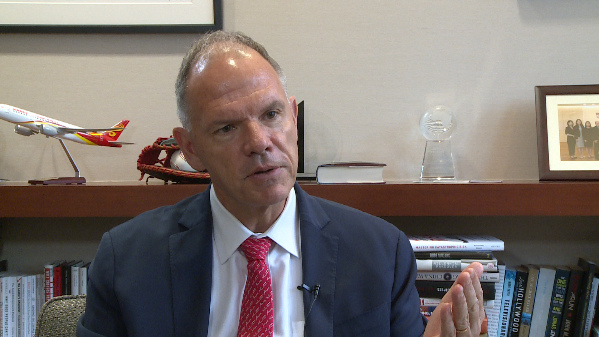
Geoffrey Garrett, the Dean of Wharton School of Business, speaks with CGTN./ CGTN Photo
Geoffrey Garrett, the Dean of Wharton School of Business, speaks with CGTN./ CGTN Photo
Trump is politicizing economic issues
To illustrate how trade becomes political, Garrett went on to argue that the base of Trump’s electorate is frustrated people who feel their lives have not been better. Most Americans have not experienced any income growth for a decade, against the backdrop of economic inequality and technological innovation.
Stagnated income draws voters to “out-of-mainstream” politicians for change. When those frustrated Americans want to blame somebody, they tend to blame the outsiders. In trade, it would be China. However, Garrett does not believe that levies are the solution.
“Trade is not an enemy. Trade is a win. For example, Americans have benefited from China in two fundamental ways: one, the American interest rates are lower thanks to the Chinese capital. Two, prices of the goods we pay are lower than they otherwise would be because of Chinese production," he said.
In fact, many so-called exports from China to the US are products of America’s multi-national firms operating in China and selling back to the States, a leading example being Apple’s iPhone.
Trump's claims have no justification under WTO
While Trump is using Section 232 and 301 against China on trade disputes, Garrett doubts that the World Trade Organization (WTO) can provide any justification for the claims.
“When it comes to a trade disputes, the US would like to use its own trade law. The US is saying that Chinese trade is unfair. I think Chinese can turn around and say well it’s quite unfair that the US is using its own domestic rules to arbitrage trade with China rather than going to the WTO.”
To look at the bigger picture, Garrett pointed out these two distinct countries have committed to increasing economic engagement since the early 1970s. But the current trade war is imposing highly dramatic changes to this trajectory.
Nevertheless, Garrett acknowledged that the US should desire more opening of the Chinese market, which is also in China’s interest.
China is moving to a more open economy
Garrett also recognized that China is moving to a more open economy – the recent rule relaxation allowing car makers like Tesla to enter China’s market without a joint venture is one signal.
“We should encourage China to continue the development path that it is already on," Garrett suggested.
Meanwhile, Garrett commented that in President Xi’s second term, there should be more structural reform in China than there was in the previous five years.
Optimistic about the China-US economic relations
Looking to the future, Garrett remains optimistic about the economic relations between the two countries.
“The economic entanglement between China and the US is just enormous. In fact, I think it is the biggest and the most complex economic relationship the world has ever seen. Trying to unwind that is very difficult to conceive. The economic consequences would be dire for US, China, and the world. I just don’t think it is going to happen,” he noted.
Despite the optimism, Garrett pointed out the two most prominent issues in the disputes: Made in China 2025 and industrial policy.
First, Made-In-China 2025 is a very aggressive and ambitious policy from China, which Garrett believed have caught a lot of people in the US off guard.
Second, China is exercising active industrial policy, coordinated by the government to encourage the growth of part or all of economic sectors.
A lot of developing countries have had that in the past, but China now is a relatively rich country with an enormous economy. It is debatable whether the world can absorb an active industrial policy in China, Garrett said.
Zero-sum thinking is dangerous for economic decisions
Overall, Garrett believes that zero-sum thinking is dangerous for economic decisions.
As Trump is destabilizing the current relations due to his win-loss perspective, the mindset reminds Garrett of those disastrous outcomes brought by World War Two.
“Because of the depth and breadth of the economic interconnection between the two countries, we are not in the same place as the world economy was before World War One, World War Two. The interconnection will provide us with continuous stability,” explained Garret.
“Yes, we got to manage the frictions with China. Why? Because these are two great countries, yet very different countries,” said Garrett.
(Zishan Xia contributed to this article)