
Opinion
11:48, 03-May-2019
Joe Biden is right to question the 'China threat' narrative
Updated
14:24, 03-May-2019
 ["china"]
Share







Copied
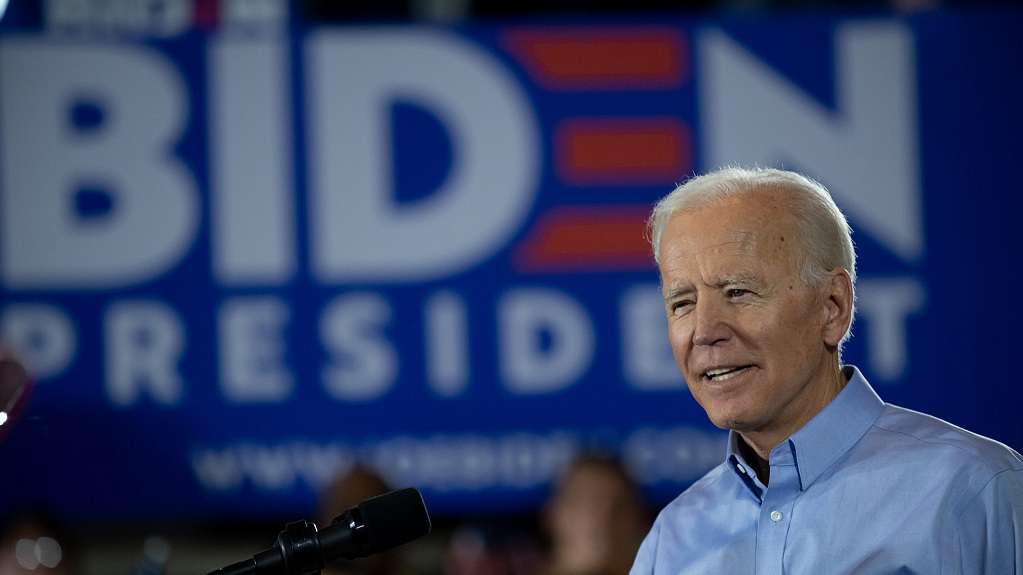
Editor's note: Tom Fowdy is a British political and international relations analyst and a graduate of Durham and Oxford universities. He writes on topics pertaining to China, the DPRK, Britain and the United States. The article reflects the author's opinion, and not necessarily the views of CGTN.
Yesterday American Democratic presidential candidate Joe Biden raised eyebrows by playing down the idea of a "China threat." In a public speech in Iowa, the former Vice President, seen as the leading figure for his party's white house bid, mocked the hysteria that has taken grips in Washington concerning all things Beijing, quoting: "China is going to eat our lunch? Come on, man…I mean, you know, they're not bad folks, folks. But guess what? They're not competition for us."
Unsurprisingly, the comments received a backlash from the media, leading Republicans and other Democratic candidates. Mainstream newspapers such as the Washington Post were quick to assert there was a so-called "China threat" whilst even left-leaning rivals such as Bernie Sanders also said America needed to hold its own on trade.
Whilst it is unclear how far Biden will take his comments, or whether he will retract on it later, his comments nevertheless represent a refreshing change from the Cold War mania that now dominates the American political paradigm.
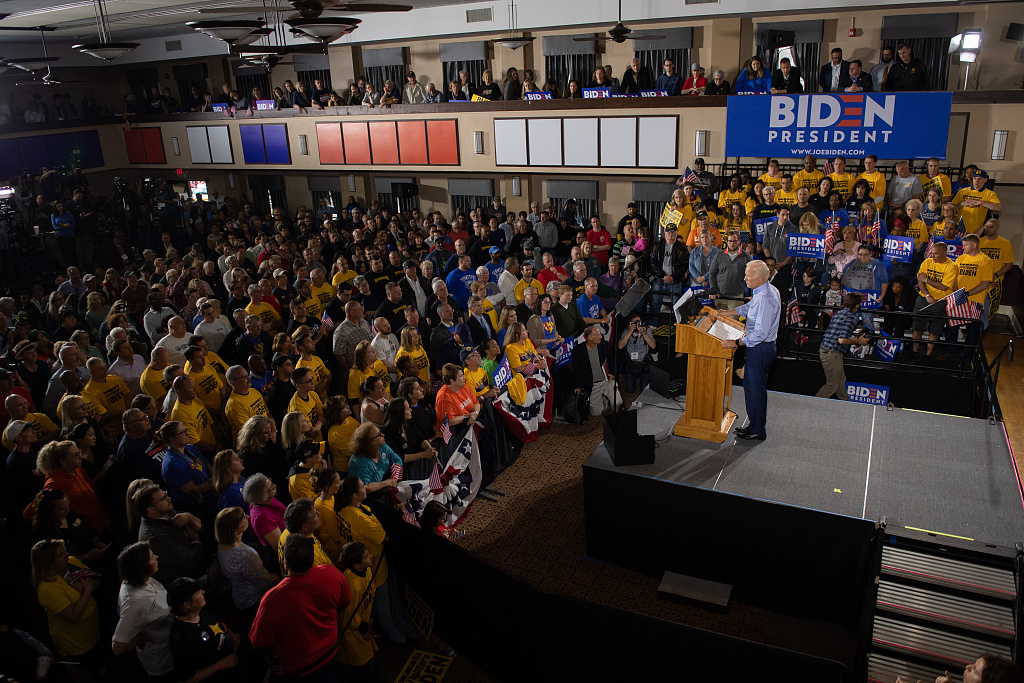
Former U.S. Vice President Joe Biden speaks at a campaign rally at Teamsters Local 249 Union Hall April 29, 2019 in Pittsburgh, Pennsylvania. /VCG Photo
Former U.S. Vice President Joe Biden speaks at a campaign rally at Teamsters Local 249 Union Hall April 29, 2019 in Pittsburgh, Pennsylvania. /VCG Photo
The "China threat" narrative has long exceeded all justifiable reason among the media, commentators and politicians, asserting itself as an unquestionable religious truth of which to violate is a damning blasphemy. Thus, more must be willing to speak out and question the Salem witch hunt mentality.
American politics is often characterized by abject hysteria, a type which makes foreign observers of the country's politics shake their heads and cringe in disbelief. The origins of such a political culture are normative, deriving from a set of defined behaviors and modes which were socialized and entrenched into institutional and political life.
In early New England, the influence of Puritanism and evangelical Protestantism would prove decisive, placing extreme emphasis on outward devotion, public demonstrations of virtue and of course a marked intolerance for those who did not pay lip service to the infallible truth of the faith or to whom stood outside it completely.
Although so much of course has changed since that time, the legacy of early America has nevertheless entrenched the conventions of a hysterical, aggressive and evangelized mode of politics which so often transcends basic reason. Whilst there are many examples of how such plays out in confrontational debates over matters such as abortion, gun control, equal rights and so on, never has such been more applicable in the field of foreign policy, intensified by how the U.S perceives its value sentiments and identity in relation to the rest of the world, or to put it in a simple term "American exceptionalism".
Inevitably, foreign affairs become a playground for such hysteria, with American politicians cynically manipulating the "rules" of their political culture to generate irrational comprehensions of "threats" in order to push sublime foreign policy goals. The most marked contemporary example is to how the threat of terrorism was exaggerated beyond reason to push a regime change war in Iraq, which was in fact completely unrelated.
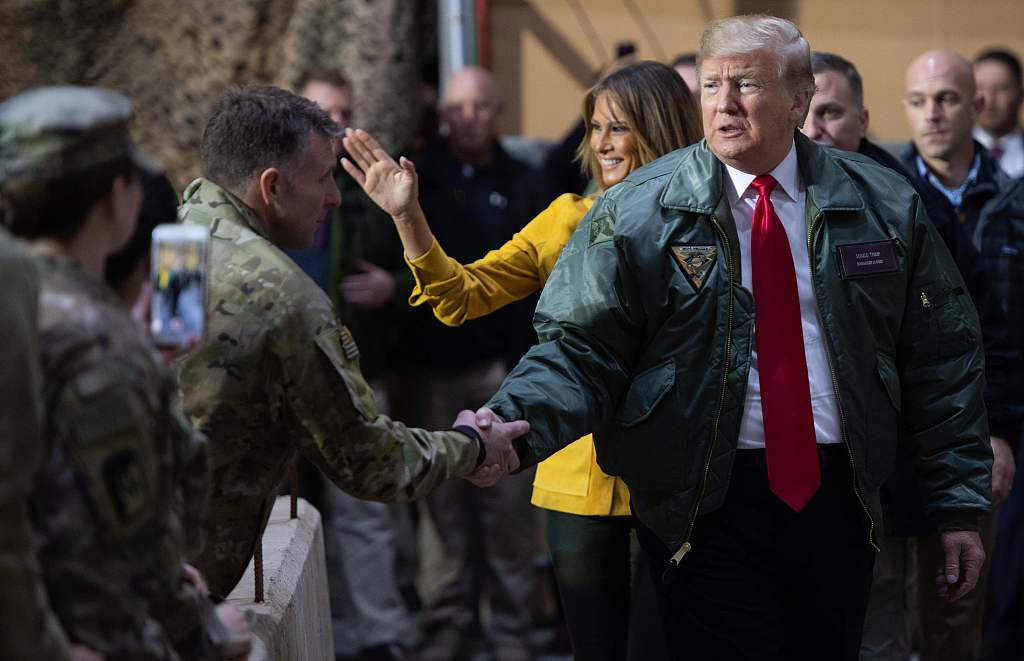
U.S. President Donald Trump and First Lady Melania Trump arrive to speak to members of the US military during an unannounced trip to Al Asad Air Base in Iraq on December 26, 2018. /VCG Photo
U.S. President Donald Trump and First Lady Melania Trump arrive to speak to members of the US military during an unannounced trip to Al Asad Air Base in Iraq on December 26, 2018. /VCG Photo
Now of course, the issue is China and euphoria is abound within Washington for what is described as the so-called "China threat"- whereby everything pertaining to Beijing is rendered a suspect of espionage in a part of a grand conspiracy to steal America's technology, cheat and build new world hegemony.
What is unfortunate is that these claims have in fact obtained mainstream political standing. In doing so, it is not a contentious debate with polarized sides (i.e immigration) but instead it has gained broad bipartisan support, transforming it into a religious-like "truth" (like Protestantism of old) which thus obligates and constrains most mainstream leaning politicians to pay lip service to it to various extents, facing of course the typical public and media stigma derived from America's longstanding traditions, for daring to challenge it.
Nevertheless, this mode of thinking should be held to account. Whatever concerns the U.S. may have pertaining to its relationship with China, the manner and character which they have been conducted has truly transcended all tangible rationality. The Trump administration in particular, on perpetuating this mode of thought, has taken numerous courses of action concerning Beijing which ultimately contravene and jeopardize American interests in the long term, none of which have received any meaningful form of public scrutiny from either the media or other politicians.
Given this, Joe Biden's comments are a breath of fresh air. The China threat narrative is at best abject hysteria characteristic of longstanding institutionalized traits within America's political culture and of course especially within the realm of foreign policy. America so desperately needs a China stance that is driven by reason and rationale, not confrontation, scaremongering and Cold war chauvinism. With such a leading figure playing down the “threat” mentality, more politicians should be prepared to come out and criticize Washington's new McCarthyism.
(If you want to contribute and have specific expertise, please contact us at opinions@cgtn.com)