
Company
16:09, 30-Apr-2019
All eyes on China sales for Apple's Q2 earnings report
Updated
16:48, 30-Apr-2019
 ["china"]
Share







Copied
It's that time of year again, when major global companies reveal how well (or not) they have performed in the last quarter.
One of the most closely watched quarterly reports will be from Apple, which is set to publish its earnings for the second quarter of its fiscal year on Tuesday.
2018 was an uncertain year for Apple, as Chinese consumers looked elsewhere for the latest tech products and investors were left unconvinced by the company's expensive smartphone lineup, sending shares down by as much as 34 percent.
Will Apple see its China market share fall further?
The last quarter of 2018 saw revenue of 13.2 billion U.S. dollars for Apple in Greater China Region. A year earlier, that figure was almost 18 billion U.S. dollars.
The Chinese market is so important to Apple, that the decrease of almost five billion U.S. dollars was enough to wipe out any sales increases the company made in other regions.
In terms of sales, China is Apple's third largest market. But its share in that market has decreased in the last few years, coinciding with the rise of Chinese brands like Huawei, Oppo and Xiaomi.
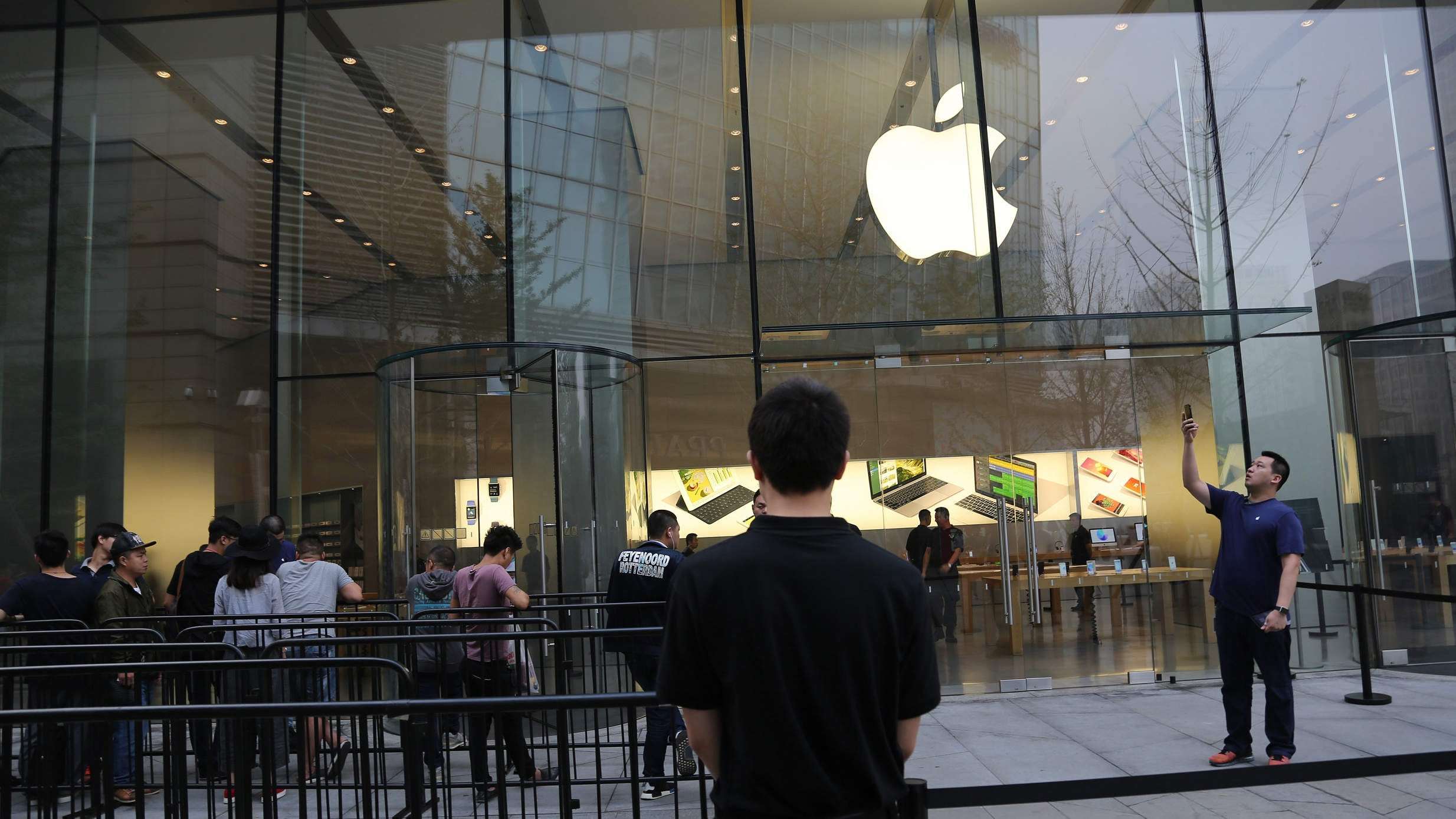
VCG Photo
VCG Photo
In the last three months of 2018, Apple's China market share had dropped to 12 percent, with Huawei out in front with 28 percent.
Chinese consumers are still buying smartphones in large quantities – but they aren't buying as many Apple handsets as before.
Huawei saw its sales last year skyrocket, as global revenue grew by 19.5 percent. In the third quarter of 2018, Vivo and Oppo saw their China sales grow by 14 percent and 7.5 percent, while Apple's own figures went down by 10 percent.
Will cutting prices boost sales for Apple?
While Apple CEO Tim Cook looked to blame disappointing revenue figures on the Chinese market, many analysts instead pointed the finger at its overpriced model iPhone X.
A study by FT Confidential found that only 1.1 percent of Chinese consumers would be willing to spend more than 10,000 yuan (1,485 U.S. dollars) on a smartphone.
Last September, Apple unveiled the iPhone XR and XS models, initially at lower prices to the iPhone X.
Earlier this month, the company further reduced prices for Chinese consumers.
However, the 64GB iPhone XS still costs 8,199 yuan (1,220 U.S. dollars). Even after the price cuts, that's more than double the price of a Huawei P30 smartphone.
VCG Photo
VCG Photo
Apple saw its share price fall sharply towards the end of 2018, and while it briefly became one of the first companies to hit a value of one trillion U.S. dollars in August, the company needs a jolt of momentum to prevent a further investor selloff.
With declining or stagnant sales elsewhere, that jolt needs to come from the Chinese market. Without it, Apple investors could become increasingly nervous that this fall is a trend that can't be halted.
Is Apple too big to fail?
Less than a decade ago, Nokia was the world's biggest smartphone maker, with a market share of more than 38 percent. Last year, that share shrank to less than one percent.
The launch of the first iPhone in 2008 consigned Nokia's smartphones to the history books, with the company failing to catch up with Apple's innovative new product.
Ten years on, Apple now finds itself under immense pressure to come up with "the next big thing." Huawei and Samsung are set to launch foldable smartphones in the coming months, while other major manufacturers are unveiling 5G-ready devices.
Apple remains silent, as investors are left to second-guess whether the company is struggling to keep up or instead on the verge of announcing a new, revolutionary product.
Tuesday's quarterly earnings report will provide only a small guide to the company's future direction. A continued downturn though will only add greater urgency and pressure when it comes to developing the next "must-have" piece of technology.