
Culture
14:40, 29-Apr-2018
Is 'Avengers' the only box office killer in May?
 ["china"]
Share







Copied

The Chinese film market in May is a bit silent. The only blockbuster to open in the world’s second-biggest film market is Marvel’s “Avengers: Infinity War,” which makes it highly likely to be the only box office killer in the month – and a mega one at that.
Lack of contenders

"Us and Them" and "A or B" /CGTN Photo
"Us and Them" and "A or B" /CGTN Photo
Two potential rivals of the superhero franchise are local films – “A or B” and “Us and Them,” both of which debuted just one day before the three-day Labor Day holiday which kicks off on April 29.
“A or B” is a crime thriller starring veteran comedian/director Xu Zheng (“Lost in Thailand”), while “Us and Them,” led by Jing Boran (“Monster Hunt”) and Zhou Dongyu (“Soulmate”), is a love drama spanning 10 years and directed by singer/actor Rene Liu.
“Us and Them” is currently a box office hit, raking in more than 380 million yuan (60 million US dollars) in just one and half days. But “A or B” is far less impressive, taking in short of 59 million yuan in the same period.
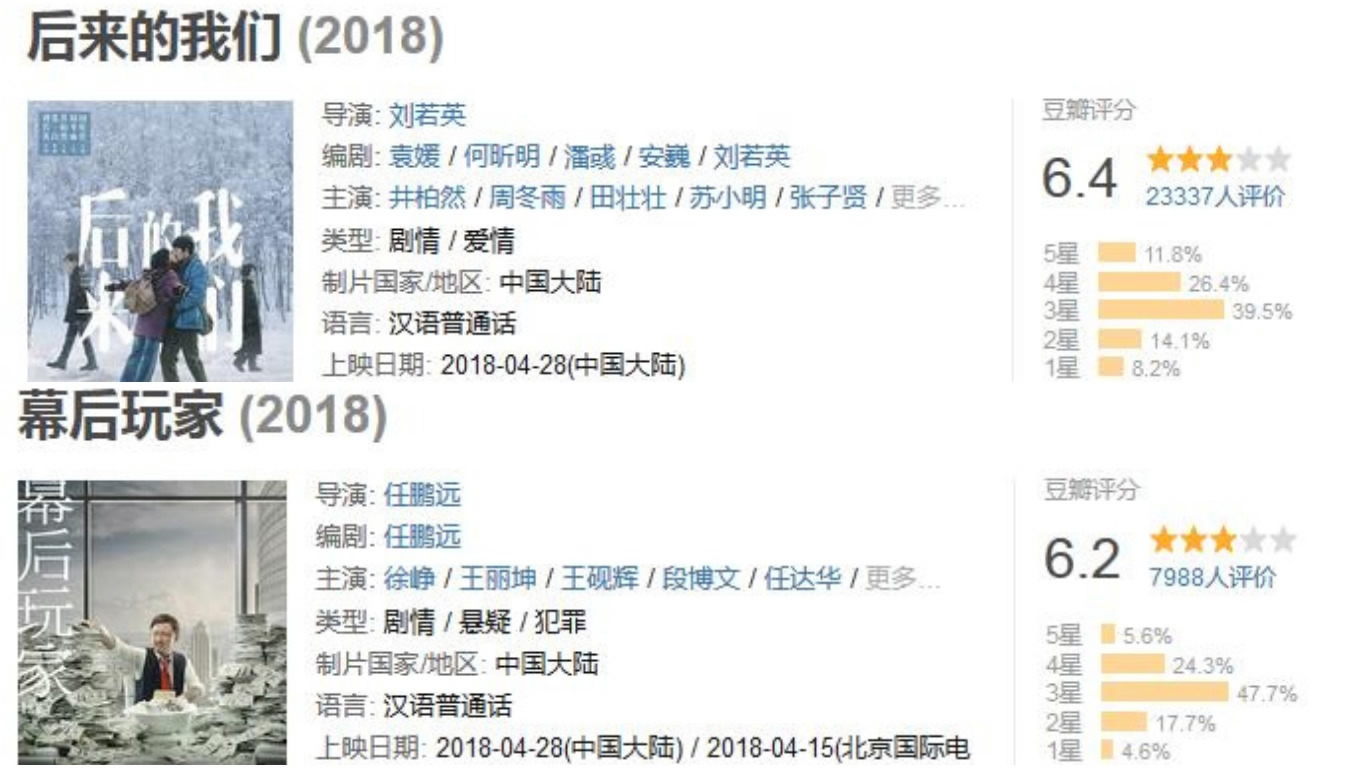
Ratings for "Us and Them" and "A or B" on movie site Douban. /CGTN Photo
Ratings for "Us and Them" and "A or B" on movie site Douban. /CGTN Photo
However, both films are poorly rated, with 6.4 points (out of 10) for “Us and Them” and 6.2 points for “A or B” on Douban, a Rotten Tomato-like site in China.
The monster film “Shin Gojira” is also expected to hit Chinese theaters in May but the release date is yet to be announced. The film, a reproduction of the classic "Gojira" film, has already opened in other parts of the world in 2016 before finally making its way into China.
‘Avengers’ smashes record
“Avengers: Infinity War” is a two-part culmination of 10 years of story lines that began with Marvel Studios’ “Iron Man” in 2008. The second "Infinity War" installment is due to be released in May 2019.
The film is estimated to take in 106 million US dollars on opening day in North America, according to Box Office Mojo. The weekend opening is expected to top 240 million US dollars, making it the second largest debut of all time in the US, only behind “Star Wars: The Force Awakens” (247.9 million US dollars).
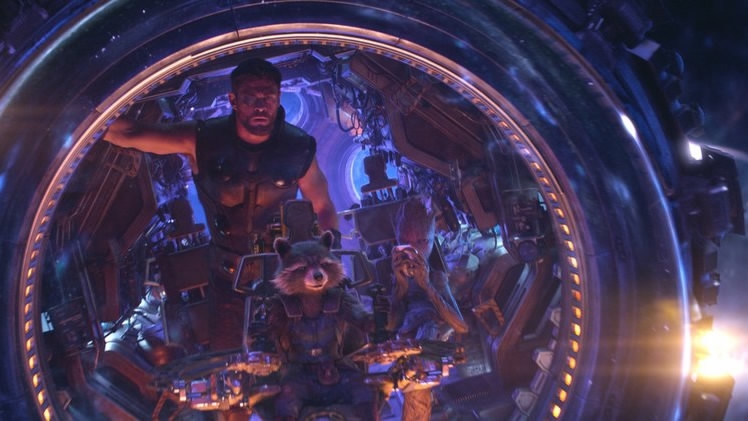
A still from "Avengers: Infinity War" /Photo via AP
A still from "Avengers: Infinity War" /Photo via AP
Earlier, “Infinity War” nabbed the fourth biggest preview gross ever, earning 95 million US dollars in 43 countries and regions ahead of its debut in North America.
It also set a new record for Marvel Studios as the superhero film scooped up 39 million US dollars in the US from Thursday-night previews.
It may be too early to predict the performance in China, but the previous installments provided a sneak peak. The first "Avengers" film grossed only 568 million yuan in 2012 but the second film rocketed to 1.46 billion yuan in 2015. Considering the growing number of screens in the Chinese market, industry insiders estimate the third one will surpass 2 billion yuan.
Strong IP power
“Infinity War” features some 20 superheroes from the Marvel Universe, including Iron Man (Robert Downey Jr.), Black Panther (Chadwick Boseman), Thor (Chris Hemsworth), Captain America (Chris Evans), Doctor Strange (Benedict Cumberbatch), Black Widow (Scarlett Johansson), Spider-Man (Tom Holland) and the Hulk (Mark Ruffalo) as they join forces with the Guardians of the Galaxy crew.
They are a tiny part of the 5,000 strong in the Marvel family.
Over the years, Marvel has built a gigantic universe for its superheroes who are inter-linked, which provides the studio an infinite source for business opportunities – ranging from comic books, TV, films to derivatives and intellectual property (IP) transactions.
The Marvel Universe has grown into a super IP brand recognized all around the world. Chinese entrepreneurs are not left behind. As early as 2015, Alibaba's movie platform and online store Tmall, authorized by the Disney company, partnered with 40 brands including Audi and Lego to produce limited products to lure the consumers.
The online-offline marketing strategy was the first of its kind in China, which taught Chinese filmmakers an important lesson. "The revenues of domestic films rely highly on the box office while other revenues such as IP transactions are little, which is a sharp contrast compared with foreign films," the China Business Herald reported citing an industry insider in 2015.
"Taking Hollywood for example, box office revenues contribute around 30 percent in the industry chain, while the other 70 percent comes from derivatives," the newspaper continued. "While in China, 90 to 95 percent of a film's revenue comes from box office."
China's box office fetched 55.9 billion yuan, a 13 percent increase from the previous year. Experts say the market for derivatives is huge, but the problem is how to unearth the potential.