
Opinion
08:14, 13-May-2019
Iran sanctions highlight world overreliance on dollars
 ["china"]
Share







Copied
Editor's Note: Adam Garrie is the director of the UK-based global policy and analysis think tank Eurasia Future and co-host of the talk show "The History Boys." The article reflects the author's opinion, and not necessarily the views of CGTN.
The vast majority of countries in the world want to preserve the 2015 Iran deal known as the Joint Comprehensive Plan of Action (JCPOA). This includes all of the parties to the deal except for the United States which last year unilaterally withdrew from the agreement.
The U.S. recently increased pressure on countries supporting the maintenance of the deal by withdrawing waivers which granted certain countries exemptions from so-called secondary sanctions as a penalty for continuing to purchase Iranian oil.
Now, Italy, Greece, Turkey, India, China, Japan and the Republic of Korea will theoretically face U.S. sanctions if they continue to buy energy from Iran. Additionally, the U.S. is now threatening secondary sanctions against countries buying other products from Iran, including Iranian iron, steel, copper and aluminum.
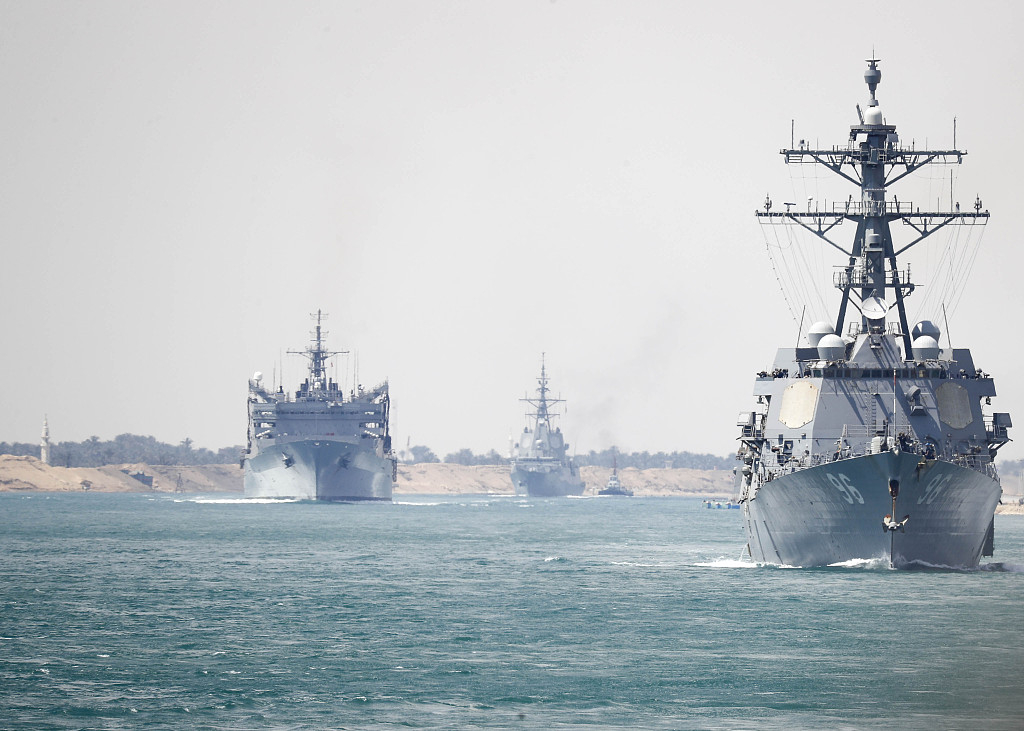
The Abraham Lincoln Carrier Strike Group transits the Suez Canal, May 9, 2019. /VCG Photo
The Abraham Lincoln Carrier Strike Group transits the Suez Canal, May 9, 2019. /VCG Photo
These unilateral moves by the U.S. have been condemned by the European Union, Turkey, China and Russia and have been deployed by Iran itself. The question now remains: What can the world do to preserve the deal?
There is no easy answer in the short term but in the long term, the difficulty arises from the world's continued reliance on the U.S. dollar as the international reserve currency and de facto currency of international commerce. Because the world is overly reliant on the dollar, the world is also overly reliant on U.S.-based financial institutions.
Because of this, the threat of so-called secondary sanctions from Washington goes far beyond restricting the sale of goods to and from a sanctioned country and the United States. Instead, such sanctions could severely restrict nations from engaging in international commerce with a multitude of nations, including nations that wish to mutually engage in commerce with one another on a voluntary basis.
The fact that any one nation holds the ability to control and therefore to quash international commerce in such a unilateral way should worry those who seek to preserve and expand upon a rules-based system of international commerce as opposed to one built on the hegemony of a single country.
The solution ultimately lies in creating an international reserve currency that is not directly tied to any single state. Such a concept long predates the current crisis regarding Iran.
During the 1944 negotiations which led to the creation of the Bretton Woods system, economist John Maynard Keynes proposed a super-national currency to be called Bancor which would become the world's new reserve currency and standard currency of international trade.
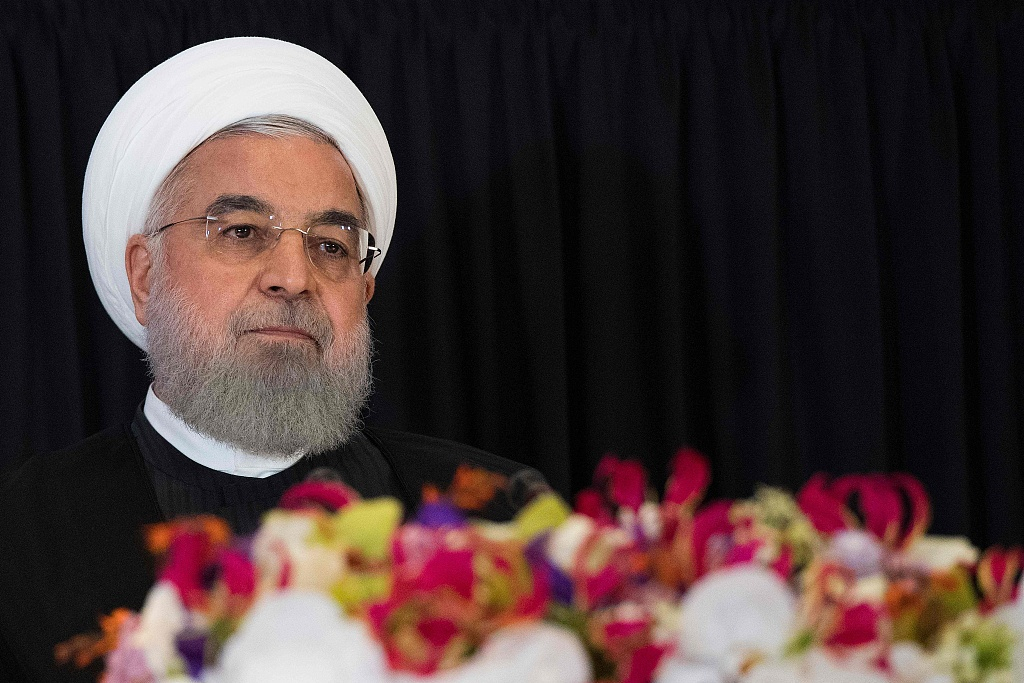
Iranian President Hassan Rouhani speaks during a press conference in New York, saying U.S. sanctions were "economic terrorism," as he sought to foster a united front from visiting regional officials on December 8, 2018. /VCG Photo
Iranian President Hassan Rouhani speaks during a press conference in New York, saying U.S. sanctions were "economic terrorism," as he sought to foster a united front from visiting regional officials on December 8, 2018. /VCG Photo
Keynes foresaw what would later be defined as the Triffin Dilemma. According to this Dilemma, in order for a single nation to supply the world with enough liquid currency to sustain healthy levels of trade, one's own reserves become depleted, thus leading to an inevitable balance of payments current account deficit. Even when the Triffin Dilemma led to the eventual collapse of Bretton Woods in 1971, the troubles were not over.
In 2009, Governor of the People's Bank of China Zhou Xiaochuan explained that even in a world of fiat currencies, the Triffin Dilemma still exists and pointed to this phenomenon as one of the major causes of the 2008 global recession.
But the other worry regarding a reserve currency unilaterally controlled by a single nation is that such a nation can exploit the rest of the world for political reasons through manipulating not only the value of the currency but manipulating access mechanisms to the currency. Zhou pointed this out just over 10 years before the current crisis in Iran which is a direct symptom of unilateral one-nation control over the world's reserve currency.
If a currency basket like Special Drawing Rights (SDRs), something akin to Bancor or a classical metallic standard existed, the U.S. threat of secondary sanctions would be far less impactful than it currently is. Under a de-centralized or multilateral international reserve currency, the most that the U.S. could do with secondary sanctions is prohibit one from trading goods with the U.S. It could not, however, prohibit financial transactions among other countries.
Such a system would give the world a great deal of leverage against Washington in scenarios such as that which has arisen over Iran. The unfortunate reality today, however, is that a de-centralized or multilateral reserve currency system is not in place and such things simply cannot be created instantly. It would take the better part of a decade even to switch over to an existing multilateral currency basket like the much neglected SDRs.
Keynes, Triffin and Zhou each understood the systematic flaws in allowing any one nation to control global finance by virtue of minting the international reserve currency. If their words are not heeded, more crises like that regarding the Iran deal will continue to spring up over the years.
(If you want to contribute and have specific expertise, please contact us at opinions@cgtn.com.)