
Opinion
15:44, 14-May-2019
No challenge can hold back China’s progress
 ["china"]
Share







Copied

Editor's note: This is an edited translation from an editorial originally published in Chinese by People's Daily on May 13.
China-U.S. trade friction has escalated again. The U.S. ignored China's sincere attitude and actions and raised the tariffs on Chinese goods exported to the U.S. and expanded the scope of goods subject to tariff hikes. China had no choice but to announce that it had to take necessary countermeasures.
The U.S. continues to launch trade offensives, which not only cost its own credibility but also seriously disrupted the China-U.S. economic and trade negotiation process.
However, regardless of the sincerity and actions of the Chinese side, the U.S. disregarded the principle of equality and mutual benefit, engaged in extreme pressure and hard bargain, and once again escalated trade friction between China and the United States, which cast a long shadow over China-U.S. economic and trade relations.
Unilateralism and hegemonism lead to nowhere
The unilateralism and hegemonic practices pursued by the United States lead to nowhere, only posing a serious negative impact on world economic growth and global trade.
As the main founder and participant of the global economic order and the multilateral trade system after the end of World War II, the United States should shoulder its due responsibilities, take the lead in complying with multilateral trade rules, and properly handle disputes with other members through the dispute settlement mechanisms within the framework of the WTO. This is also a clear promise made by the U.S. government to the international community.
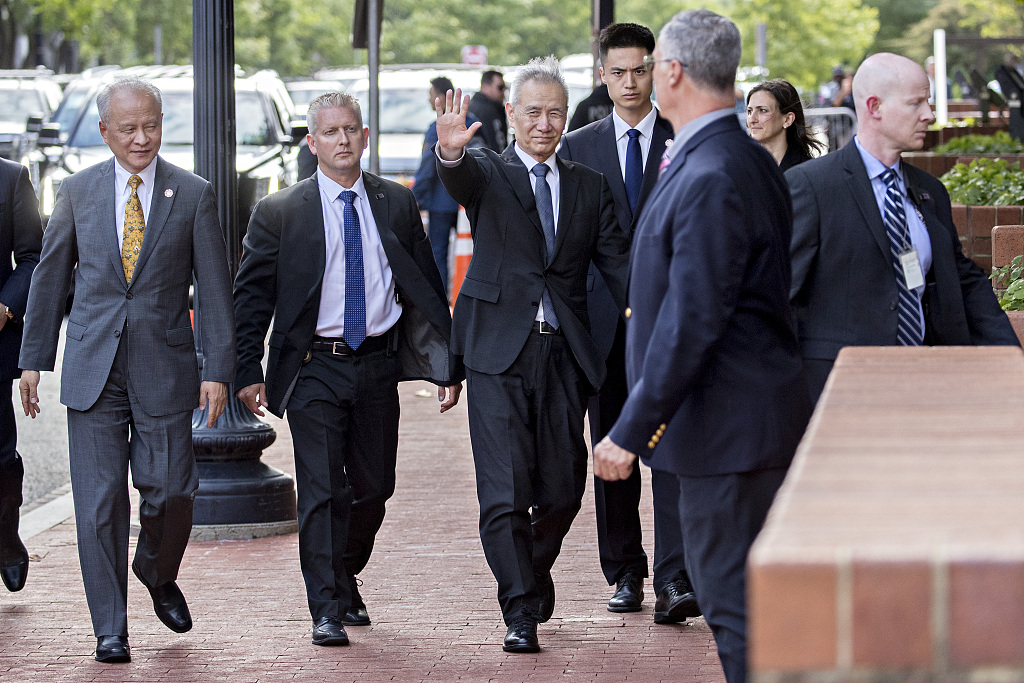
Liu He (C), China's vice premier, waves while arriving at the Office of the U.S. Trade Representative in Washington, D.C., on Thursday, May 9, 2019. /VCG Photo
Liu He (C), China's vice premier, waves while arriving at the Office of the U.S. Trade Representative in Washington, D.C., on Thursday, May 9, 2019. /VCG Photo
However, while enjoying the benefits brought by the global trade system, the current U.S. government unilaterally exaggerates its domestic problems and attributes them to other countries, politicizes economic and trade issues, pursues extreme pragmatism, and even openly violates the WTO rules, thus damaging its national image.
The sudden increase in tariffs imposed by the U.S. government will inevitably cause enormous harm to the United States itself. This is a consensus that has already been reached in American society. “It is my company, not China that has paid the 25 percent tariff. This is a tariff imposed on American consumers.” On American social media, there are many voices of opposition. Rick Helfenbein, president of the American Apparel and Footwear Association, said the additional tariffs would only hurt U.S. families, U.S. workers, U.S. companies and the U.S. economy.
American farmers have also been hit. In 2018, the net income from agriculture in the United States fell 12 percent. The prices of soybeans, pork, dairy products and wheat plummeted. While profits fell, equipment prices rose. Lowell Neitzel, a fourth-generation farmer of the Bismarck Farm in Kansas, said that the farm had been through “difficult economic times” since last year because of the tariff increase. He and other farmers were victims of the trade disputes. Grain farmer Jim Taphorn said, “We survived the difficult times of the 1970s and 1980s, but we can't survive now.” His family had to give up their farm after nearly 100 years of operation.

Chinese-made jackets are displayed for sale at a Manhattan department store on May 07, 2019 in New York City. /VCG Photo
Chinese-made jackets are displayed for sale at a Manhattan department store on May 07, 2019 in New York City. /VCG Photo
Not only that, the trade friction between the world's two largest economies has sparked international concerns about global economic growth. The International Monetary Fund, the World Bank and other institutions recently lowered their projection for global growth. Christine Lagarde, Managing Director of the International Monetary Fund, described the current economic weather as "unsettled" and regarded trade as "the biggest factor of uncertainty in the world." The WTO has lowered the growth forecast of global trade for 2019 from 3.7 percent to 2.6 percent, the lowest level in three years.
The trade war can't solve any problem, and the U.S. foolhardy behavior of protectionism has harmed the interests of its consumers, farmers, businesses and other groups and the global industrial chain. At present, the economic and political pressure on the United States is increasing, and it is difficult for the U.S. to bear the cost of further escalation of trade friction. International public opinion has it that the U.S. can only return to the negotiation table in the end and solve the problem through equal negotiation. This is the only right choice.
Cooperation is the best choice for both sides
To resolve China-U.S. trade frictions, China's position has always been clear: cooperation is the best choice for both sides. However, cooperation shall be based on principles and there shall be a limit for concessions. China will never develop itself at the expense of other countries' interests, nor will it give up its legitimate rights and interests for development. Over the past year or so since the China-U.S. trade friction occurred, its impact on China's economy has been under control in terms of macro-economy, corporate development and people's livelihood.
Long-term positive economic fundamentals provide the fundamental support for China's response to risks and challenges.
Since the beginning of this year, the main macroeconomic indicators have stayed within a reasonable range, and market confidence has improved significantly. In the first quarter, China's GDP grew 6.4 percent year on year, exceeding market expectations. At the end of March, the surveyed urban unemployment rate was 5.2 percent, so the employment situation was generally stable, and the quality of development was higher.
The impact of China-U.S. economic and trade issues on China's economic growth is limited. In recent years, thanks to the huge domestic market and consumption upgrade, domestic demand has become the main driver of China's economic growth, with consumption contributing 76.2 percent of economic growth last year. The impact of fluctuations in China-U.S. economic and trade relations is also limited.
Common prosperity is good for both countries
The common interests between China and the United States outweigh the differences. Prejudice cannot be allowed to fuel misjudgment about the general trend of China-U.S. relations in the future.

On day 18 of the partial government shutdown, fourth generation crop farmer John Boyd, and president of the Black Farmers' Association, plants winter wheat in one of his fields in Baskerville, Virginia on Tuesday, January 8, 2019. /VCG Photo
On day 18 of the partial government shutdown, fourth generation crop farmer John Boyd, and president of the Black Farmers' Association, plants winter wheat in one of his fields in Baskerville, Virginia on Tuesday, January 8, 2019. /VCG Photo
From a historical perspective, every major breakthrough in China-U.S. economic and trade relations has pushed bilateral relations to a new level in the past 40 years. Today, despite the changes to their domestic situations and the world, the two sides should stay calm, not be confused or wrongfooted by what's going on.
Judging from the actual needs, today China and the United States have become each other's largest trade partner and important investment destination. Between the two countries, a flight takes off and lands every 17 minutes, and more than 14,000 people travel between the two coasts of the Pacific every day. The annual bilateral trade volume of goods has increased from less than 2.5 billion to 630 billion U.S.dollars. The interests in bilateral economic and trade cooperation continue to expand, giving rise to a situation where each country has a stake in the other's success. The people of the two countries have continuously deepened their understanding of each other and benefited from it.
The China-U.S. economic and trade exchanges are large in scale, rich in content, wide in scope and diverse in stakeholders. Some contradictions and differences are inevitable. However, the interests of China and the United States are deeply intertwined and their markets can complement each other. The economic and trade cooperation between the two countries is essentially mutually beneficial. Only when a holistic view is taken on the bilateral relations and commitments are made in safeguarding the strategic interests of the two countries and the international order can we properly handle differences and resolve conflicts in a pragmatic manner.
From the perspective of people-to-people exchange, the friendship between the two peoples has always been the source of new development of China-U.S. relations. The story of "Ping-Pong Diplomacy" is widely spread among the people of the two countries. Disneyland opens in Shanghai; McDonald's, KFC and Starbucks are all over China's urban and rural areas. Over the past 40 years, China-U.S. people-to-people exchange has become increasingly frequent, involving many fields such as economy and trade, law, education sports, etc.
History tells us that a prosperous China is good for the United States, and a prosperous United States is also good for China. China has no intention to change the United States or replace it. The United States cannot control China, let alone contain it. How China and the United States see each other's strategic intentions will directly determine what policies they adopt and what relations they develop. The two countries cannot afford to make mistakes on this fundamental issue, or the two would risk being caught in a death spiral of confrontation.
(If you want to contribute and have specific expertise, please contact us at opinions@cgtn.com.)