
World
13:14, 14-Jun-2018
Macedonia president slams 'shameful' name deal with Greece
 ["europe"]
Share







Copied
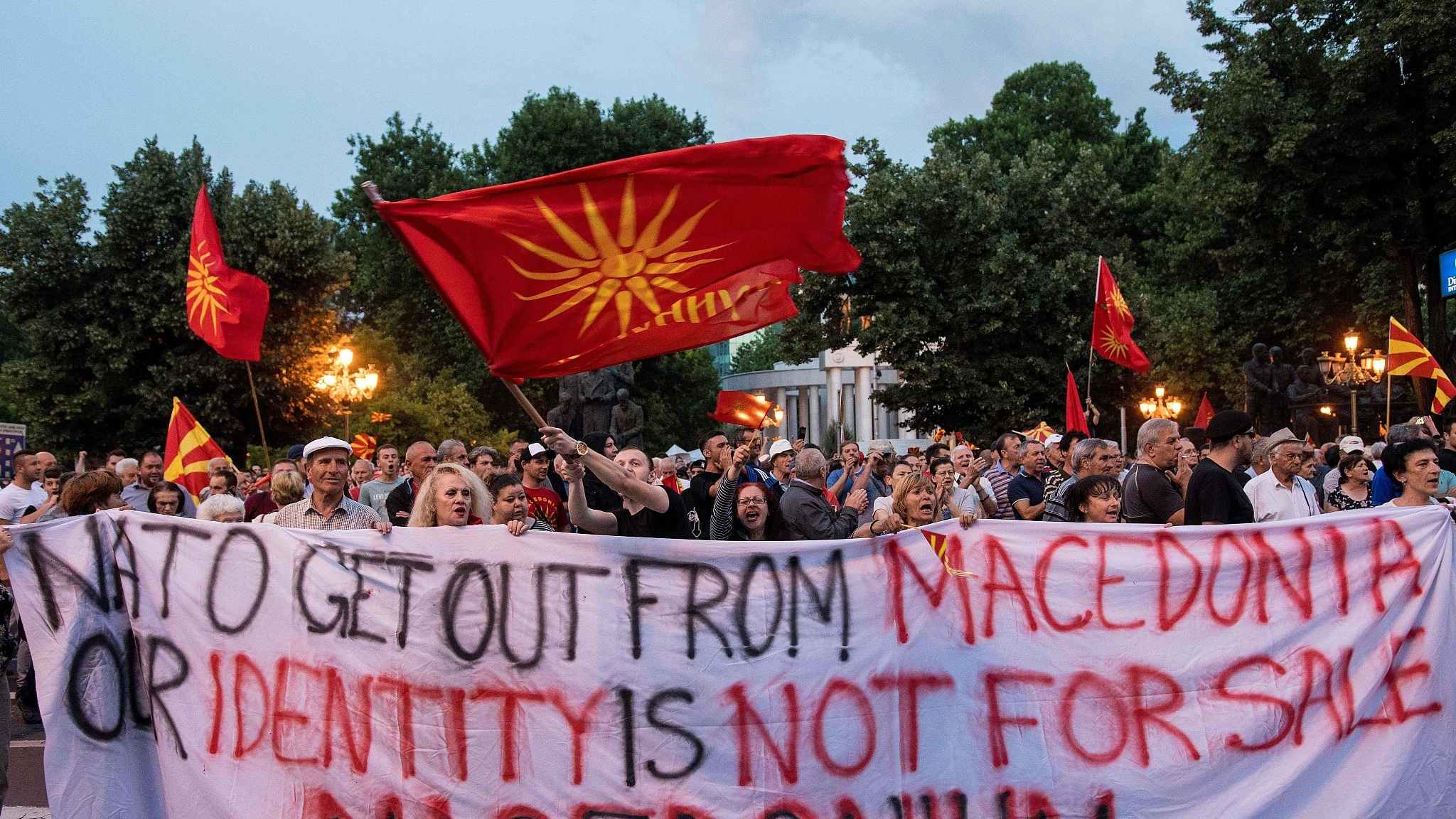
Macedonia’s President Gjorge Ivanov said Wednesday he will not sign a deal struck by his prime minister and Greece to end a long-standing dispute over his country’s name, highlighting the obstacles the agreement still faces before it becomes final.
Macedonian Prime Minister Zoran Zaev and his Greek counterpart Alexis Tsipras on Tuesday announced they had reached a "historic" accord for the country to be renamed Republic of North Macedonia.
The name dispute, going back 27 years to Macedonia’s independence from the former Yugoslavia, has seen Athens block Skopje’s efforts to join the European Union and the NATO military alliance.
00:43
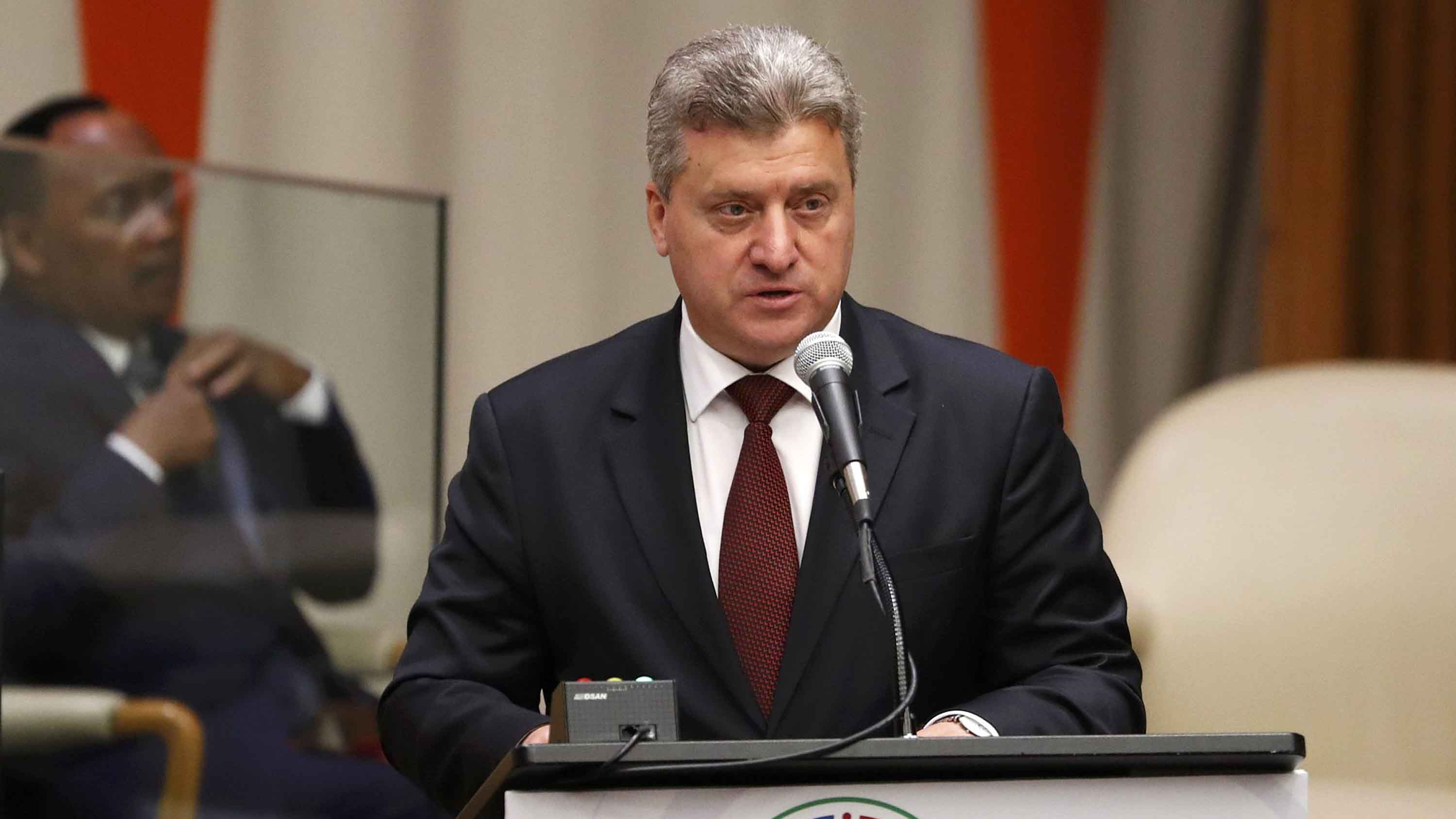
Ivanov on Wednesday however rejected the deal and stormed out of a meeting with Zaev and Foreign Minister Nikola Dimitrov.
"Such a harmful agreement, which is unique in the history of mankind is shameful and unacceptable for me," he said in a TV address afterwards.
"European Union and NATO membership cannot be an excuse to sign such a bad agreement which has unforeseeable damaging consequences for state and national interests of the Republic of Macedonia."
"My position is final and I will not yield to any pressure, blackmail or threats. I will not support or sign such a damaging agreement," he concluded.
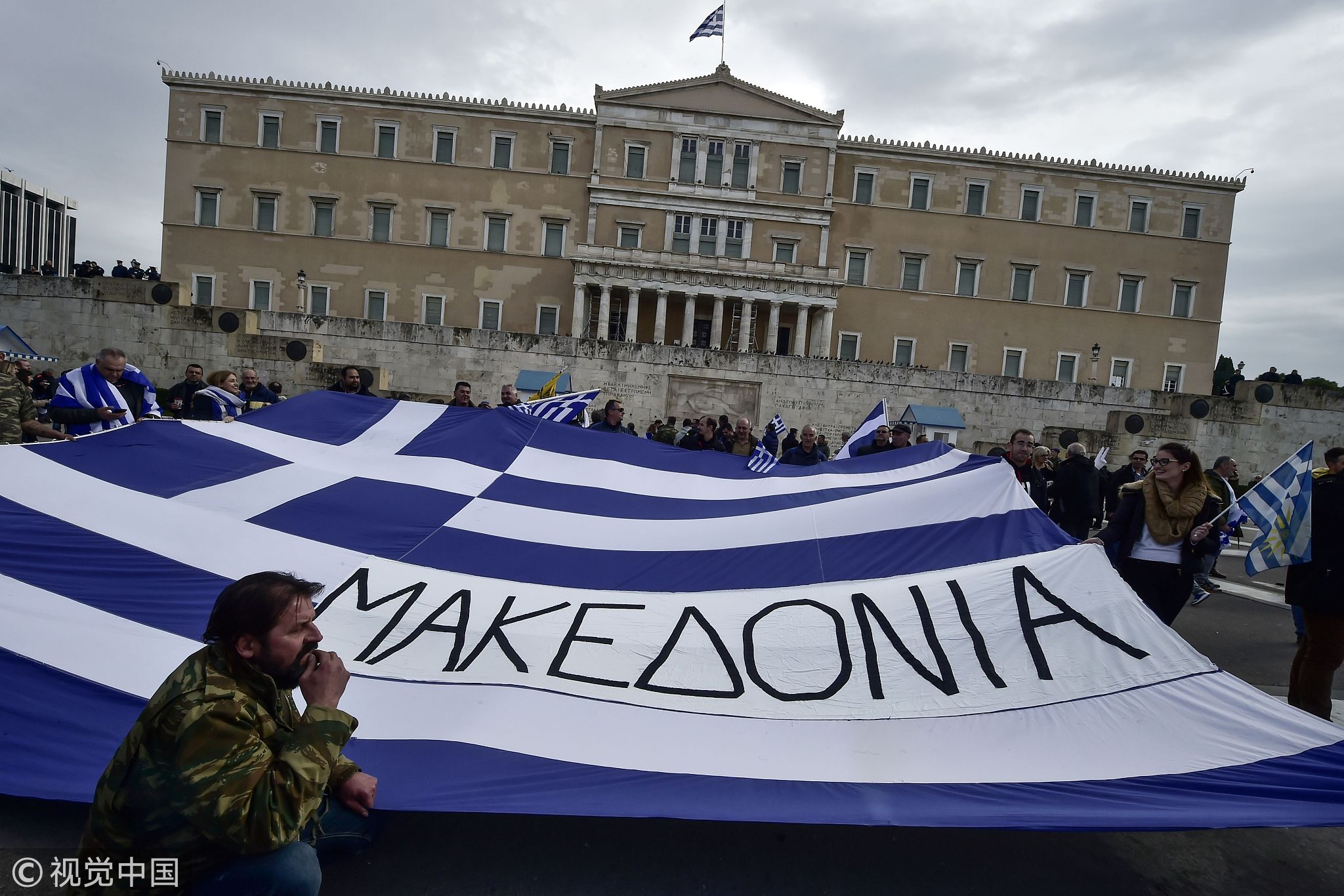
People hold a huge Greek flag reading "Macedonia" ahead of a demonstration at Syntagma Square in Athens, Greece, February 4, 2018 /VCG Photo
People hold a huge Greek flag reading "Macedonia" ahead of a demonstration at Syntagma Square in Athens, Greece, February 4, 2018 /VCG Photo
Ivanov’s comments were an indication of the uphill battle the deal still faces before it is finalized.
Greece and Macedonia’s foreign ministers are due to sign the accord over the weekend but it must then be ratified by both parliaments, as well as survive a referendum in Macedonia.
In order to get the required two-thirds parliamentary majority, Macedonia's center-left government will need the support of the nationalist opposition VMRO-DPMNE, which is strongly opposed to the deal.
Once approved, Ivanov can still veto it and send it back to parliament. If however it is approved a second time, Ivanov must sign it.
On the Greek side, the deal is expected to secure parliamentary approval more easily.
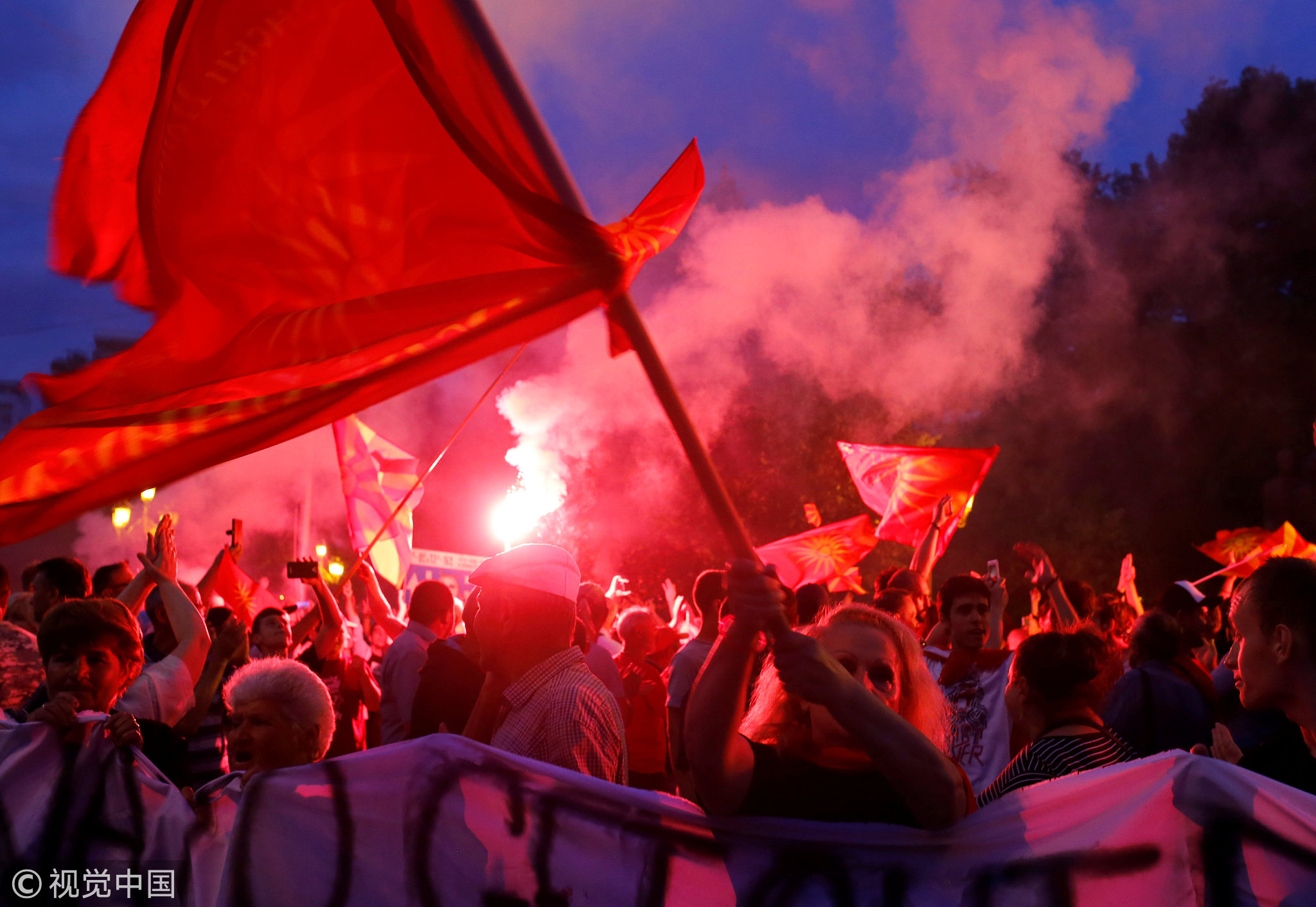
Protestors wave flags and flares during a rally against changing the country's constitutional name in front of the parliament building in Skopje, Macedonia, June 13, 2018. /VCG Photo
Protestors wave flags and flares during a rally against changing the country's constitutional name in front of the parliament building in Skopje, Macedonia, June 13, 2018. /VCG Photo
The Macedonian president was not the only one to express his displeasure at the deal.
On Wednesday evening, some 2,000 protesters rallied in central Skopje in support of Ivanov's comments. Many deplored that Skopje had made too many concessions to reach a resolution.
The VMRO-DPMNE meanwhile condemned the deal as "an absolute defeat of Macedonian diplomacy in every possible way."
Over the border in Greece, the main opposition party, New Democracy, was even threatening to file a motion of no-confidence against Tsipras’s government on Thursday over the Macedonia deal, Reuters reported.
Protests against the deal were also planned in front of the parliament in Athens on Friday and Saturday.

A woman passes in front of a graffiti with an old map of Macedonia referring to the long-running name row with neighboring Greece, in Skopje, June 13, 2018. /VCG Photo
A woman passes in front of a graffiti with an old map of Macedonia referring to the long-running name row with neighboring Greece, in Skopje, June 13, 2018. /VCG Photo
The dispute originated over Skopje’s use of the name "Republic of Macedonia" when it declared independence in 1991.
Macedonia is also the name of a northern Greek province and Athens feared its northern neighbor could lay territorial claims to its own region, as well as to its heritage: the region was the cradle of Alexander the Great’s empire, a fact that modern-day Greeks are still very proud of.
As a compromise, international organizations like the UN have used the name "Former Yugoslav Republic of Macedonia" or FYROM.
The deal between Tsipras and Zaev comes ahead of an EU meeting later this month and a NATO summit in July.
Skopje is hoping that with the name dispute settled, it will be invited to join NATO and be able to formally start EU accession talks soon.
7532km