
02:55, 20-Aug-2017
Unit 731 War Crimes: China reveals new evidence of Japan's germ war atrocities
 []
[]
Share







Copied
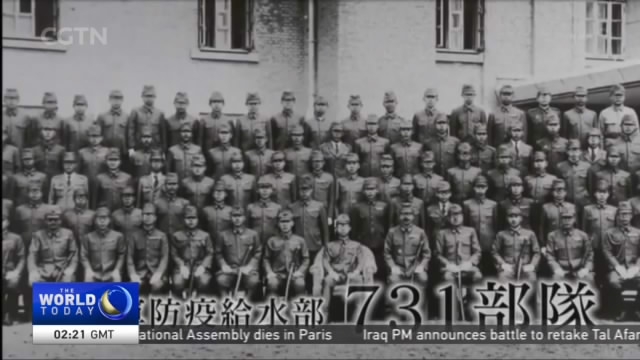
Fresh evidence has been released of human experiments and war crimes carried out by Japan's notorious Unit 731 in the Chinese city of Harbin during the second world war. It verified many details about the camp's horrors that were depicted in a recent documentary aired in Japan. Jiang Shaoyi has more.
KAWASHIMA KIYOSHI FORMER CHIEF OF UNIT 731 " Is it true or not that nobody could walk out of your jail alive?" "Yes, that's right." A living hell in which no-one was supposed to walk out alive, and its grim story is only now coming to light. A recent documentary, produced by Japan's national broadcaster NHK, caused shockwaves across the region, as it exposed the inhumane experiments and germ war crimes conducted in a top-secret Japanese warfare research base during the second world war.
Unit 731 was set up in the northeast China's city of Harbin in 1935 and, more than 80 years later, evidence of these atrocities has been released by a museum in the city. It includes images of the unit, written confessions of germ war criminals, a transportation record of human experiments, and an incubator for producing plague bacillus.
The evidence essentially verifies the confession of a germ war criminal in the documentary. TOSHIHIDE NISHI MEDICAL OFFICER OF UNIT 731 "We had a room to conduct experiments on plague bacillus. Four or five people were kept in the room, and we spread plague bacillus infected fleas around the room. All of them were infected after that experiment."
The evidence also verified the confessions of a criminal that there was a culture room that could produce 10 kilograms of germs in 12 or 24 hours, using four incubators. More than three-thousand people were killed in various human experiments by the unit. Some of them were children.
The documentary sparked heated discussion on Chinese social media. Many spoke highly of the documentary which faced up to history, while calling NHK a media agency with a conscience. And in Japan, there were many who were also overcome by the documentary's revelations.
TOTSUKA SHINYA FORMER MEMBER OF PARLIAMENT "For years, there was very little coverage in the Japanese media about Unit 731. And the recent situation in Japan is raising concerns about whether war will break out again. So it is very courageous of NHK to broadcast this documentary at this time."
KEIICHILO ICHINOSE LAWYER "I hope this documentary can prompt authorities, like the Japanese Defense ministry, to take their first step into investigating what the unit did. This is an obligation of the Japanese government, to let people know about the history and admit the fact of the invasion. As the perpetrator of the war, Japan should apologise to the victims."
After Japan's defeat in 1945, the unit hastily pulled out of China, leaving some 3-thousand children and experimental equipment behind. Many of the Japanese children were then raised by Chinese families. JIANG SHAOYI CGTN.