
Opinions
21:26, 10-May-2018
Opinion: Will Beijing-Tokyo rapprochement be a flash in the pan, again?
 ["other","Asia"]
Share







Copied

I still remember the audience quietly sobbing while watching Stand by Me Doraemon in the dark movie theater. The famous kids’ film has garnered numerous adult fans, many of whom quickly flocked to cinemas across China in early summer of 2015, to relive childhood memories of the chubby robot from the future.
The film quickly toppled the weekly box office records and became the highest-grossing animation of the year in Chinese mainland with a staggering box office revenue of around 530 million yuan.
The film broke a three-year Chinese embargo on imports of Japanese movies since September 2012, when Tokyo’s declaration of nationalizing the Diaoyu Islands once again plunged bilateral ties into an extended stalemate. Many pinned hopes on the omnipotent cat to mitigate the frosty Beijing-Tokyo ties.
Expectedly, months later, China, Japan and the Republic of Korea (ROK) held the sixth trilateral summit in November after a three-year hiatus. The hard-won meeting was hailed as an ice-breaking diplomatic move that signaled a full resumption of bilateral and multilateral cooperation. Beijing and Tokyo also witnessed increasing interactions.
But good times faded quickly – given a stack of differences, including historical leftovers and perennial territorial disputes, the three-way summit was stalled once again. Japan’s relations with either China or the ROK that had recovered on a fragile basis, quickly cooled down.
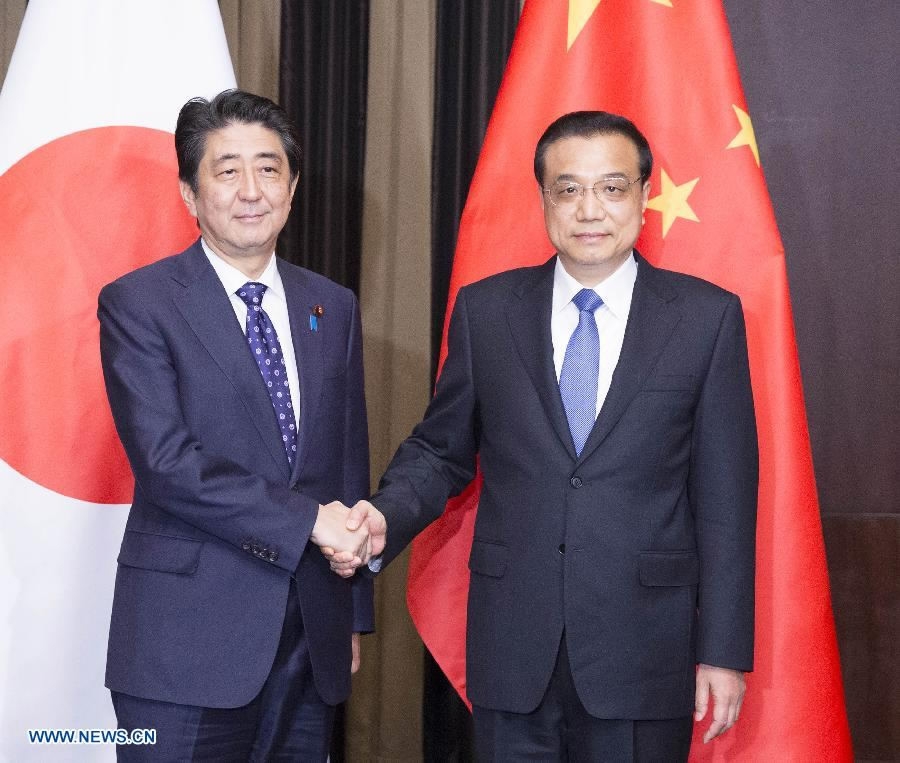
November 1, 2015: Chinese Premier Li Keqiang (R) meets with Japanese Prime Minister Shinzo Abe in the ROK capital of Seoul. /Xinhua Photo
November 1, 2015: Chinese Premier Li Keqiang (R) meets with Japanese Prime Minister Shinzo Abe in the ROK capital of Seoul. /Xinhua Photo
This time, the diplomatic impasse lasted for two-and-a-half years till this May when the seventh summit ultimately arrived.
The meeting in Tokyo was, once again, cheered by the public as the herald of a diplomatic thaw in East Asia. In particular, it’s the first time that a Chinese premier has visited Japan in eight years.
Apart from securing a host of substantive cooperation pacts with Japanese Prime Minister Shinzo Abe at a bilateral summit, Chinese Premier Li Keqiang met with Emperor Akihito on Thursday before his trip to Hokkaido.
What accompanies the beaming engagement, however, are deep concerns about how long it will persist given the ups and downs in China-Japan relations over the past decades.
Actually, the worry is fully grounded because there has been no signal of any change in their fundamental positions regarding historical and territorial contentions.
But the high-level meeting this time came against an unprecedented, unanticipated backdrop, which created mature conditions for a rapprochement.
The much-blighted Korean Peninsula is seeing a rosy dawn as Pyongyang proactively seeks peace with regional stakeholders. Democratic People’s Republic of Korea leader Kim Jong Un has met Chinese President Xi Jinping twice within 42 days, held a landmark summit with ROK President Moon Jae-in and is expected to meet US President Donald Trump early next month.
Abe longs to have a say on the Korean Peninsula, and by presenting a united front on the peninsular conundrum, he has contributed to the peacebuilding process in East Asia.
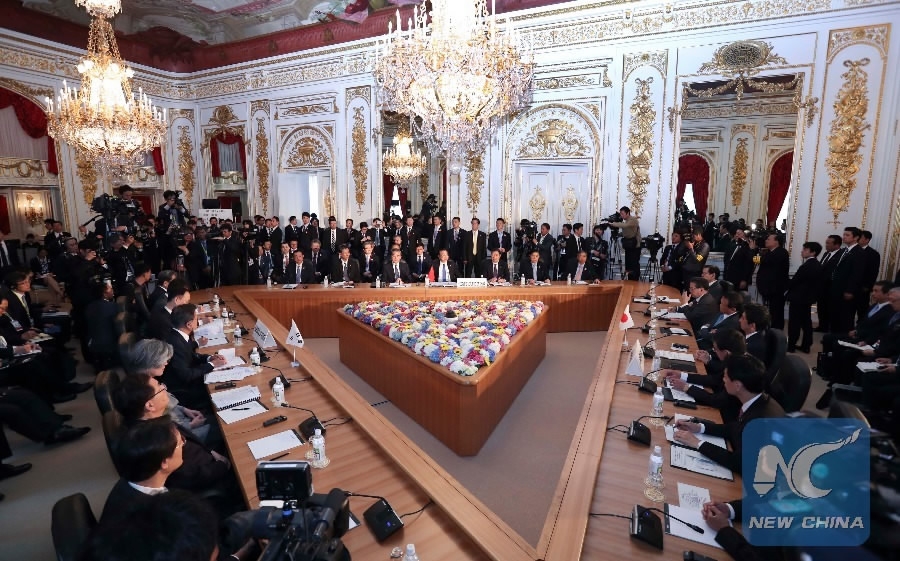
Chinese Premier Li Keqiang, Japanese Prime Minister Shinzo Abe and ROK President Moon Jae-in attend the 7th China-Japan-ROK leaders' meeting in Tokyo, Japan, May 9, 2018. /Xinhua Photo
Chinese Premier Li Keqiang, Japanese Prime Minister Shinzo Abe and ROK President Moon Jae-in attend the 7th China-Japan-ROK leaders' meeting in Tokyo, Japan, May 9, 2018. /Xinhua Photo
Trump’s economic pressure on Japan also drove Abe to turn to China for business cooperation.
It’s noted that Tokyo, unlike other Asian allies of the US, did not survive Trump’s steel and aluminum tariffs. Spurned by a unilateralist Trump, Abe betrays anxiety to seek in-depth cooperation with China – its largest trading partner since 2009.
“Japan is not that type of country who will put all eggs in one basket,” said Li Ruoyu, associate professor at the School of History and Culture, Sichuan University in southwest China.
After all, Japan has been on alert since the lost decade resulting from the 1985 Plaza Accord.
What’s more, engaging Beijing is a “rigid demand” for Japan, Li noted, as China ushers in Xi Jinping’s new era and the world’s biggest power is risking upending globalization.
The Japan trip by Premier Li and economic officials marked several “firsts” – the first time for a Chinese leader to publish an article on a mainstream Japanese media outlet as the premier did so on Asahi Shimbun; the first time that China agreed to grant Japan investment quota to purchase Chinese assets; the first time the two sides are set to clinch a currency swap accord and set up a mechanism to further cooperation in third-party markets; and the first time they will join hands to establish an air and maritime mechanism over the East China Sea.
These positives show that Beijing and Tokyo are sincerely making headway to prosper from their ties.
The highly-anticipated diplomatic breakthrough has stolen the show on the world stage, just like the cuddly Doraemon did that summer three years ago. Even though their relations cannot dispense with complicated underlying political divergences, it’s believed they can manage to go beyond politics with good faith, as the famous blue cat shows.
(The author is a reporter for CGTN Digital.)