
Tech & Sci
19:23, 15-Aug-2018
Scientists solve age-old spaghetti riddle with a twist
Updated
18:47, 18-Aug-2018
 ["north america"]
Share







Copied

The spaghetti riddle has been finally solved with a "bend and a twist."
The challenge of breaking uncooked spaghetti noodles into two pieces had given many physicists sleepless nights for years. When bent at both ends, a pasta string always snaps into three or more pieces, but never into two.
The mystery even baffled Nobel Prize laureate Richard Feynman, who is known for his pioneering work in modern Quantum Physics. The celebrated physicist reportedly spent hours every evening to postulate a theory to explain the phenomenon.
The experiments remained inconclusive for years, until a team of French physicists in 2005 was able to come up with a workable theory behind the noodle’s fragmentation.
The research titled “Fragmentation of Rods by Cascading Cracks: Why Spaghetti Does Not Break in Half” won lg Nobel Prize, a parody Nobel Prize awarded to recognize trivial scientific achievements. The theory explained why a spaghetti stick breaks into three or more pieces, but the question "Can it be split into two sections?" remains unanswered.
On Tuesday, Massachusetts Institute of Technology (MIT) announced that they have found the perfect way to break uncooked spaghetti strings in two. In a paper published in the Proceedings of the National Academy of Sciences, researchers demonstrated a way to break spaghetti in two by both bending and twisting the dry noodles.
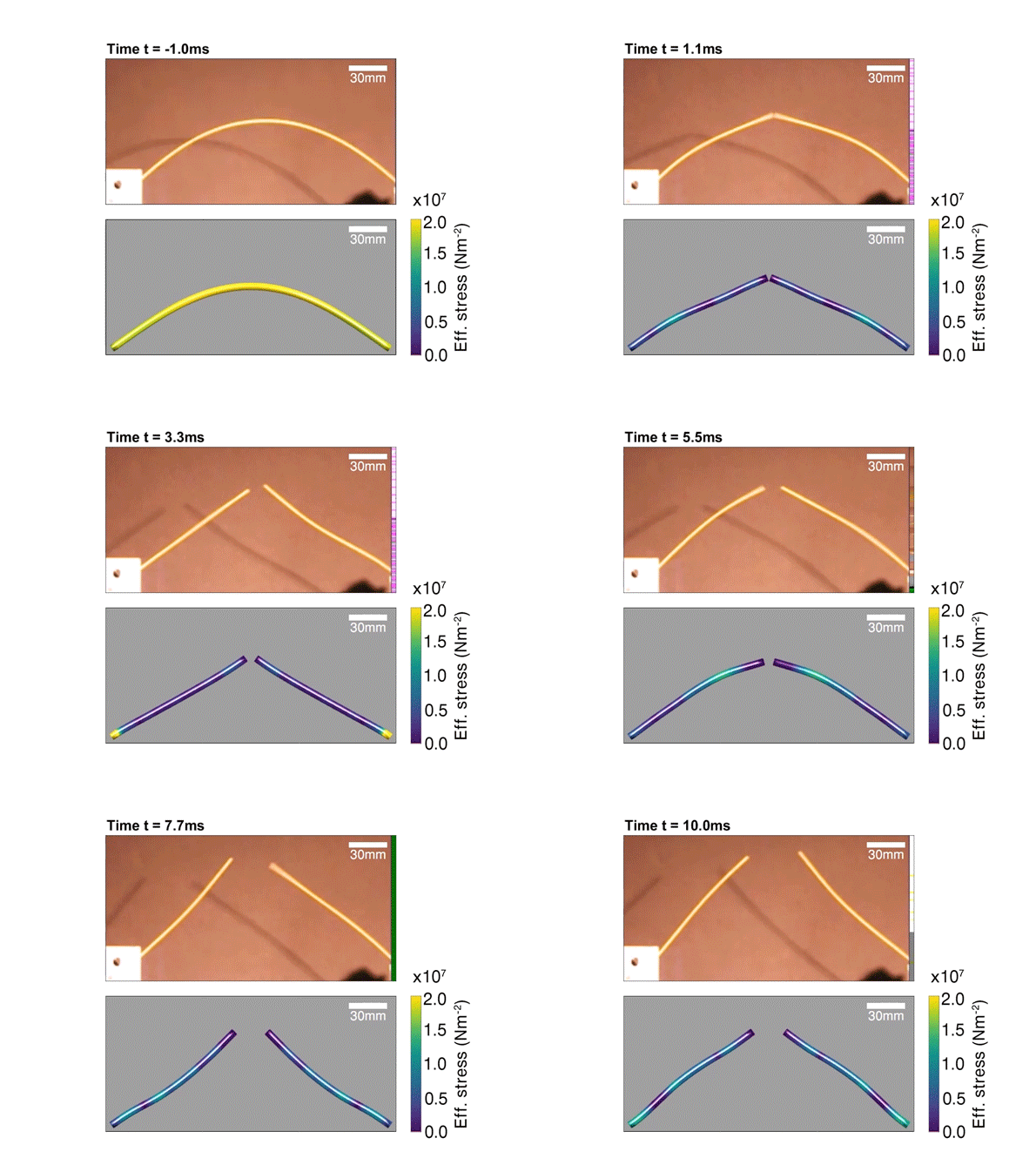
Experiments (above) and simulations (below) show how dry spaghetti can be broken into two fragments, by twisting and bending. /MIT Graphics
Experiments (above) and simulations (below) show how dry spaghetti can be broken into two fragments, by twisting and bending. /MIT Graphics
The breakthrough comes after Ronald Heisser and Vishal Patil, mathematics students at MIT, carried out hundreds of experiments to crack the spaghetti mystery.
"They carried out experiments with hundreds of spaghetti sticks, bending and twisting them with an apparatus they built specifically for the task," MIT maintained in a press statement.
"The team found that if a stick is twisted past a certain critical degree, then slowly bent in half, it will, against all the odds, break in two."
Researchers developed a device to bend and twist hundreds of spaghetti sticks. The process of noodle breaking was recorded with a camera, at up to a million frames per second. "In the end, they found that by first twisting the spaghetti at almost 360 degrees, and then slowly bringing the two clamps together to bend it, the stick snapped exactly in two," the MIT release said.
The findings were consistent across two types of spaghetti: Barilla No. 5 and Barilla No. 7, which have slightly different diameters. Jörn Dunkel, co-author of the study pointed out it would be interesting to see whether and how twisting could similarly be used to control the fracture dynamics of two-dimensional and three-dimensional materials.
"In any case, this has been a fun interdisciplinary project started and carried out by two brilliant and persistent students — who probably don’t want to see, break, or eat spaghetti for a while."