
Opinions
23:06, 11-Jul-2018
Opinion: NATO 2018: A living dead?
Updated
22:24, 14-Jul-2018
 ["china"]
Share







Copied
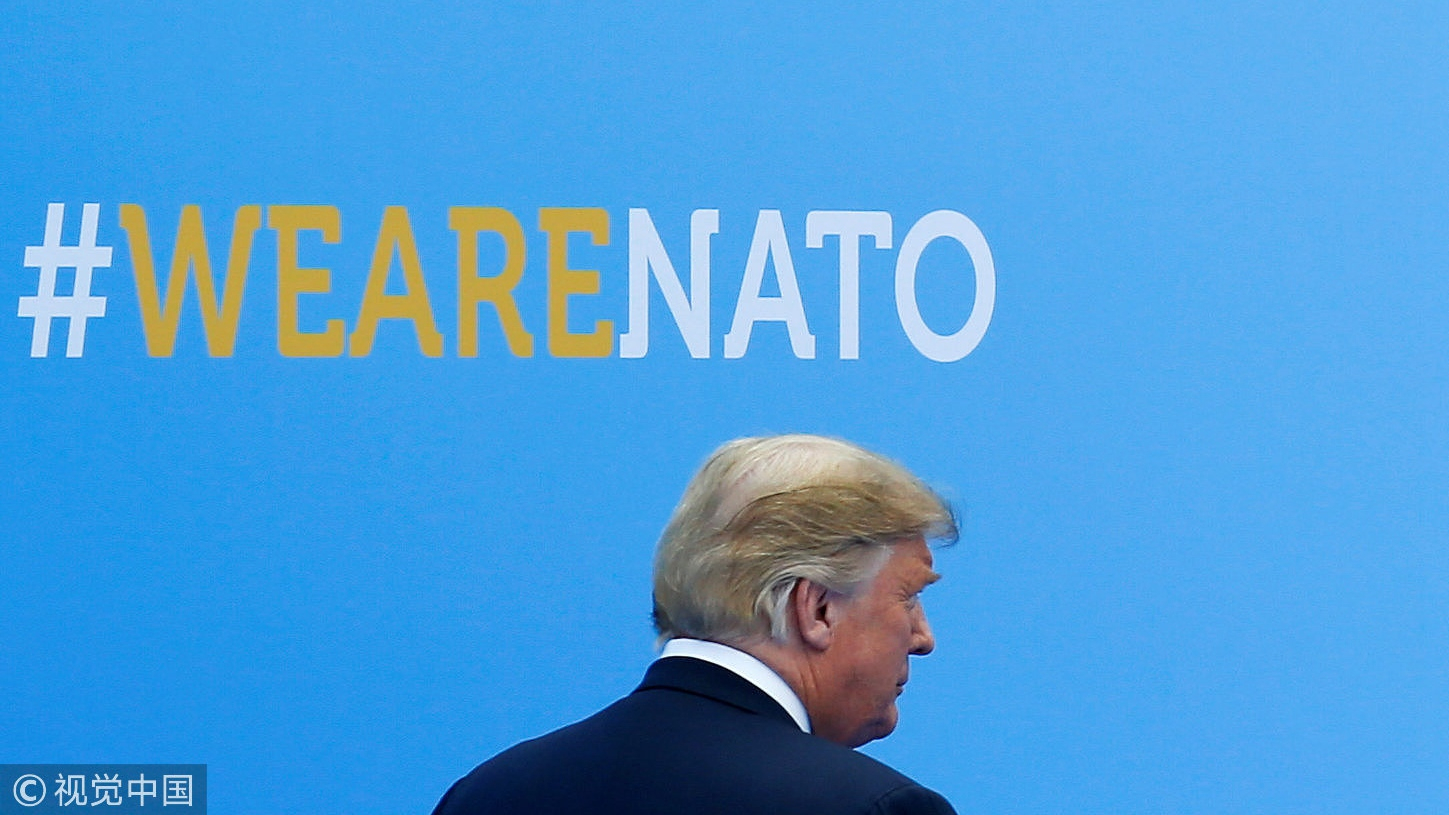
Editor's note: Biljana Vankovska is a professor of IR and Peace Studies at the Faculty of Philosophy at Ss. Cyril and Methodius University in Skopje, the Republic of Macedonia. The article reflects the author’s opinions, and not necessarily those of CGTN.
With President Trump and other countries' leaders gathering at Brussels, the two-day NATO summit has officially unveiled.
Ever since the end of the (First) Cold War, NATO has been searching for a reason d’etre. The search is not over yet although it gets apparently an unexpected twist.
The Second Cold War is already here (understandably in a rather altered international setting), but the Alliance is hardly ‘rallied around the flag’ to confront the common ‘enemy.’ Namely, the member-states have different interests and attitudes vis-à-vis Russia (for instance Germany vs. the Baltic states).
The NATO summit takes place under an atmosphere of a trade war between the US and Europe. Vassilis Fouskas is rightly arguing that the conflicts inside NATO are not due to a lack of EU military spending. In fact, the only thing the NATO imperialists agree on is that hundreds of billions of euros should be taken away from budgets allocated for welfare spending.
Neo-liberalism now creeps into defense and security matters more naturally than before because of the altered international system. The US remains the key pillar of NATO, but under Trump, things are getting blurred because, for the first time, the economic and security concerns are not as compartmentalized as they used to be with decades.
The game is now about the economic interests (mostly, the American ones) with regard to Africa, and maybe primarily China. The quarrel over the money in NATO is just a reflection of other deeper developments that do not have much to do with the NATO primary mission.
Trump's doctrine (if it can be named doctrine at all) is named ‘unileadersm’ (to quote John Feffer). It practically proves that “America First” means that if the US is to have allies, they must play a role as vassal states.
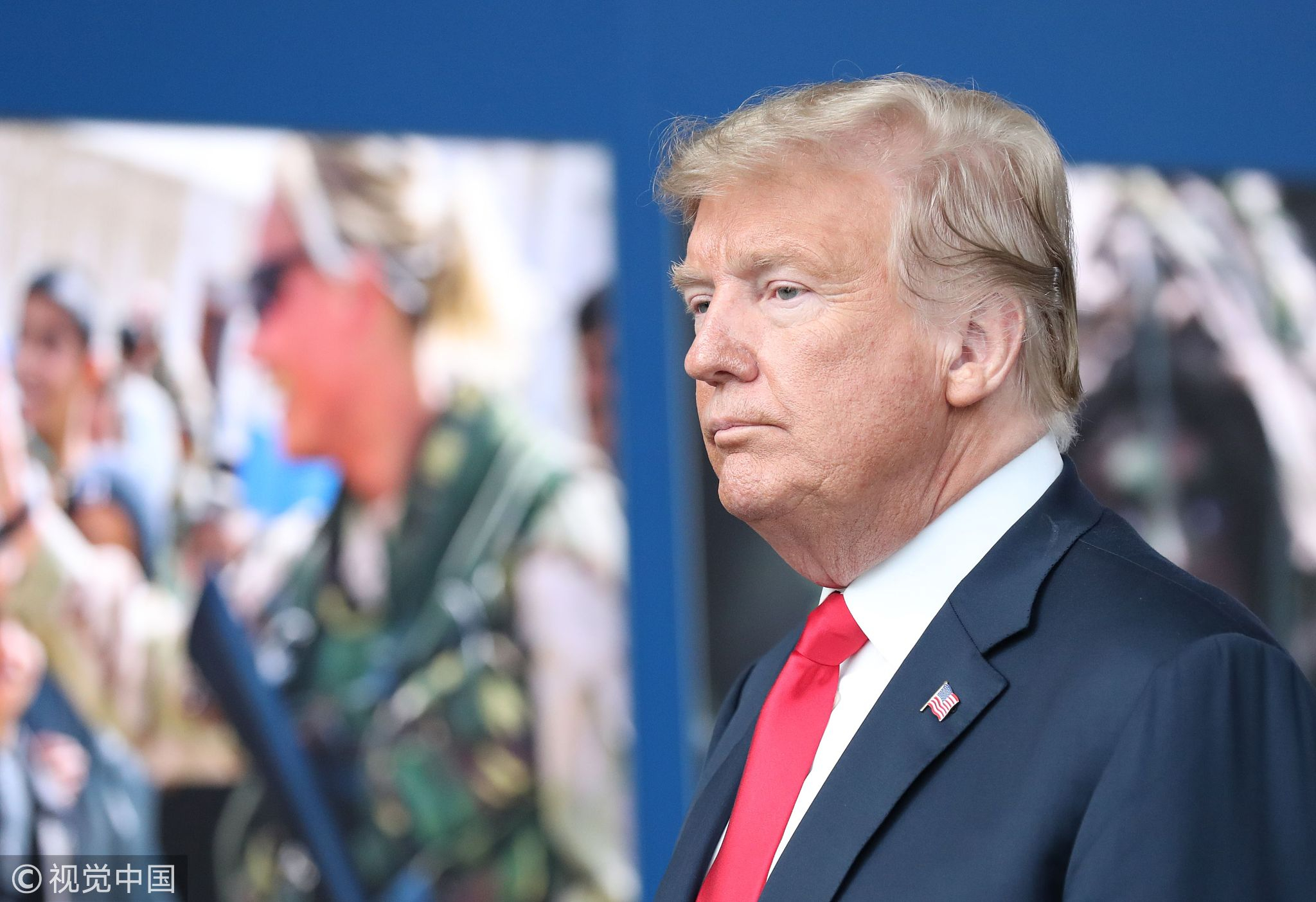
July 11, 2018: US President Donald Trump arrives for the NATO (North Atlantic Treaty Organization) summit, at the NATO headquarters in Brussels. / VCG Photo
July 11, 2018: US President Donald Trump arrives for the NATO (North Atlantic Treaty Organization) summit, at the NATO headquarters in Brussels. / VCG Photo
It does not call for a prophet to tell that Trump seems to be itching to get into a new round of the fight with the European allies. His grand policy (to make America great again) calls for disciplinary measures and scolding of the undisciplined protégées, especially with regard to the military spending.
No matter what the official summit agenda is, NATO’s challenges are specific: the leader is distrustful and disrespectful towards the allies and is ready to extort as many funds as possible for no clear goal (with an aim to undermine Europe’s economic and political independence).
The (old) Europeans are rightly asking: why should they buy more weapons rather than butter? To the contrary, the new Europeans (former Eastern countries) shows that NATO is not all about (military) security, but instead about (real or imagined) fears.
Turkey’s close ties and Germany’s economic/energy interests with Russia only add to these divisions. Just a few weak and impoverished states (such as Georgia and the Republic of Macedonia) are eager and hope to join the club no matter what costs because they have economic or political ‘strategy’ of vassals.
Very few pose the obvious question: if the Alliance is genuinely efficient (i.e., spreads peace and security), why should its financial expenditures grow so much? Who is the enemy, and why it has not been kept under control?
Whatever is the outcome, one thing is sure: the global military-industrial complex is well-alive, and the global militarization won’t stop any time soon. Parallel to that, one may expect to worsen of the economic war across the globe.
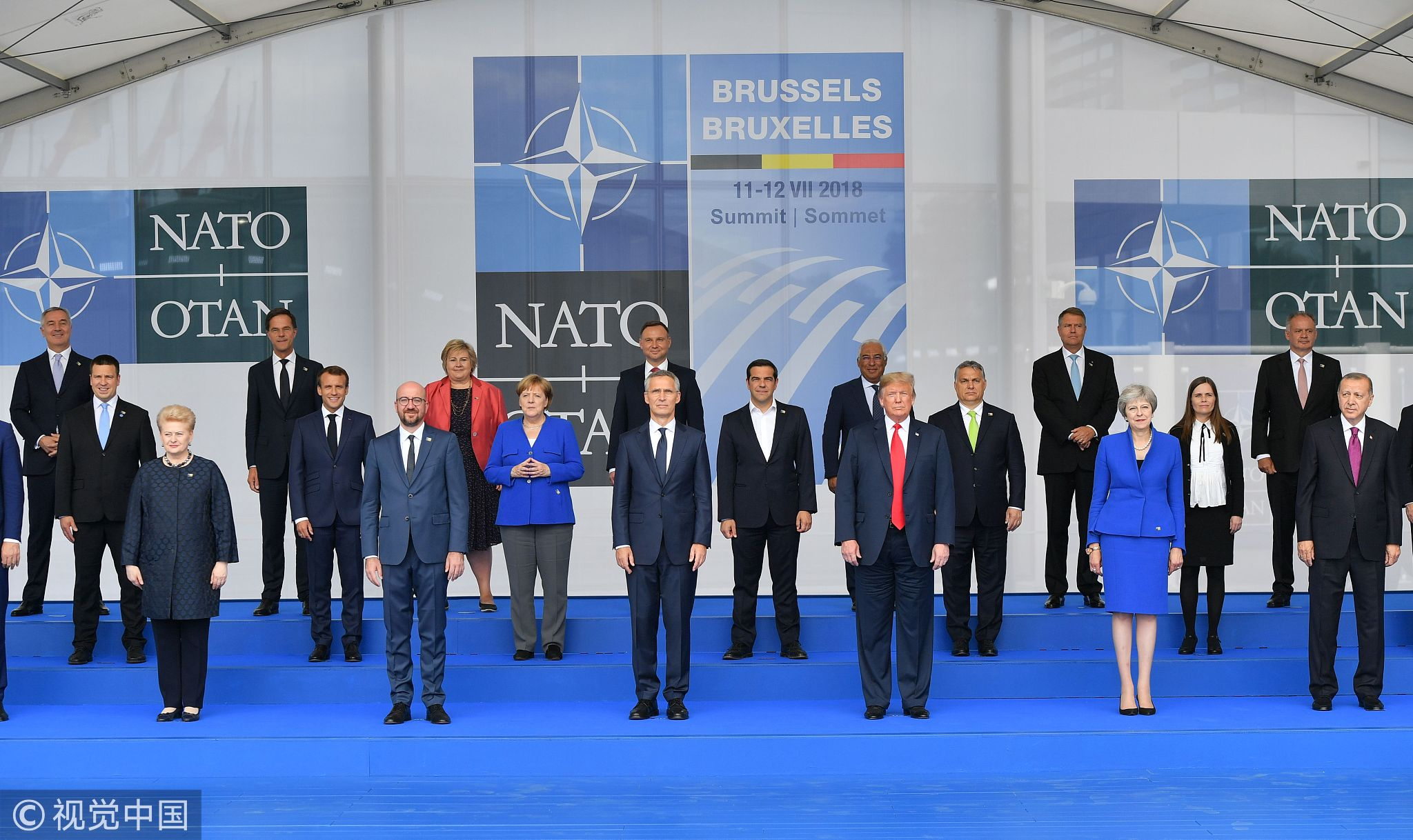
July 11, 2018: NATO heads of state and Prime Ministers pose for a family photograph during the NATO (North Atlantic Treaty Organization) summit at the NATO headquarters in Brussels./ VCG Photo
July 11, 2018: NATO heads of state and Prime Ministers pose for a family photograph during the NATO (North Atlantic Treaty Organization) summit at the NATO headquarters in Brussels./ VCG Photo
The announcement of Trump-Putin summit has already overshadowed the NATO gathering in Brussels and created contradictions. Russia is at the same defined as a threat to NATO security and is a potential (although unreliable) partner of the US in some parts of the world.
Nothing strange, as NATO partnerships come with inevitable contradictions and even duplicity for quite some time.
In 2017 Canada’s military chief said that “NATO has reached the stage where it is a corpse decomposing” — and an author rightly concluded that the stink is expensive and dangerous. Referring to the NATO summit and Trump, some headlines announce ‘international chaos.’
Obviously, if the international anarchy has been imperfect and unstable, international chaos is a far worse scenario. Contrary to popular narrative, NATO (and particularly the leading powers in it) needs to be recognized for what it really is: an imperial military alliance!
The mightiest military power in world’s history seems to be led by a man who - according to New York Times - is remaking America “into a selfish, dishonest country, with no close friends, totally unpredictable, free of any commitment to enduring values, ready to stab an ally in the back.”
Trump’s doctrine is deficient in many ways, but mostly it fails to identify long-term goals, corresponding strategies, and cultivating key allies to achieve those goals. Jan Oberg rightly points out that NATO is what its members make out of it.
Because of it, the European allies have to oppose ‘unileadership’ that involves a new type of open dictatorship that threatens to penetrate the European economic and political landscape. This is the first time to openly see a US president to connect/mix trade and (military) security interests, which is something that Europeans can hardly accept.
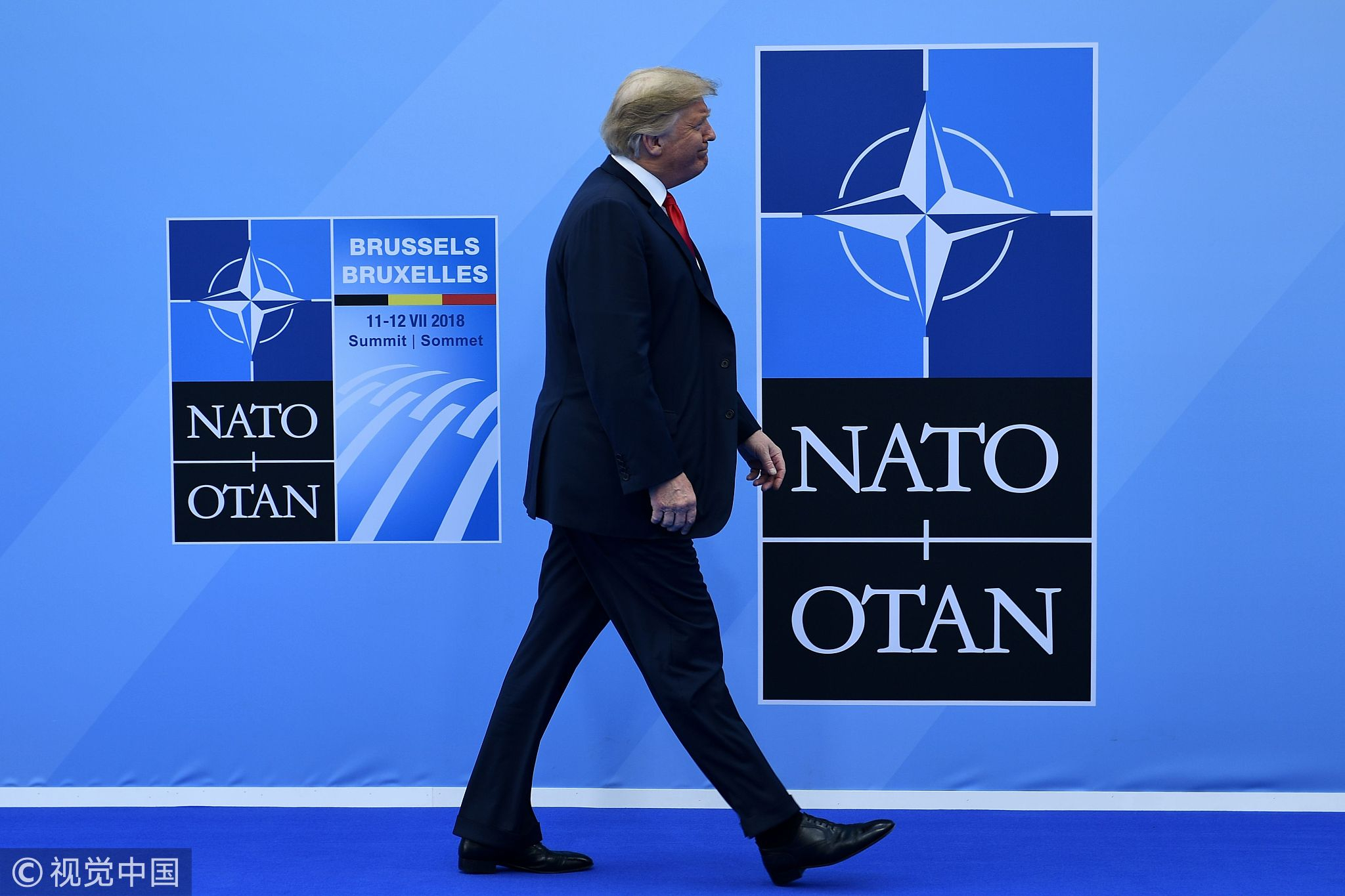
July 11, 2018: US President Donald Trump arrives to attend the NATO (North Atlantic Treaty Organization) summit in Brussels./ VCG Photo
July 11, 2018: US President Donald Trump arrives to attend the NATO (North Atlantic Treaty Organization) summit in Brussels./ VCG Photo
At this point, it is hard to predict the outcome of the Brussels summit, but it will be still NATO run by the US. Jeffery Sachs wrote that “the US has probably never before had a delusional President, one who speaks gibberish, insulting those around him including his closest associates, and baffling the world.
By instinct, we strive to make sense of Trump’s nonsense, implicitly assuming some hidden strategy.” Indeed there is no hidden strategy as Trump is not a strategist - he is an unscrupulous businessman.
In a report for a Macedonian TV channel, a journalist was quickly shut up when she was about to spell out that the NATO summit may end as a total disaster: if Trump pull US military protection for European allies, it would mean a clear fracture the notion of collective defense that is central to NATO's identity.
Indeed, NATO may face a fiasco, but it should be kept secret for the enthusiastic micro-states - the small pawns in the chess game - which still dream of ‘sitting at the table together with superpowers.’
The article reflects the author’s opinions, and not necessarily those of CGTN.