
Opinions
10:55, 20-Jul-2018
Opinion: Xi's Middle East and Africa visit – new opportunities for BRI
Updated
10:55, 23-Jul-2018
 ["china"]
Share







Copied
Editor's note: Xu Jingzhi, a doctorate in economics from the Chinese Academy of Social Sciences, is also a former military attache at the Chinese embassy in the United States and a research fellow at China Institute for Geopolitics and Energy Strategy. The article reflects the author’s opinions, and not necessarily the views of CGTN.
Chinese President Xi Jinping on Thursday started his state visits to the United Arab Emirates, Senegal, Rwanda and South Africa.
The trip will also take him to Mauritius for a friendly visit. He will also attend the 10th BRICS leaders' meeting in Johannesburg, South Africa.

View of downtown Johannesburg at sunset, South Africa./VCG Photo
View of downtown Johannesburg at sunset, South Africa./VCG Photo
Since March in 2013, President Xi has visited many countries in the Middle East and Africa, promoting friendly cooperation and economic and trade exchanges between China and these countries. He proposed the Belt and Road Initiative (BRI) in the same year.
Over the past five years, the initiative has moved from a concept to action, from a vision to a reality. The BRI has become the world's most famous a connectivity project.
It is believed that Xi's trip will effectively promote more pragmatic cooperation between China and other Asian and African countries. The visit will also closely link the BRICS cooperation mechanism to the BRI.
The BRI will develop further in developing countries and will usher in new development opportunities.
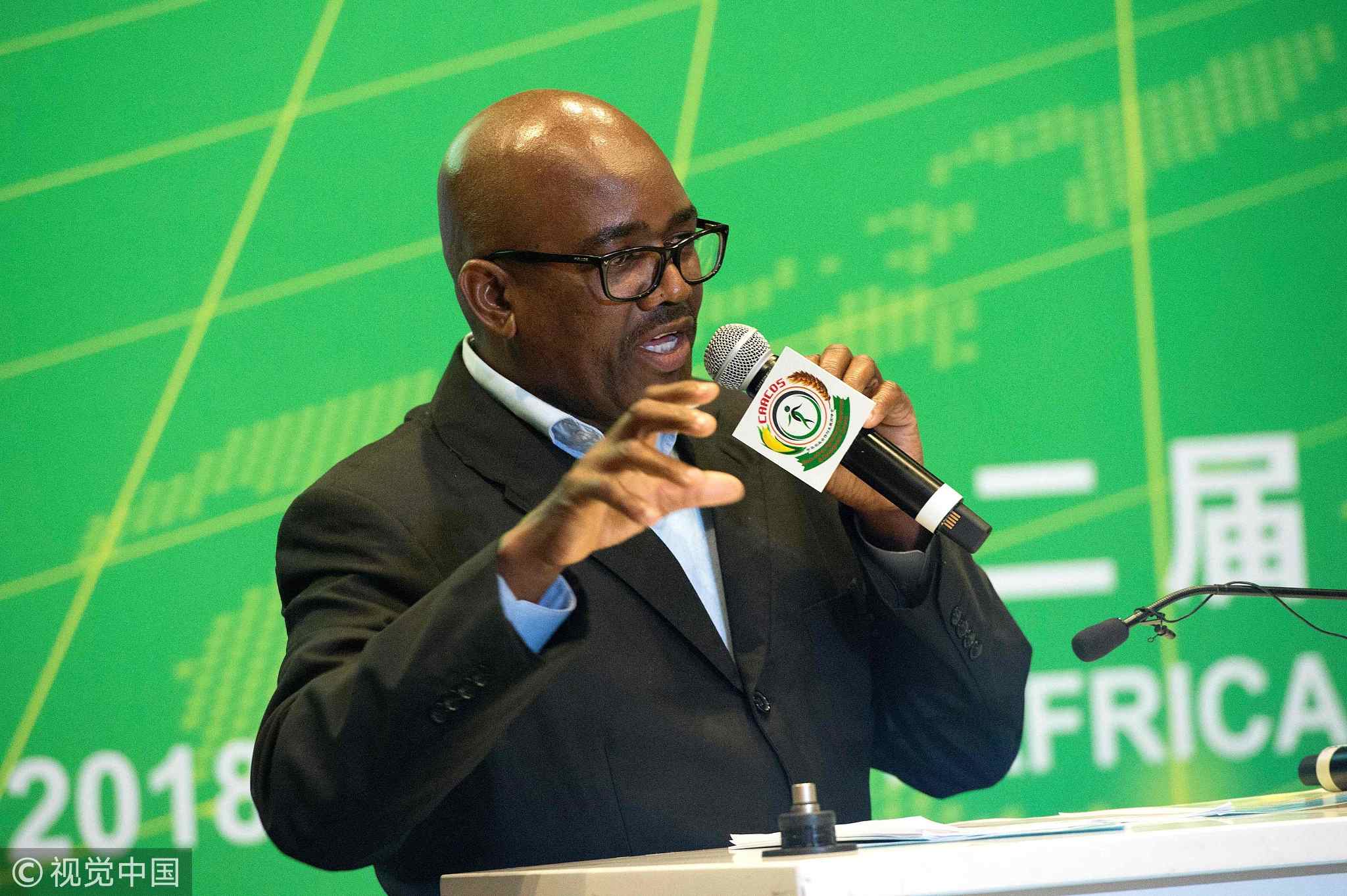
Shammi Budlu, Secretary of the Black Farmers Association of South Africa speaks during the start of the Second China-Africa Agricultural Cooperation & Development Summit in Cape Town on Jul 12, 2018,/VCG Photo
Shammi Budlu, Secretary of the Black Farmers Association of South Africa speaks during the start of the Second China-Africa Agricultural Cooperation & Development Summit in Cape Town on Jul 12, 2018,/VCG Photo
Firstly, China's economic cooperation with Arab countries in the Middle East will be further strengthened. The BRI is a bridge connecting China and the Middle East. As Xi is currently paying a state visit to the UAE, the bilateral relations will surely embrace new historical opportunities. Through the UAE, the bridgehead of the BRI in the Middle East, practical cooperation between China and Arab countries will continue to grow.
China has become the second largest trading partner of Arab countries, with more than 15 billion US dollars of direct investment. With energy cooperation as the central element, infrastructure construction and trade and investment convenience as the foundation, high-tech fields as a breakthrough, cooperation framework between China and the Arab world further strengthened.
Secondly, the BRI will extend to Africa's inland areas. The continent plays an important role in the current world political and economic pattern and is also an important developing direction of this initiative.
A growing number of African countries are eagerly looking forward to joining the BRI which will surely benefit their economic construction.
At present, China's economic and trade cooperation with mainly northeast African countries is developing rapidly, while its collaboration with other inland regions has yet to be improved. President Xi will visit the western, central and southern Africa. These countries are also natural extensions of the BRI. Through this visit, more landlocked African countries will speed up their integration into the initiative.
Thirdly, the BRI will be further linked to the BRICS Mechanism. The Johannesburg Summit, which coincides with the 10th anniversary of the BRICS leaders' meeting, has attracted worldwide attention.
China and the other four BRICS countries are the world's largest emerging economies and beneficiaries and defenders of the multilateral trading system. All the BRICS countries expressed their readiness to follow the trend of multi-polarization and economic globalization and jointly safeguard an open world economy and promote trade and investment liberalization and facilitation.
BRICS is a group of major emerging economies that includes Brazil, Russia, India, China and South Africa, with 42 percent of the world's population and nearly 23 percent of the world's GDP. The BRICS countries are all at an important juncture of the Belt and Road. Taking these countries as important fulcrum points will surely promote the development of the BRI to a global depth.
The BRICS mechanism is open, inclusive and cooperative. Deep integration of this mechanism and BRI will strongly promote the economic globalization and the development of countries participating in the BRI including the BRICS.