
Tech & Sci
10:43, 23-Jul-2018
Cities in China are turning green and also making money
Updated
10:22, 26-Jul-2018
 ["north america"]
Share







Copied
Long a perpetrator of choking pollution, Chinese cities are turning things around with many considerably lowering emissions in the past year, while also maintaining significant economic growth, a report based on data from 115 cities claimed.
More than 90 percent of the 115 cities studied showed gross domestic growth ranging from 40 to 100 percent between 2010 and 2015. Around 90 of these cities performed well on the Low-carbon and Green Index for Cities (LOGIC), which tracks progress and recommends solutions for lowering emissions in urban areas.
The 90 cities that registered high economic growth also increased their LOGIC scores – some with slight increases, others jumped as high as 25 percent. Overall, Chinese cities’ scores grew 6.6 percent on the index, the report maintained.
This turnaround comes as “industries and buildings have started using clean energy, transport and adopting smart technologies, but more such efforts are needed,” Hu Min, executive director of Innovative Green Development Program (iGDP) told CGTN.
Titled “China’s Cities Transitioning toward Energy Sustainability, and Pursuing Early Peaking of Carbon Emission,” the report released Thursday in Washington, DC, revealed that China’s “mega” cities, “postindustrial” cities, and “low-carbon pilot” cities are performing particularly well.
The index measured each city’s performance along seven parameters – energy and power use, green buildings, land use, industry, economic dimension and policy interventions for greening the city and lowering carbon emissions.
“Economic growth, energy, and industry categories are powerful drivers of cities’ index scores," iGDP maintained. "It implies that urban energy and economic structures play an essential role in low-carbon transitions."
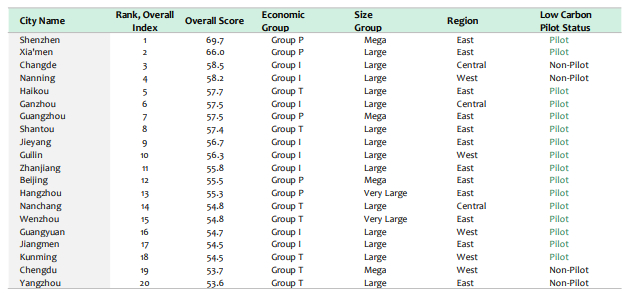
City ranking on LOGIC index for green and low carbon index. /iGDP Graphics
City ranking on LOGIC index for green and low carbon index. /iGDP Graphics
China witnessing the world's largest urbanization
China is witnessing the “largest wave of urbanization in the world” with 770 million people currently living in cities – nearly a four-fold increase from 190 million in 1980. Experts estimate by 2030, more than one billion people, or 70 percent of China’s population, will be living in urban areas.
Urban development led by the industrial and service sectors has also pulled more than 700 million people out of poverty in the last 30 years.
However, urbanization has come with environmental consequences. In 2014, concerned over the rising emissions from buildings, transport, solid waste and industries, a National New-type Urbanization Plan set targets for urban infrastructure and urban development.
A year later, 21 Chinese cities formed an Alliance of Peaking Pioneer Cities (APPC) to peak energy-related carbon dioxide emissions before 2030.
A report released last month by the University of East Anglia claimed 182 cities account for a whopping 85 percent of carbon emissions in China. These cities are home to 62 percent of the country’s population and accounted for 77 percent of the GDP in 2010.
Despite positive growth in LOGIC scores for all Chinese cities between 2010 and 2015, the average score among all of the cities was only 44.9 out of 100. “Chinese cities have room to improve,” the report warned.
However, there is a “large margin between the average score, and scores achieved by China’s best-performing cities, which indicates a positive pathway for all cities to catch up,” the report added.
There should be more focus on integrated planning for cities, formulating effective policies, promoting a green lifestyle, and allowing for robust data collection to ensure cities stay within minimum emission limits, suggested iGDP director Hu Min.
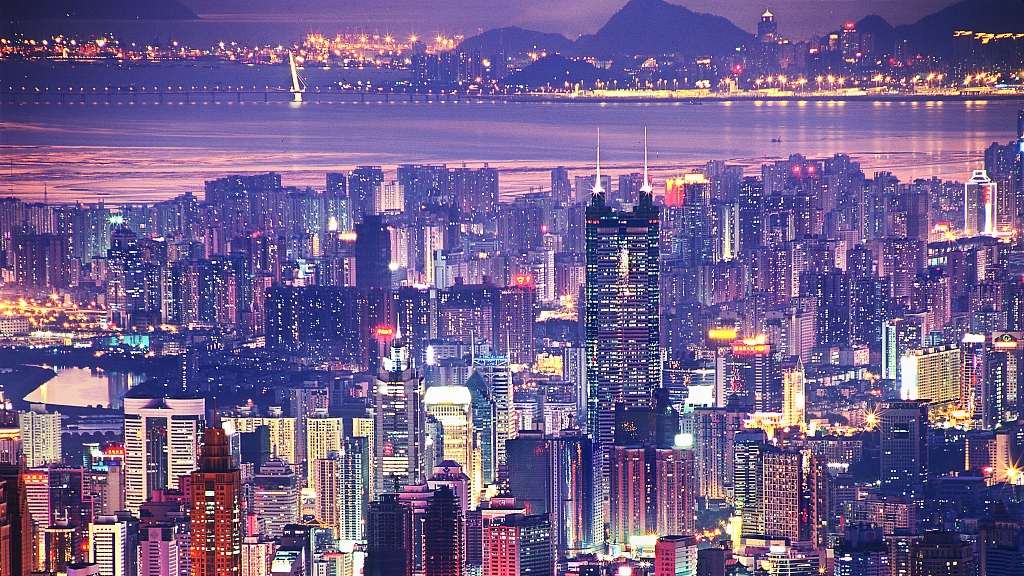
(Cover Image: Shenzhen has emerged as the best performing city on the LOGIC index for green and low carbon development. /VCG Photo)