
Opinions
11:47, 06-Jun-2018
Opinion: How would Trump undermine the G7 summit in Canada?
 ["china"]
Share







Copied

Editor's note: Dr. Zhang Zhixin is an Associate Research Professor at the Institute of American Studies, China Institutes of Contemporary International Relations (CICIR). The article reflects the author's opinion, and not necessarily the views of CGTN.
With the Group of Seven summit to be held on June 8 and 9 this month in Charlevoix of Canada, the meeting is overshadowed by the US trade actions recently. As is shown in the G7 financial chiefs’ meeting, the trade dispute is triggering one of the biggest crisis in the G7 since the group’s formation in the 1970s. G7 used to build consensus and set trends, but now with an unconventional US President in the White House, it is struggling for relevance in international politics.
The recent steel and aluminum tariffs imposed by the Trump administration is certain to dominate the G7 summit this week, but it is not the first move that Trump surprised his Western allies with. Ever since he came into power, his American First policy has stunned the world occasionally. It withdrew from the Trans-Pacific Partnership, called for its NATO allies increasing defense spending, withdrew from the Paris Climate Agreement, and then quit the Iran Nuclear deal, and the European Union, Canada and Mexico, are not happy.
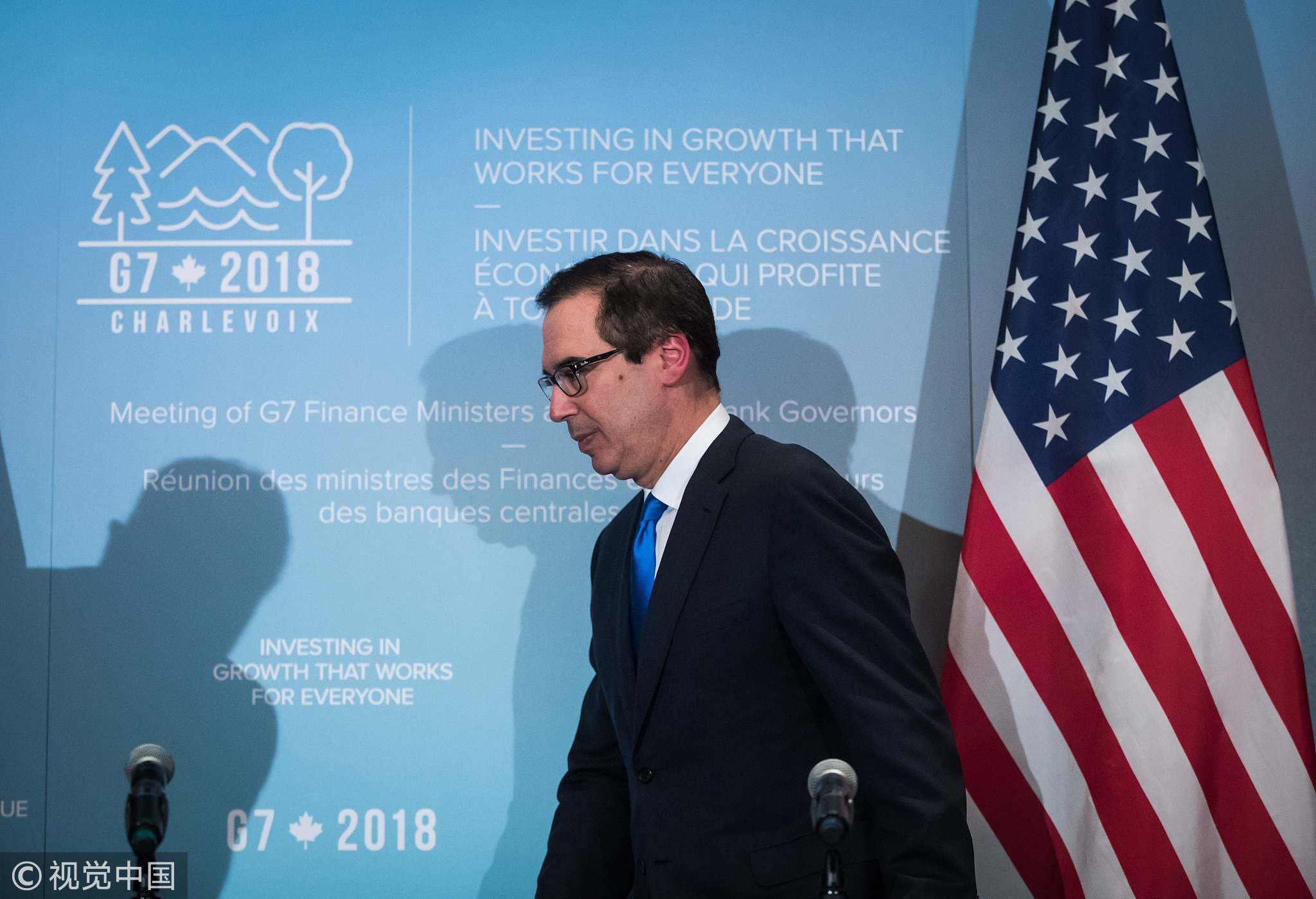
Steven Mnuchin, US Treasury secretary, leaves after a news conference at the closing of the G7 finance ministers and central bank governors meeting in Whistler, British Columbia, Canada, on June 2, 2018./VCG Photo
Steven Mnuchin, US Treasury secretary, leaves after a news conference at the closing of the G7 finance ministers and central bank governors meeting in Whistler, British Columbia, Canada, on June 2, 2018./VCG Photo
While US officials trying to downplay the significance of the tariffs, and their negative effect on the G7 summit, the US hardening trade approach has already invited strong reactions from allies. The US Treasury Secretary Mnuchin said that Trump was just focused on "rebalancing our trade relationships". However, that the tariffs were imposed in name of protecting the US national security made some angry. The Canadian Prime Minister Justin Trudeau called the White House's reasoning "quite frankly insulting and unacceptable" in light of the two nations' long history of military cooperation. The EU threatened tariffs on Harley Davidson motorcycles and bourbon, measures that aimed at the political bases of the US Republican legislators.
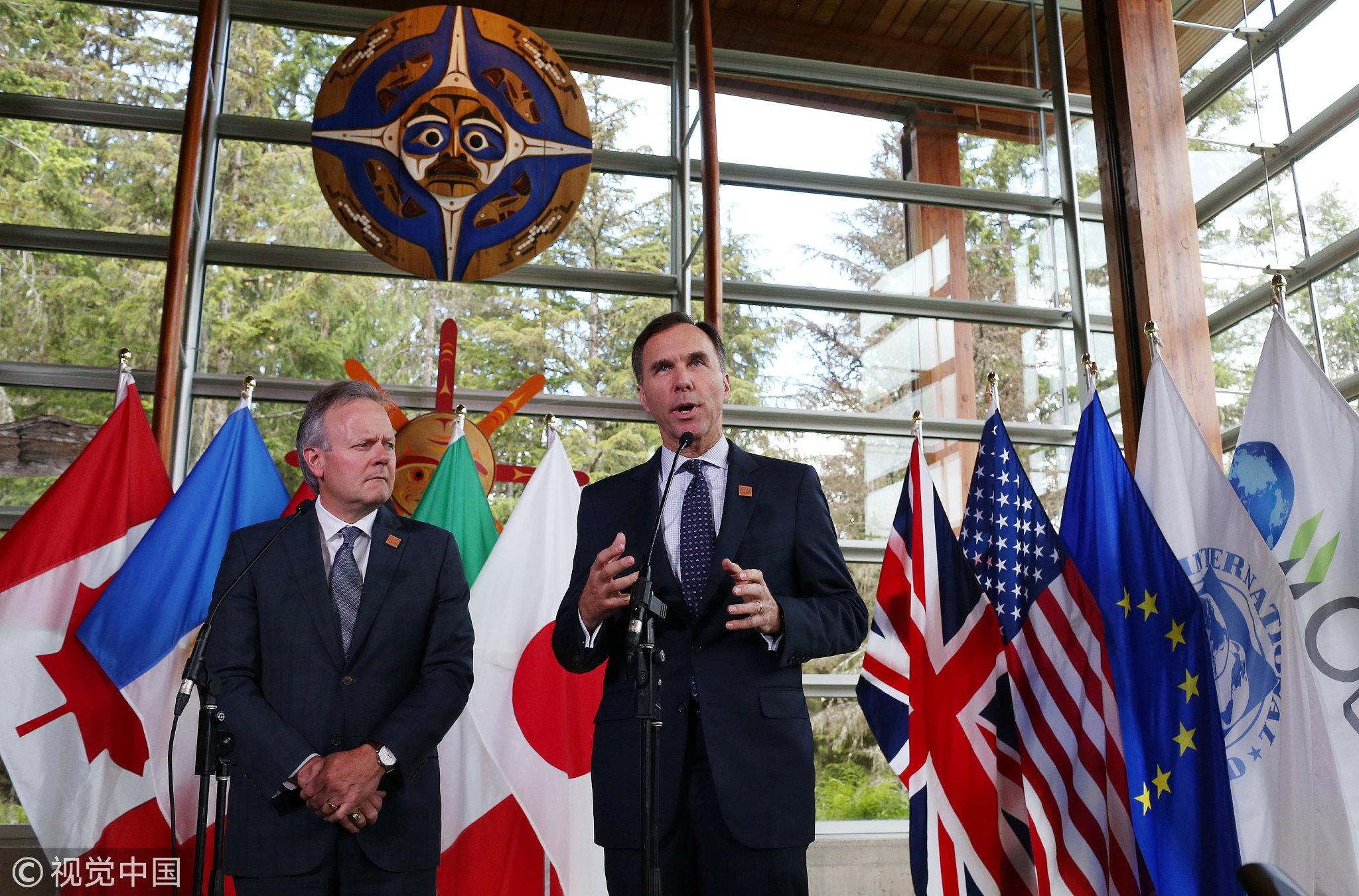
Governor of the Bank of Canada Stephen Poloz (L) and Canada's Minister of Finance Bill Morneau hold a news conference after the G7 Finance Ministers Summit in Whistler, British Columbia, Canada, on June 2, 2018./VCG Photo
Governor of the Bank of Canada Stephen Poloz (L) and Canada's Minister of Finance Bill Morneau hold a news conference after the G7 Finance Ministers Summit in Whistler, British Columbia, Canada, on June 2, 2018./VCG Photo
Besides the tariffs that outraged the EU members and its neighbors, president Trump's foreign policy moves also made the G7 summit more complicated, such as the US withdrawal from the Iran nuclear deal and the transfer of the US Embassy in Israel to Jerusalem. Originally, the G7 meeting's formal agenda is to focus on the themes of gender equality, women's empowerment, clean energy and economic growth that works for everyone. With the trade dispute overhead, divisions between the US and all the other 6 members will likely dominate headlines and private discussions.
President Trump’s recent irrational move made the western countries wonder if the US is circumventing international trade rules with the tariffs or ceding leadership of a global economic and trading system it largely built after World War Two. Interestingly, the US used to be the leading advocate and top beneficiary the globalization. However, with the 2008 financial crisis and the mess it created, the US seemed to lose its self-confidence and behaved more and more in an isolated way. President Trump was elected largely because he appealed to the needs of the so-called silent majority whose interests were harmed during the new round of globalization. With the midterm election coming this November, President Trump is eager to have political and economic gains that he can boast of during the campaign.
What's more, in the era of post-financial crisis, the G7 has lost its direction of development. Historically speaking, the creation of the body now known as the G7 was a result of the US President Richard Nixon's across-the-board tariffs in 1971, which finally led to the expansion of the international trade liberalization under the General Agreement on Tariffs and Trade and then the WTO. President Trump's economic nationalism and the accumulation of global reaction to such protectionist policies might eventually force a readjustment of the current international trade rules and system.
Therefore, the G7 summit in Canada might provide an opportunity to reset international trade relations, and the key is for all 7 countries to find common ground on the tariff issue, so as to both maintain the integrity of the G7 itself and to reduce the possibility of a trade war. However, President Trump will very likely defend his insistence on " fair and reciprocal trade", and the other 6 nations will have less incentives to compromise on the threatened tariffs. So the Western world might have to pray for a productive meeting in Canada.