
Opinion
15:15, 04-May-2019
Why African leaders should follow up on the outcome of the second BRF
 ["china"]
Share







Copied
Editor's note: Lateef Salau is a Nigerian journalist. He's currently a participant of the 2019 China-Africa Press Center (CAPC) program in Beijing. The article reflects the author's opinion, and not necessarily the views of CGTN.
The second Belt and Road Forum for International Cooperation (BRF) ended on April 27 with 283 deliverables achieved, a little higher than the 279 cooperation projects agreed at the first meeting in 2017.
The three-day multilateral event was attended by leaders of 38 countries, five of whom were from Africa: Kenya, Mozambique, Djibouti, Ethiopia, and Egypt.
One of the most prominent highlights of the forum was the consensus on building "high-quality, sustainable, risk-resistant, reasonably priced, and inclusive infrastructure."
"We emphasize that high-quality infrastructure should be viable, affordable, accessible, inclusive and broadly beneficial over its entire life-cycle, contributing to the sustainable development of participating countries and the industrialization of developing countries," said a joint communique issued at the end of the forum.
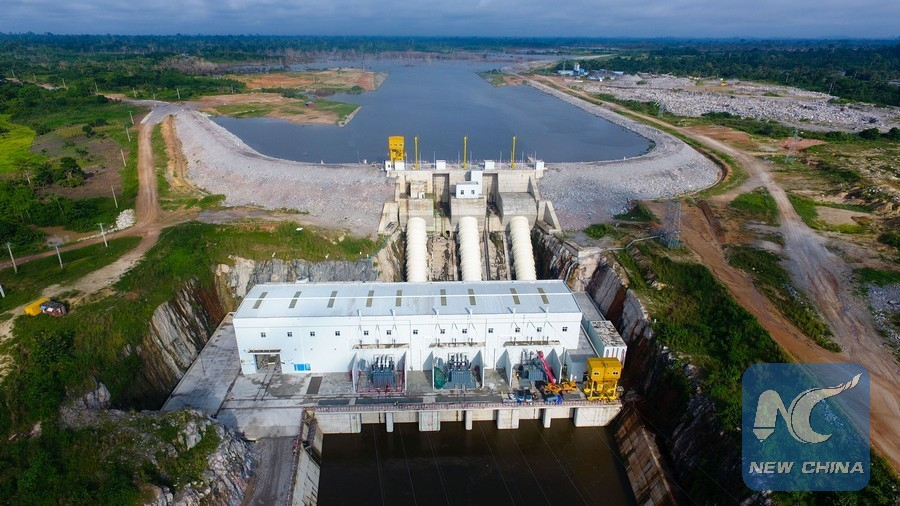
The Chinese-built Soubre hydroelectric power station in Soubre, Côte d'Ivoire. /Xinhua Photo
The Chinese-built Soubre hydroelectric power station in Soubre, Côte d'Ivoire. /Xinhua Photo
These deliverables offer Africa numerous opportunities and should invite a proactive response from African leaders. Here's why.
There have been repeated calls for Africa to industrialize its economies to engender economic growth and improve its citizens' living standards. But these calls often end at fora where they are made as there had been no corresponding actions to translate them into reality.
In fact, as the calls for industrialization grow stronger, the less industrialized the continent becomes. In the last decade, industrial GDP remains very low across Africa. Africa Development Bank, (AfDB), report in 2018 says, on average, African industry generates merely 700 U.S. dollars of GDP per capita, which is less than a third of the same measure in Latin America (2,500 U.S. dollars) and barely a fifth of that in East Asia (3,400 U.S. dollars).
African economies are largely dependent on unprocessed commodities that account for more than 70 percent of Africa's exports, according to AfDB. These exports are susceptible to external shocks, that any precipitous crash in commodity prices exposes the economic frailties in the region that imports most of its manufactured goods.
For instance, in 2016, many African countries faced serious economic headwinds as a result of the fall in commodity prices. The price of oil plummeted from 100 U.S. dollars a barrel in 2013 to 26 U.S. dollars a barrel in February 2016. With low per-barrel prices, economic growth in all of Africa's oil-exporting countries fell from an average of 5.4 percent in 2014 to an average of 2.9 percent in 2016.
The potential of the Belt and Road Initiative (BRI) for Africa's industrial transformation is huge. The initiative promises to boost infrastructure connectivity, a major problem inhibiting Africa's industrial development.
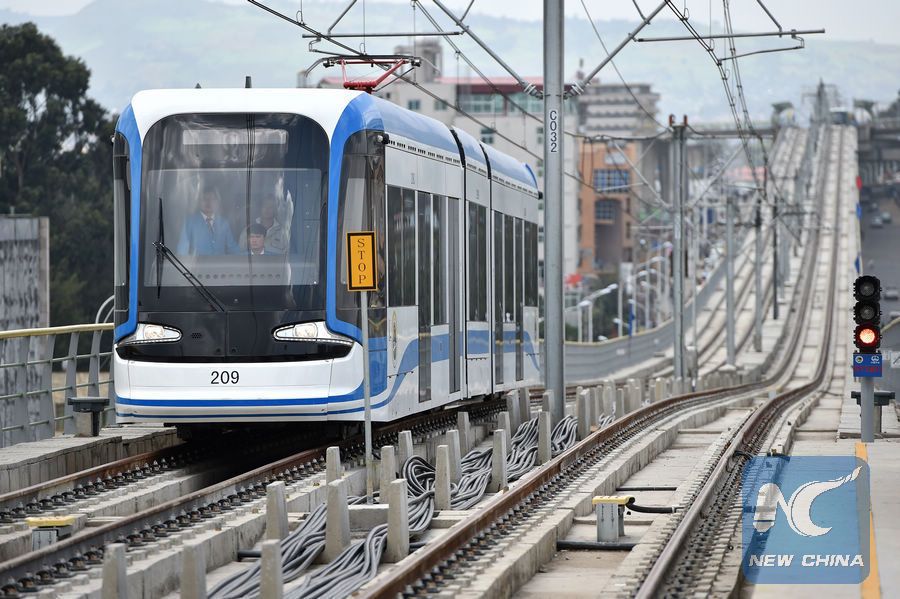
A train operates on the light rail in Addis Ababa, Ethiopia. /Xinhua Photo
A train operates on the light rail in Addis Ababa, Ethiopia. /Xinhua Photo
The Economist, a UK-based magazine, in its analysis of why Africa has failed to industrialize, said that weak infrastructure - lack of electricity, poor roads, and congested ports - drives up the cost of moving raw materials and shipping out finished goods.
Chinese President Xi Jinping alluded to this fact at the opening of the second BRF on April 26, when he said infrastructure is a bottleneck in the development of many nations.
He said building high-quality infrastructure "can help countries give full play to their advantages in resources and better integrate into the global supply, industry and value chains for interconnected development.”
Africa's growing population remains a huge strain on its weakening infrastructure. This critical infrastructure gap cuts across all segments of the economy, the most pronounced include transport and power.
Amidst these chronic challenges, China came to the rescue. Across Africa, Chinese loans have financed large scale infrastructural projects, ranging from airports, hydro power to highways and railways.
To consolidate these gains, African leaders need to proactively follow up on the outcomes of the second BRF, especially its promise to deliver green and high-quality infrastructure projects in partners' countries.
"We support comprehensive and multi-modal infrastructure connectivity, fostering economic growth and improving the standards of living catalyzed by infrastructure investment," the communique said.
There is no region that needs this offer more than Africa. The region is richly endowed with resources and increasing young population. In sub-Saharan Africa alone, over 70 percent of the region's population is below age 30. Despite their manufacturing potential, the persistent lack of industrialization remains a brake on African economies.
Since industrial growth has a positive influence on overall GDP and productivity, industrialization is a necessity for Africa while BRI offers the shortest route to the continent's industrial transformation.
(If you want to contribute and have specific expertise, please contact us at opinions@cgtn.com)