
Tech & Sci
17:23, 06-Aug-2018
Luckin Coffee, will its model work?
Updated
16:58, 09-Aug-2018
 ["china"]
Share







Copied
03:53
The competition within the once-new-and-previously-uncharted coffee delivery territory in China just got a little more exciting.
Just over half a year since new retail chain Luckin Coffee began trial operations, Starbucks closed in and officially announced its tie-up with Alibaba Group’s food delivery arm Ele.me to deliver coffee in China.
Prior to this, market observers have touted Luckin as a potential rival to Starbucks, as it has opened over 500 outlets in just five months.
To compete with Starbucks, Luckin is lowering its coffee prices, aggressively expanding outlets across the country, and leveraging on what China does best – it's whopping 527 million mobile payment users.
“That’s a pretty powerful combination that could work, the net result of that is if you and I have any inkling to have a cup of coffee, we can get it immediately. It’s affordable, convenient, and it lowers the threshold,” Jeffrey Towson, professor of investment at Peking University’s Guanghua School of Management told CGTN.
“This is the new ‘New Retail’ story of China; we’ve seen it for convenience stores, supermarkets, food delivery… but we haven’t seen it for coffee.”
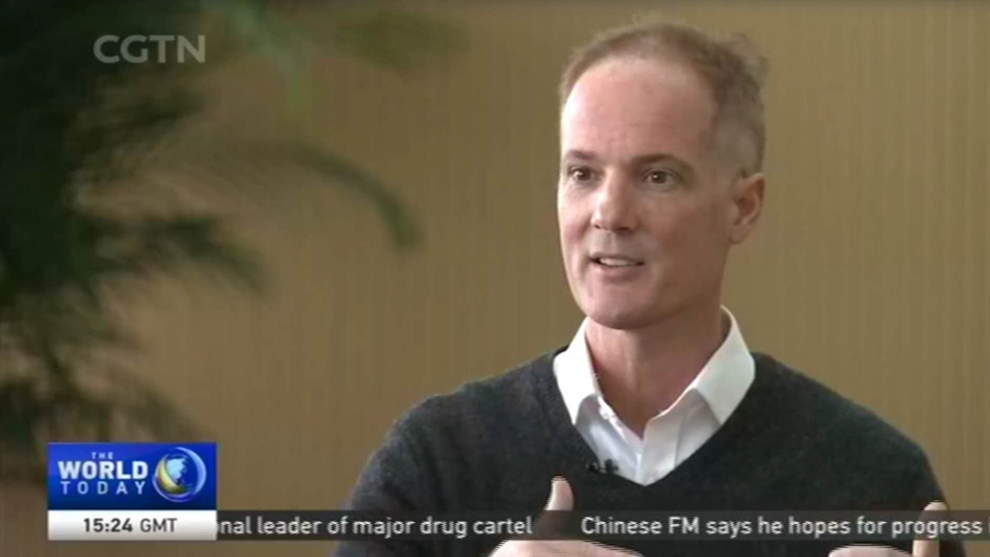
The big question for Jeffrey Towson, professor of investment at Peking University’s Guanghua School of Management, is if China is going to become a coffee drinking country. /CGTN Photo
The big question for Jeffrey Towson, professor of investment at Peking University’s Guanghua School of Management, is if China is going to become a coffee drinking country. /CGTN Photo
Essentially, one can select a pick-up or delivery option from the Luckin mobile app – you’ll get your cup of joe in less than 30 minutes.
Is China ready for this?
The big question for Luckin, according to Towson, is, “Does this retail coffee experience make sense for the mass market or is this always going to be a niche market?”
This, considering, that coffee at 35 RMB per cup is the same level as New York, he said, although the GDP per capita in China is about one-sixth.
And so, this begs the bigger question if China is going to become a coffee drinking country, Townson asks.
He brought to light the analogy of Xiaomi with what it did with smartphones. “They took iPhones which were very expensive, brought the price down and made them available to the mass market. And their volume took off like crazy in a couple of years, is that what we are going to see?”
A venture capital play
When asked about sustainability, Towson refers to Luckin as more like a venture capital play.
“This is not build a couple of stores, see if they work, then we’ll build more stores, build on profitability and business model. This is more like a VC play, we’re going to build big, win big or not do too well.”
He adds that, many successful digital companies in China are still loss-making. “Food delivery has been notoriously unprofitable even though usage is unbelievable.”
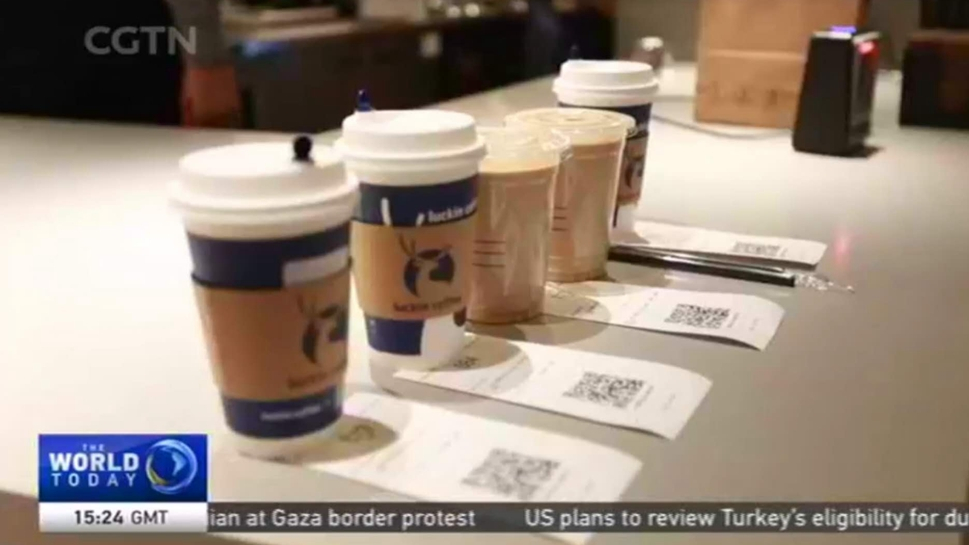
Luckin Coffee is using mobile Internet and big data to capture the still under penetrated Chinese coffee market. /CGTN Photo
Luckin Coffee is using mobile Internet and big data to capture the still under penetrated Chinese coffee market. /CGTN Photo
In the middle of July, Luckin Coffee secured 200 million US dollars in its Series A funding. Among its investors is Singapore's sovereign wealth fund GIC. This reportedly puts Luckin's valuation at one billion dollars – unicorn status.
Post-financing, the company said it will focus on product development, technique innovation, and business expansion.
Based on the latest reports, of Luckin's 525 outlets, 231 are takeaway kitchens. The company expects this ratio to come down to 15 percent in the future, as it says brick-and-mortar stores are the way forward.
Bruno Lannes, a partner with consulting firm Bain & Company said consumers are generally loyal to a location rather than a brand.
“So the game for many of these retail chains is really to increase the number of stores because then they can increase the possibility of creating loyal consumers otherwise it’s going to be limited to the very near neighborhood of where the store is.”
Competition with Starbucks
Luckin claims Starbucks has been engaging in “monopolistic behavior” by signing exclusive rental contracts, which prevents property owners from leasing to other coffee brands and shops. /VCG Photo
Luckin claims Starbucks has been engaging in “monopolistic behavior” by signing exclusive rental contracts, which prevents property owners from leasing to other coffee brands and shops. /VCG Photo
Media reports confirmed, quoting Luckin’s CEO, that Chinese courts have accepted an antitrust lawsuit Luckin filed against Starbucks.
Luckin claims Starbucks has been engaging in “monopolistic behavior” by signing exclusive rental contracts, which prevents property owners from leasing to other coffee brands and shops. Starbucks had responded, referring to this move as a publicity stunt.
But according to Towson, Luckin doesn’t have to beat Starbucks to win.
“The market is so big potentially that if they get any degree of traction in the mass market retail coffee, ‘they will be big and win big without Starbucks’,” he quipped.
“Now, however, Chinese consumers are notoriously fickle in any industry, just about you see market shares swing every year. Whether it’s in smartphones, cars… It would not surprise me at all if we see 10 or 20 percent of Starbucks volume shift.”
At the end of the day, management execution is key. “The founders of this company are veterans of UCar, veterans of China’s internet industry.”
As to the biggest risk for Luckin? “It’s that these stores are built, people know about it, and it turns out China’s mass market does not like going to have coffee that much.”
(Top image via VCG)