
Business
20:37, 17-Aug-2018
Will Malaysian PM's visit to China herald a turning point in their economic relations?
Updated
20:20, 20-Aug-2018
 ["china"]
Share







Copied
03:51

China and Malaysia have a close trading relationship and Malaysian Prime Minister Mahathir Mohamad is paying an official visit to China, seeking to strengthen those bilateral ties.
China-Malaysia bilateral relationship is not only significant to both countries, but also important for the China-ASEAN relations, according to Wang Jianhui, general manager of the R&D Department at Capital Securities.
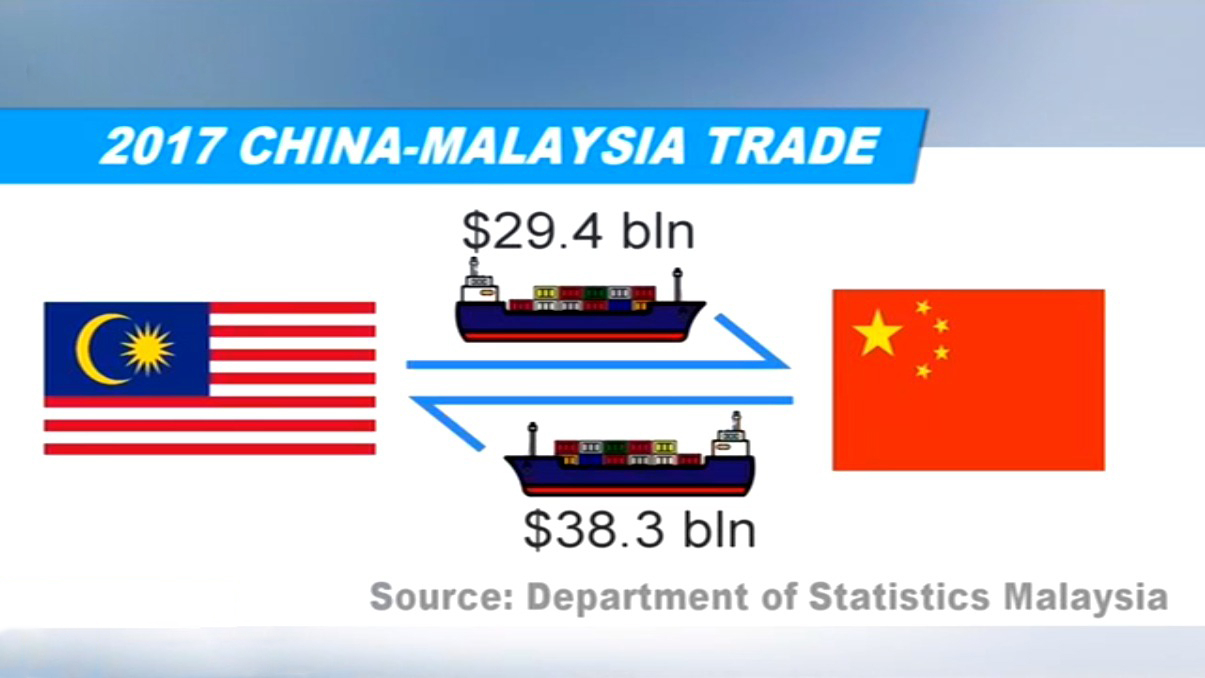
China has been Malaysia’s largest trading partner for the last nine consecutive years. Data from Malaysia's statistics agency showed in 2017, Malaysia's exports to China came in at close to 29.4 billion US dollars, and Malaysia’s imports from China reached 38.3 billion US dollars the same year.
00:22
But Wang mentioned that the two sides need some “boost and push to resume reasonable growth.”
“Since 2015, a cumulative growth rate of the foreign trade between the two countries has increased by only eight percent, compared to 25 percent of the ASEAN overall level,” Wang noted.
“Malaysia has a high percentage of GDP components on agriculture and mining industries. Those industries in China have only three or six percent contributions [to GDP]. So we might need a lot of products from those areas from Malaysia,” Wang explained.
Meanwhile, Malaysia manufacturing sector is relatively weak, accounting for about 22 percent of its GDP, Wang observed, while China’s manufacturing sector contributed some 32 percent to its overall GDP. “So we might have more cooperation opportunities there,” Wang added.

CGTN Screenshot
CGTN Screenshot
Since China and the US both play significant roles in Malaysia’s economy, some experts are concerned that the China-US trade disputes could have a negative impact on the Southeast Asian country.
From Wang’s perspective, as trade with Malaysia makes up only a small share of the US GDP, the US may not want to pick a fight right with yet another new target. “And also I don’t see any direct competition between Malaysian products and American products,” Wang opined.