
Space
22:32, 07-Jun-2018
Second nearest star system may be ‘habitable’ in terms of X-ray radiation: NASA
 ["china"]
Share







Copied
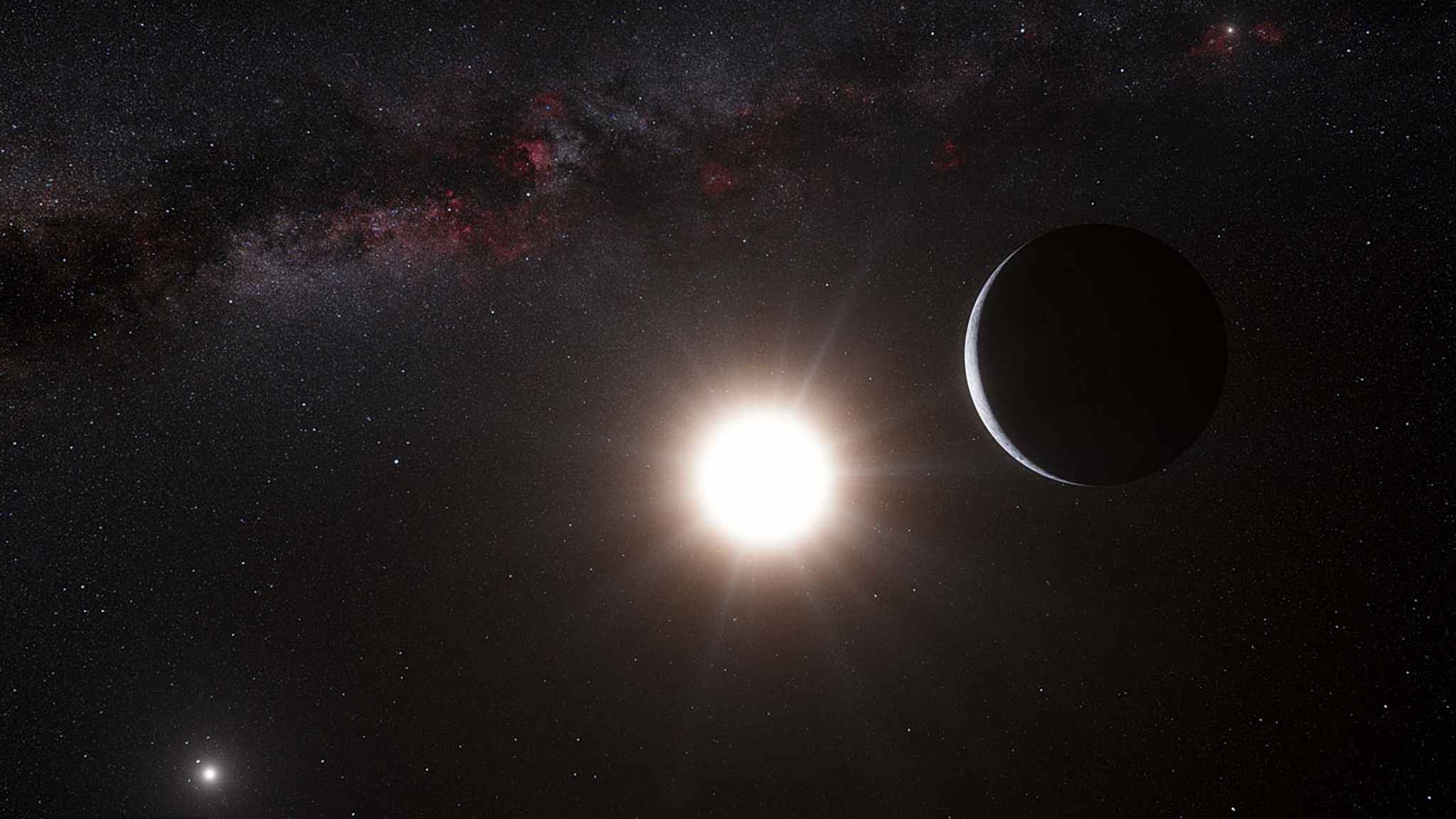
A new study involving monitoring of nearest stars beyond our Sun revealed that one of them might be friendlier to life than the Sun in terms of X-ray radiation.
The US space agency NASA said on Wednesday in a news release that any planets orbiting the two brightest stars in the Alpha Centauri system were likely not being pummeled by large amounts of X-ray radiation from their host stars.
Alpha Centauri is a triple star system located over four light years, or about 40 trillion kilometers, from the Earth.
"Because it is relatively close, the Alpha Centauri system is seen by many as the best candidate to explore for signs of life," said Tom Ayres of the University of Colorado Boulder.
"The question is, will we find planets in an environment conducive to life as we know it?" said Ayres.
X-rays and related space weather effects will do harm to unprotected life, directly through high radiation doses and indirectly through stripping away planetary atmospheres.
The stars in the Alpha Centauri system include a pair called "A" and "B," which orbit relatively close to each other.
Alpha Cen A is a near twin of our Sun in almost every way, including age, while Alpha Cen B is somewhat smaller and dimmer but still quite similar to the Sun.
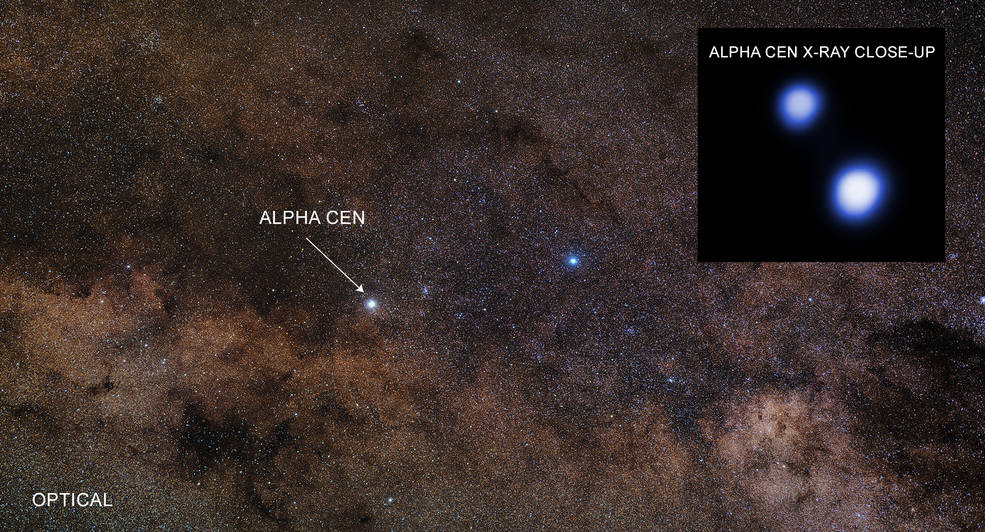
NASA's optical image of the triple star system /Photo courtesy of NASA
NASA's optical image of the triple star system /Photo courtesy of NASA
The third member, Alpha Cen C, also known as Proxima, is a much smaller red dwarf star that travels around the AB pair in a much larger orbit that takes it more than 10,000 times farther from the AB pair than the Earth-Sun distance.
Proxima currently holds the title of the nearest star to Earth, and AB is a very close second, according to NASA.
The Chandra data revealed that the prospects for life in terms of current X-ray bombardment were actually better around Alpha Cen A than for the Sun, and Alpha Cen B fares only slightly worse.
Proxima, on the other hand, is a type of active red dwarf star known to frequently send out dangerous flares of X-ray radiation, and is likely hostile to life, according to NASA.
The findings came after more than a decade of observation by NASA's Chandra X-ray Observatory.
"This is very good news for Alpha Cen AB in terms of the ability of possible life on any of their planets to survive radiation bouts from the stars," said Ayres. "Chandra shows us that life should have a fighting chance on planets around either of these stars."
However, the bad news is that, although there is one remarkable Earth-size planet around Proxima, astronomers have till now failed to find exoplanets around Alpha Cen A and B.
Planet-hunting around these stars has proved more difficult recently due to the orbit of the pair, which has drawn the two bright stars close together in the sky over the past decade.
Planets in the habitable zone around Proxima receive an average dose of X-rays about 500 times larger than those on Earth, and 50,000 times larger during a big flare, said NASA.
[Top image: An artist's impression shows the planet orbiting the star Alpha Centauri B, a member of the triple star system that is the closest to Earth. Alpha Centauri B is the most brilliant object in the sky and the other dazzling object is Alpha Centauri A. Our own Sun is visible in the upper right. The picture was released on October 17, 2012. /VCG Photo]
Source(s): Xinhua News Agency