
Politics
10:38, 18-Jun-2018
The Global Political Week: Merkel, migration and Turkey
 ["other"]
Share







Copied
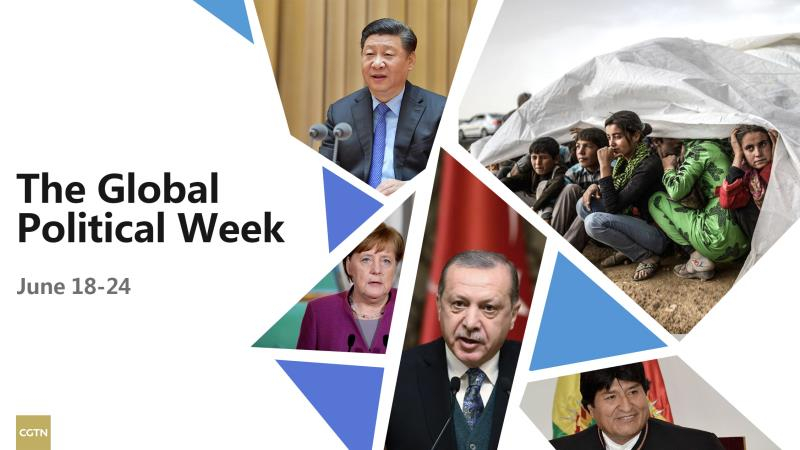
The global political week will feature German Chancellor Angela Merkel prominently, while there will be several high-level visits to China, discussions will continue in Iraq aimed at resolving the country's political crisis, the battle for Yemen is set to continue, and a formal suspension of US-Republic of Korea military drills could be announced.
Monday
The week begins with Bolivian President Juan Evo Morales Ayma paying a two-day state visit to China. In Europe all eyes will be on Germany, where Chancellor Angela Merkel is engaged in a row over migration policy with interior minister Horst Seehofer that could come to a head on Monday. Seehofer's Christian Social Union party is due to meet to discuss next steps. Merkel is also due to meet Italian Prime Minister Giuseppe Conte, with migration high on the agenda ahead of a key EU summit on June 28-29. In Latin America, reactions to the election on Sunday of Ivan Duque as Colombia's new president will be closely watched. The Republic of Korea and the Democratic People's Republic of Korea are due to discuss sports exchanges, while the opposition has called for sit-at-home protests in West Africa's Togo. The United Nations Human Rights Council will begin a three-week session in Geneva amid rumors the US could be set to withdraw, while the UN Security Council will meet for talks on Yemen.
Tuesday
Nepal's Prime Minister K.P. Sharma Oli is scheduled to arrive in China for a five-day official visit. There will be more high-level talks in Europe, with Merkel due to meet French President Emmanuel Macron in Berlin, an attempt to reach agreement on plans for reform of the EU. Merkel is also expected to welcome Polish Prime Minister Mateusz Morawiecki, while Thai Prime Minister Prayuth Chan-ocha is due to begin a seven-day trip to France and the United Kingdom. The Oslo Forum, an annual gathering of peace mediators from around the world, will be attended by UN Secretary General Antonio Guterres and UN Syria envoy Staffan de Mistura. Spanish King Felipe VI and Queen Letizia are expected to meet US President Donald Trump at the White House.
Wednesday
Papua New Guinea's Prime Minister Peter O'Neill is scheduled to pay a visit to China from June 20 to 26, while Danish Foreign Minister Anders Samuelsen is due to arrive in China for a three-day official visit. UN Secretary-General Antonio Guterres is due in Russia on the 70th anniversary of the beginning of the United Nations' work in the country on Tuesday, which is also World Refugee Day. Turkish President Recep Tayyip Erdogan is expected to hold mass rallies ahead of Sunday's parliamentary and presidential elections. Merkel is currently scheduled to continue her busy week with trips to Jordan and Lebanon. The Intergovernmental Authority on Development is due to lead talks between South Sudanese President Salva Kiir Mayardit and opposition leader Riek Machar. New Malaysian Prime Minister Mahathir Mohamad is expected to announce his full Cabinet, and in Georgia the ruling party must submit a new Cabinet following Prime Minister Giorgi Kvirikashvili's resignation.
Thursday
South Korean President Moon Jae-in is scheduled to begin a three-day visit to Russia, where his country is competing in the World Cup, and he will hold talks with President Vladimir Putin. It is also the first anniversary of Saudi King Salman elevating his son Mohammed bin Salman to crown prince.
Friday
Ministers from the Organization of the Petroleum Exporting Countries, or OPEC, will meet in Vienna at a key point for the global oil market, while an EU Economic and Financial Affairs Council meeting will take place in Luxembourg. In London, the 70th anniversary of the arrival of the Empire Windrush ship, which brought the first of many Caribbean immigrants to the UK, will be marked.
Saturday
A quiet political day.
Sunday
The political week rounds off with presidential and parliamentary elections in Turkey, where Erdogan is seeking reelection and his Justice and Development Party, or AKP, is striving to retain a majority in parliament in what are expected to be close-run elections.