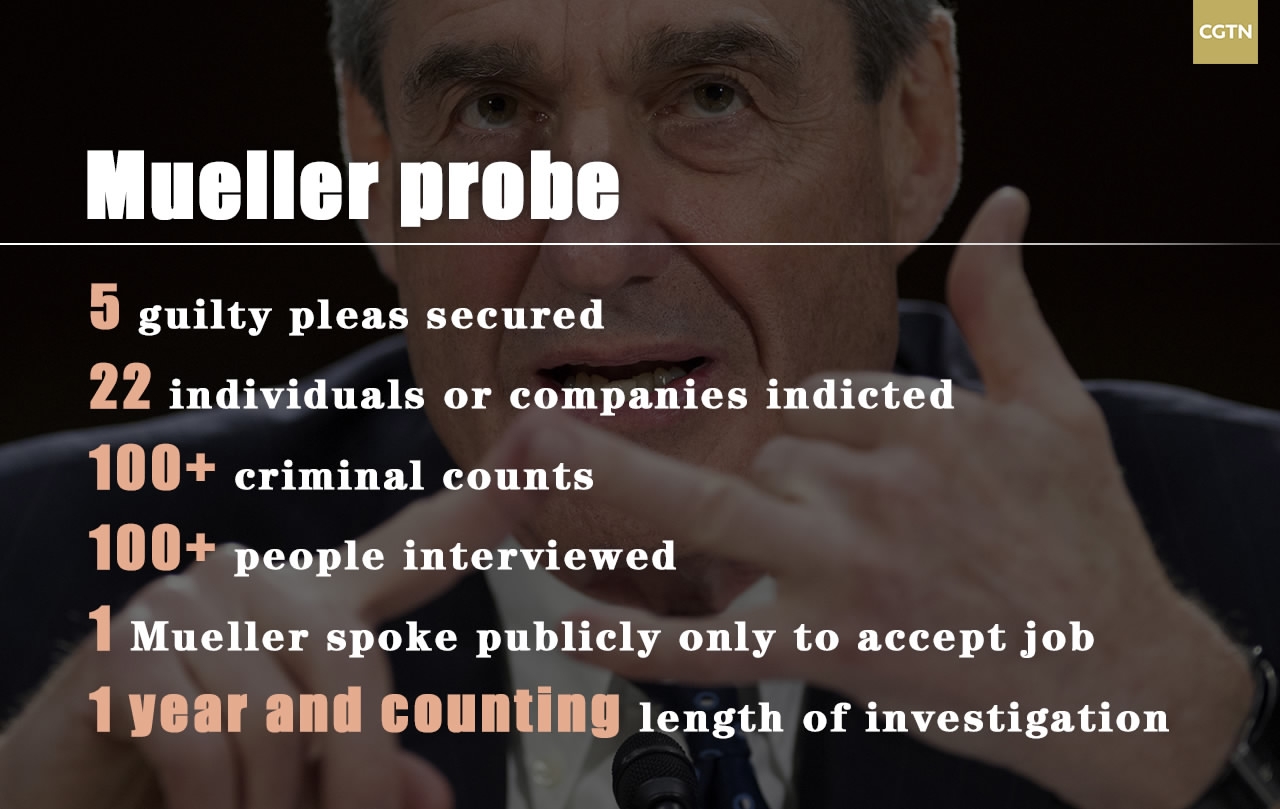
A partisan divide is hardening over Special Counsel Robert Mueller's investigation into alleged Russian meddling in the 2016 US presidential election and possible coordination with the Trump campaign, polling suggests, as the probe hit the one-year mark on Thursday.
The Mueller probe, just one of several investigations into the 2016 election, has created plenty of headlines and provoked hours of TV debate over the past 12 months.
Most Americans believe it should continue, a recent Quinnipiac poll shows, but Republicans are increasingly skeptical as the midterm elections approach and partisan attacks intensify.
Partisan divide
When appointed by Deputy Attorney General Rod Rosenstein in May 2017, there was broad agreement among Republicans and Democrats that the FBI director under presidents George W. Bush and Barack Obama was a fair choice.
However, recent polling indicates a widening partisan divide – something that's hardly unusual in US politics. The divide has been intensified by outspoken attacks from the Trump administration and its supporters.
Vice President Mike Pence said last week the investigation should be "wrapped up," Trump himself has repeatedly lambasted it as a "witch hunt."
Who is Robert Mueller? Mueller is a lawyer and former Marine who headed the FBI under presidents George W. Bush and Barack Obama.
What is he investigating? Mueller is leading a probe into alleged Russian interference in the 2016 US presidential election, whether Trump campaign figures were involved, and any other matters that arise from the investigation. He was appointed in May 2017.
What are his powers? Mueller can subpoena records, bring criminal charges and prosecute anyone who interferes in the investigation. Only Deputy Attorney General Rod Rosenstein, who appointed Mueller, has the power to fire him.
A CBS News poll this month showed that a majority of Americans (53 to 44 percent) now see the investigation as politically motivated, with a hardening of criticism among Republicans.
Support for Trump to agree to an interview with Mueller among Republicans has plummeted since January, falling by 20 points to 53 percent in May according to the CBS poll.
Most Americans believe the probe is "fair" and should continue, however, with the Quinnipiac poll showing voters believe 54 to 31 percent that Mueller is conducting a fair investigation, although 44 percent said they regarded it as a "witch hunt" when asked if it was "legitimate."
Silent Mueller
Assessing the validity of the attacks on the investigation is complicated by the lack of knowledge about what Mueller's tight-knit team is actually doing. No one outside the group is aware of what precisely the special counsel knows, who he's spoken to, or what lines of inquiry he's following.
Mueller has made a public statement just once about the investigation since it began – to accept the role – and his team has been lauded for not leaking.

Russia's President Vladimir Putin and US President Donald Trump talk at the APEC leaders' summit in the Vietnamese city of Danang, November 11, 2017. /VCG Photo
Russia's President Vladimir Putin and US President Donald Trump talk at the APEC leaders' summit in the Vietnamese city of Danang, November 11, 2017. /VCG Photo
The Washington Post identifies five areas of interest, based on witness statements in the 22 indictments and five guilty pleas brought forth by Mueller's team: the financial dealings of Trump associates; Russian intervention in the election; coordination between Russia and Trump associates during the campaign; contacts between Russia and Trump associates during the transition period; and obstruction of justice.
The allegations of Russian interference have been denied by Moscow, while Trump has repeatedly rejected suggestions his campaign engaged in collusion.
There has been speculation that Trump could seek to fire Mueller, but this would cross a "red line" with several Republican members of Congress and also be unpopular with the American people. Trump should not fire the special counsel, voters say 74 to 13 percent, including 59 to 25 percent among Republicans, according to Quinnipiac.
No end in sight
After a year of investigation, pressure on Mueller to come to a conclusion is growing. Trump lawyer Rudy Giuliani told Politico on Wednesday it would be "absurd" if the probe went beyond 2018, and warned that public opinion would quickly shift if it dragged on.
There are few indications Mueller is close to ending his investigation, however, and there is no set timeline. With the midterm elections approaching – and the balance in Congress at stake – he is unlikely to release any conclusions that could influence the vote.
A Politico analysis suggests that if history is a lesson, the probe could have some time to run; the 21 major special counsel probes in the post-Watergate era lasted an average of three-and-a-half years.
There remain several prominent individuals who have not been interviewed. The president has not agreed to sit down with the special counsel, while his daughter Ivanka, a prominent campaigner and now a White House aide, and son Donald Jr. are not known to have spoken to Mueller.
Some important dates are already in the calendar for later this year. Notably, in July, the first of former Trump campaign chairman Paul Manafort criminal trials is scheduled to begin.
How the investigation will conclude – and who will see the results – also remains unclear. Mueller is required by law to submit a report to the Justice Department, but there is no legal obligation for that report to be made public.

 ["north america"]