
Animal
20:37, 09-May-2018
Scientists discover secrets of animal movement by training spiders
 ["china"]
Share







Copied
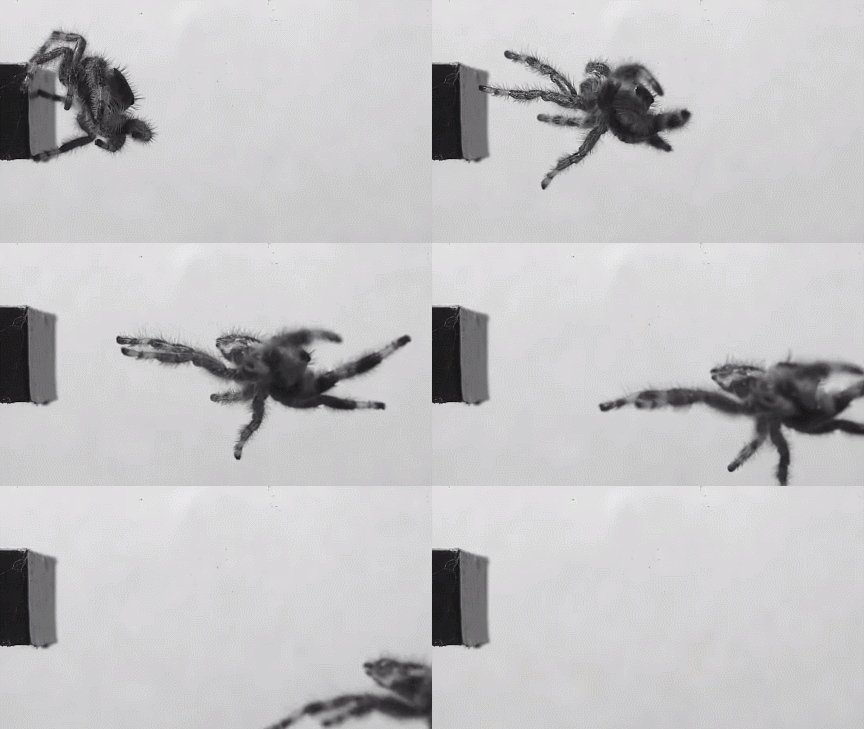
Scientists at the University of Manchester revealed Tuesday, about how they have trained a spider to jump on demand which could help them discover secrets behind animal movements.
The study, published in the journal Nature Scientific Reports, is the first to use 3D CT scanning and high-speed and high-resolution cameras to record, monitor and analyze a spider's movement. It will also help in the development of future robots.
The research has unlocked the secrets of how some predatory spiders catch their prey whilst hunting by successfully training a spider named "Kim", to jump different distances and heights.
Kim, a Regal Jumping Spider, was taught to jump on a man-made platform in a laboratory environment.
The team recorded the jumps using ultra-high-speed cameras and high-resolution micro CT scans to create a 3D model of Kim's legs and body structure in unprecedented detail.
The aim of the research is to answer the question of why jumping spider anatomy and behavior evolved the way it did. Moreover, the project used the improved understanding of spiders to imagine a new class of agile micro-robots that are currently unthinkable using today's engineering technologies.
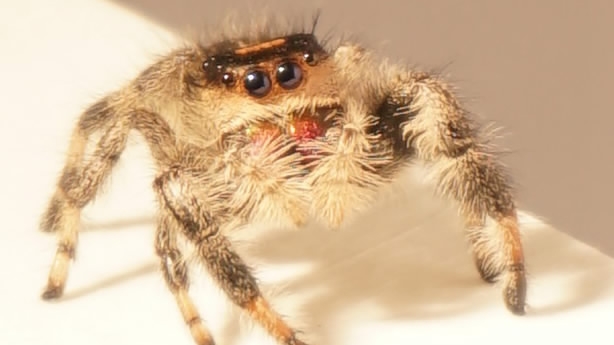
Kim, the Regal Jumping Spider. /Photo via University of Manchester
Kim, the Regal Jumping Spider. /Photo via University of Manchester
Dr. Mostafa Nabawy, lead author of the study, said, "The focus of the work is on the extraordinary jumping capability of these spiders. A jumping spider can leap up to six times its body length from a standing start. The best a human can achieve is about 1.5 body lengths."
"The force on the legs at take-off can be up to 5 times the weight of the spider. This is amazing and if we can understand this biomechanics we can apply them to other areas of research," Dr. Nabawy added.
The results show that this particular species of spider uses different jumping strategies depending on the jumping challenge it is presented with.
For shorter distances, Kim preferred a faster and lower trajectory which requires more energy but minimizes flight time. This makes the jump more accurate and more effective for capturing preys.
For longer distances, she jumped in the most efficient way to reduce the amount of energy she used.
Insects jump in a number of different ways, either using a spring-like mechanism, direct muscle forces or internal fluid pressure.
Scientists have known for more than 50 years that spiders use internal hydraulic pressure to extend their legs, but what isn't known is if this hydraulic pressure is actively used to enhance or replace muscle force when the spiders jump.
Dr. Bill Crowther, co-author of the study, said, "Our results suggest that whilst Kim can move her legs hydraulically, she does not need the additional power from hydraulics to achieve her extraordinary jumping performance. Thus, the role of hydraulic movement in spiders remains an open question."
(Cover gif via University of Manchester)
Source(s): Xinhua News Agency