
Opinions
16:28, 01-Aug-2018
Opinion: Who benefits from less trade tension between US, Europe?
Updated
15:43, 04-Aug-2018
 ["china"]
Share







Copied
Editor's Note: Daniele Lazzeri is chairman of Il Nodo di Gordio, a think tank based in Trentino, Italy.
The visit of Italian Prime Minister Giuseppe Conte to the White House is arousing great interest among international observers. The good relations established with the American President Donald Trump, in fact, could have positive effects also for the relations between Washington and Brussels.
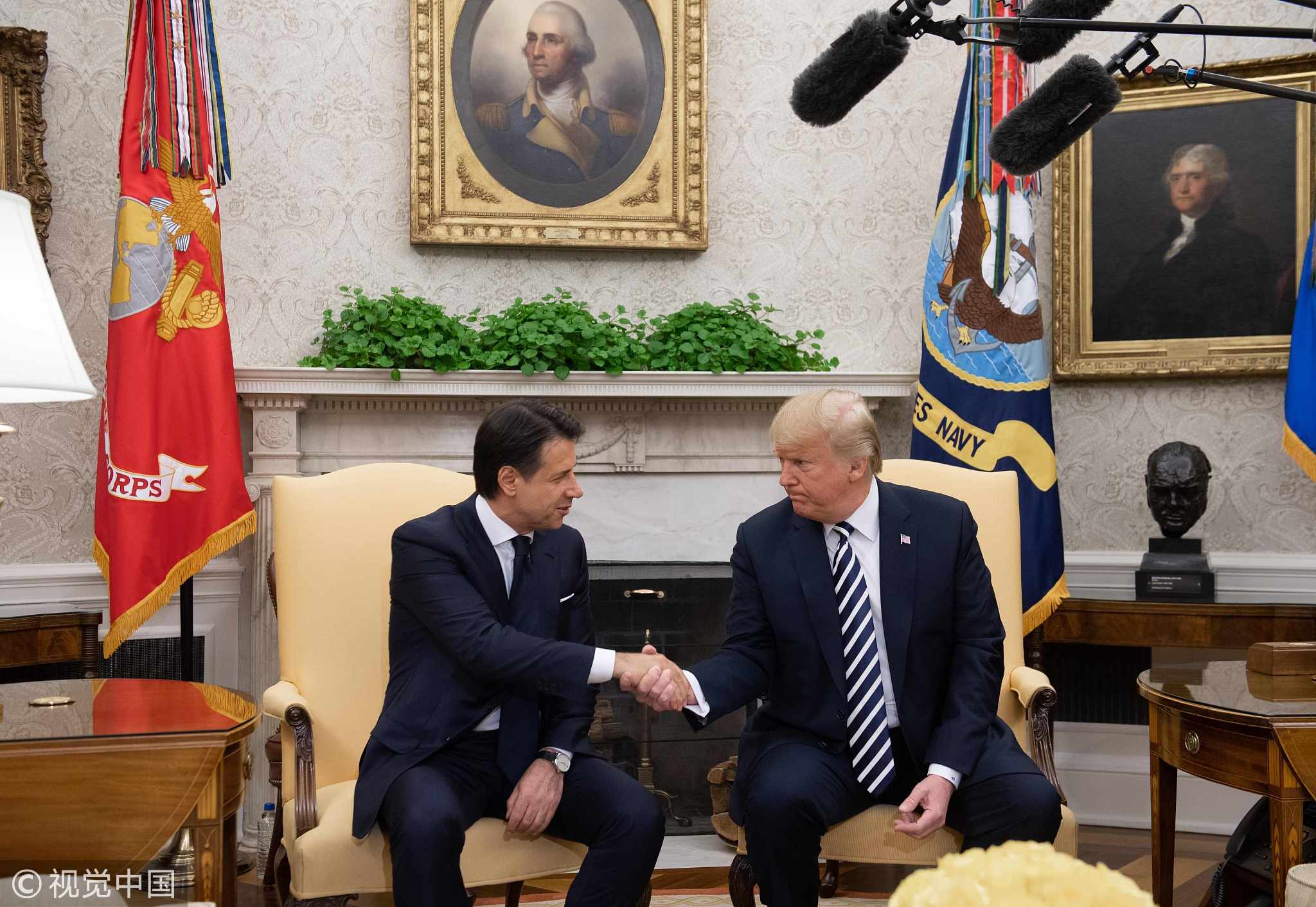
US President Donald Trump (R) and Italian Prime Minister Giuseppe Conte shake hands during a joint news conference in the East Room of the White House, July 30, 2018 /VCG Photo
US President Donald Trump (R) and Italian Prime Minister Giuseppe Conte shake hands during a joint news conference in the East Room of the White House, July 30, 2018 /VCG Photo
After months of tensions transatlantic tensions, the political climate is progressively improving even if significant differences remain on some thorny issues. There is indeed a considerable divergence of interests in many areas between the United States and the European Union. The most complex files concern economic and energy policies and, last but not least, the matter of import duties. The president of the European Commission, Jean-Claude Juncker, said at the end of the last week’s meeting with Trump that he was in favor of easing trade tensions with Washington, even if at the moment the terms of the agreement remain smoky.
There has been a general discussion in the joint declaration about reducing trade barriers between the US and Europe and eliminating tariffs on many products, but excluding the automotive sector, so a reference was made to a revision of the WTO, considered obsolete.
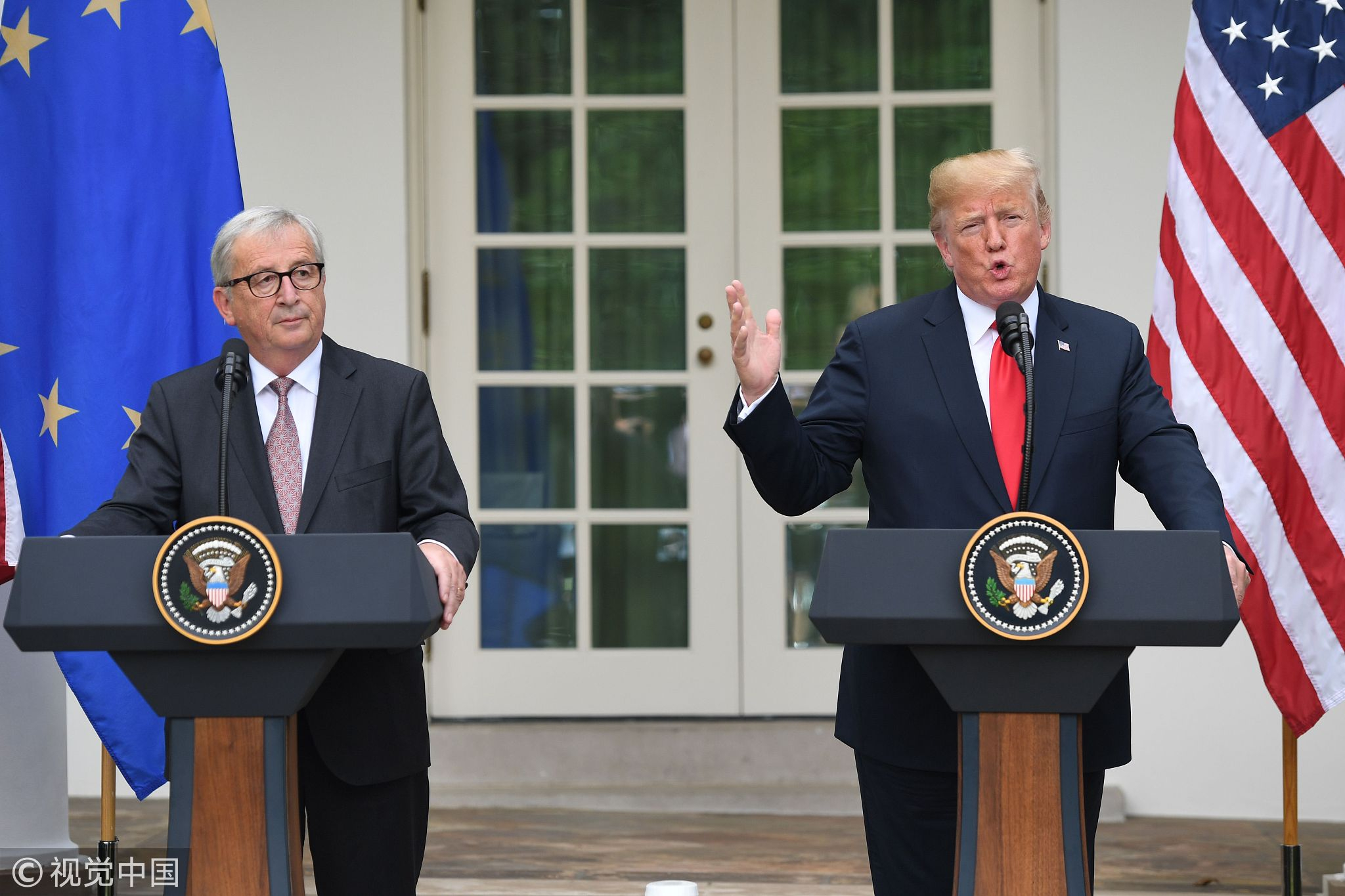
US President Donald Trump and European Commission President Jean-Claude Juncker (L) at a media briefing in the Rose Garden of the White House on July 25, 2018. /VCG Photo
US President Donald Trump and European Commission President Jean-Claude Juncker (L) at a media briefing in the Rose Garden of the White House on July 25, 2018. /VCG Photo
Surprisingly, however, the US President has renewed his opposition to the construction of the Nord Stream 2 gas pipeline that links Russian gas resources to Germany, via the Baltic Sea, while strongly supporting the "Southern Corridor," the one that will come from Azerbaijan up to the Italian shores through the TAP (Trans Adriatic Pipeline) pipeline. This statement has obviously aroused much dissatisfaction in Europe and has in particular generated a new rift with German Chancellor Angela Merkel.
But, on the table there are also some differences on the foreign policy strategy – particularly in the management of the Middle Eastern chessboard and in the new tug of war on the Iranian deal secured by Barack Obama. It seems as well that some progress has been made in achieving cooperation between the US and Europe in the Mediterranean that is also aimed at resolving migration flows through a closer relationship with Italy.
It is all too clear that Trump has been trying for a long time to establish new alliances with some individual European states and that he is simultaneously implementing a strategy of "variable geometry" in diplomatic relations with some powers of the Old Continent. Statements regarding the revision of the nuclear agreement with Iran are part of this strategy and risk further undermining relations with countries that had focused heavily on eliminating trade sanctions imposed on Tehran.
Likewise, after the warlike statements made in the past by Trump on the Ukrainian matter, the current rapprochement with Vladimir Putin's Russia is turning into a dangerous pincer that will eventually crush Europe, which continues to be weak and disintegrated internally.
A similar chapter is that of a continuous tug of war with China on customs barriers and tariffs on imports.