
13:48, 21-Aug-2017
China Unicom Financing: Regulators approve fund-raising plan
 []
[]
Share







Copied
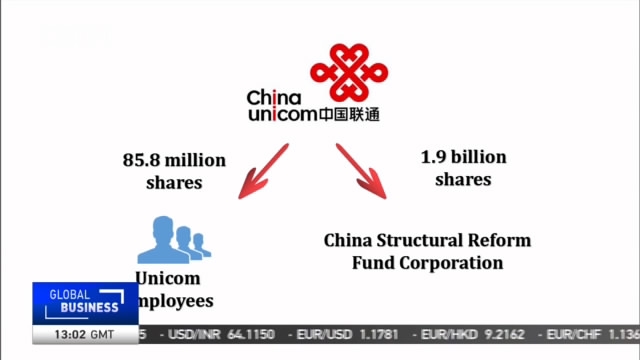
China Unicom resumed trading in both Hong Kong and Shanghai on Monday after an announcement by its mainland-listed unit that the company would raise 11.7 billion dollars from strategic investors including Tencent, Alibaba and Baidu. China Unicom's private placement plan exceeds limits set by the Securities Regulatory Commission, but the agency decided to treat the plan as a special case and has allowed the sale to go ahead. Chen Tong reports.
A China Unicom announcement last night confirmed that China's second-largest wireless operator would issue a maximum of 9.04 billion shares at 6.83 yuan per share to nine private and state investors via private placement. The purchasers include internet giants Tencet, Baidu, Alibaba and JD.com, and insurance giant China Life. The company's Shanghai unit will also grant 85.8 million shares to employees and another 1.9 billion shares to the China Structural Reform Fund Corporation. This round of private placements total 42.6 percent of the company's total shares.
The Securities Regulatory Commission said in February that private placements could not exceed 20 percent of a company's total shares. But yesterday, a separate announcement from the commission said the China Unicom deal would not be subject to the rules, since it is a special case providing what the commission called a pioneering example for China's SOE reform.
CAI JUNYI, CHIEF ANALYST SHANGHAI SECURITIES China Unicom's deal is really an example for China's future mixed-ownership reform plan, both from the standpoint of private placements and of pricing. One of the important points in the mixed-ownership reform plan is that it is to promote corporate efficiency and to protect state-owned assets. So this plan has been put together very thoughtfully. If the percentage of a private placement is low, it actually has a bad effect on the deal. I think the private placement regulations are likely to be amended.
China Unicom's shares in Shanghai opened today at the 10 percent daily gain limit, which put them at 8.22 yuan. Hong Kong-traded shares also performed outstandingly, jumping by 3.5 percent and closing at 12.36 Hong Kong dollars.