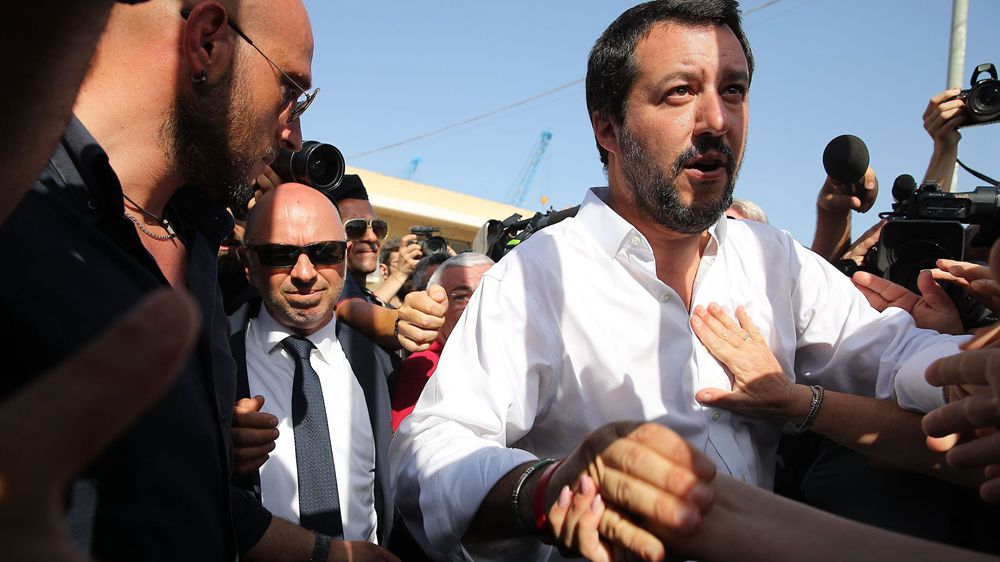
For his first official trip, Matteo Salvini, Italy’s new interior minister and leader of the far-right political party, the League, chose Pozzallo, a port in Sicily.
Sicily is the main landing port for refugees crossing the Mediterranean.
“Italy and Sicily cannot be Europe’s refugee camp,” said Matteo Salvini on Sunday to supporters in Pozzallo.

Labor and Industry Minister and deputy PM Luigi Di Maio (L) and Interior Minister and deputy PM, Matteo Salvini (R) wait for the swearing-in ceremony at the Quirinal palace, June 1, 2018, in Rome. /VCG Photo
Labor and Industry Minister and deputy PM Luigi Di Maio (L) and Interior Minister and deputy PM, Matteo Salvini (R) wait for the swearing-in ceremony at the Quirinal palace, June 1, 2018, in Rome. /VCG Photo
Migrants targeted
The minister labeled Sicily as “the refugee camp of Europe” and called for more deportations. “There is not enough housing and work for Italians, let alone half the continent of Africa,” said Salvini.
The move shows that Salvini is fulfilling his campaign pledge, to deport undocumented immigrants in Italy. The number is estimated as 500,000.
Though not as hardline as the League on immigration, the 9-year-old Five-Star Movement (M5S), which has been labeled by European media as anti-establishment, anti-globalist, environmentalist and Eurosceptic, is also against immigration.
Italy should try to improve its birthrate rather than “resigning” itself to immigration, said the party’s 31-year-old leader Luigi di Maio in January.
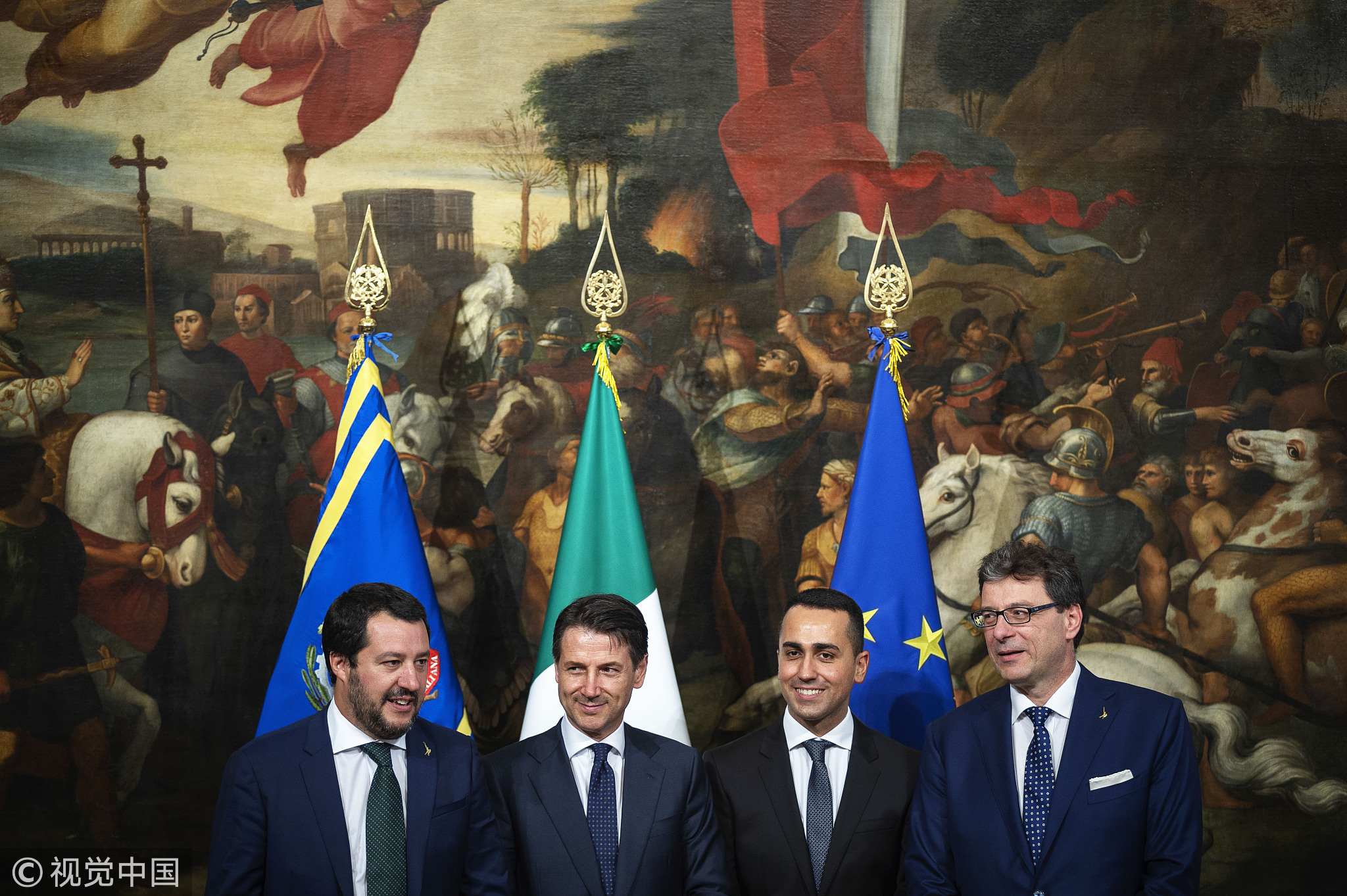
Matteo Salvini (L), deputy PM and Interior Minister, Prime Minister Giuseppe Conte (2nd L), Luigi Di Maio (2nd R), deputy PM and Labor and Industry Minister, and Giancarlo Giorgetti (R), Undersecretary for PM, pose for a picture during the first cabinet meeting of the new government at the Palazzo Chigi, June 1, 2018, in Rome. /VCG Photo
Matteo Salvini (L), deputy PM and Interior Minister, Prime Minister Giuseppe Conte (2nd L), Luigi Di Maio (2nd R), deputy PM and Labor and Industry Minister, and Giancarlo Giorgetti (R), Undersecretary for PM, pose for a picture during the first cabinet meeting of the new government at the Palazzo Chigi, June 1, 2018, in Rome. /VCG Photo
Coalition government, populist government
After months of political deadlock following March 4 elections, an anti-establishment government took power on Friday. Giuseppe Conte was sworn in as the country’s prime minister and has announced his picks for the cabinet.
53-year-old Conte, a law professor and a political novice, is supported by the anti-establishment M5S and the far-right League party. The two parties, once opponents during elections, now form a coalition government.
In the cabinet, both Luigi Di Maio, M5S leader, and Matteo Salvini, the League chief, are appointed on key posts, Luigi Di Maio as Labor and Industry Minister, and Salvini as Interior Minister.
Besides targeting immigration, the new government also vows to tighten security and introduce a series of anti-austerity measures.
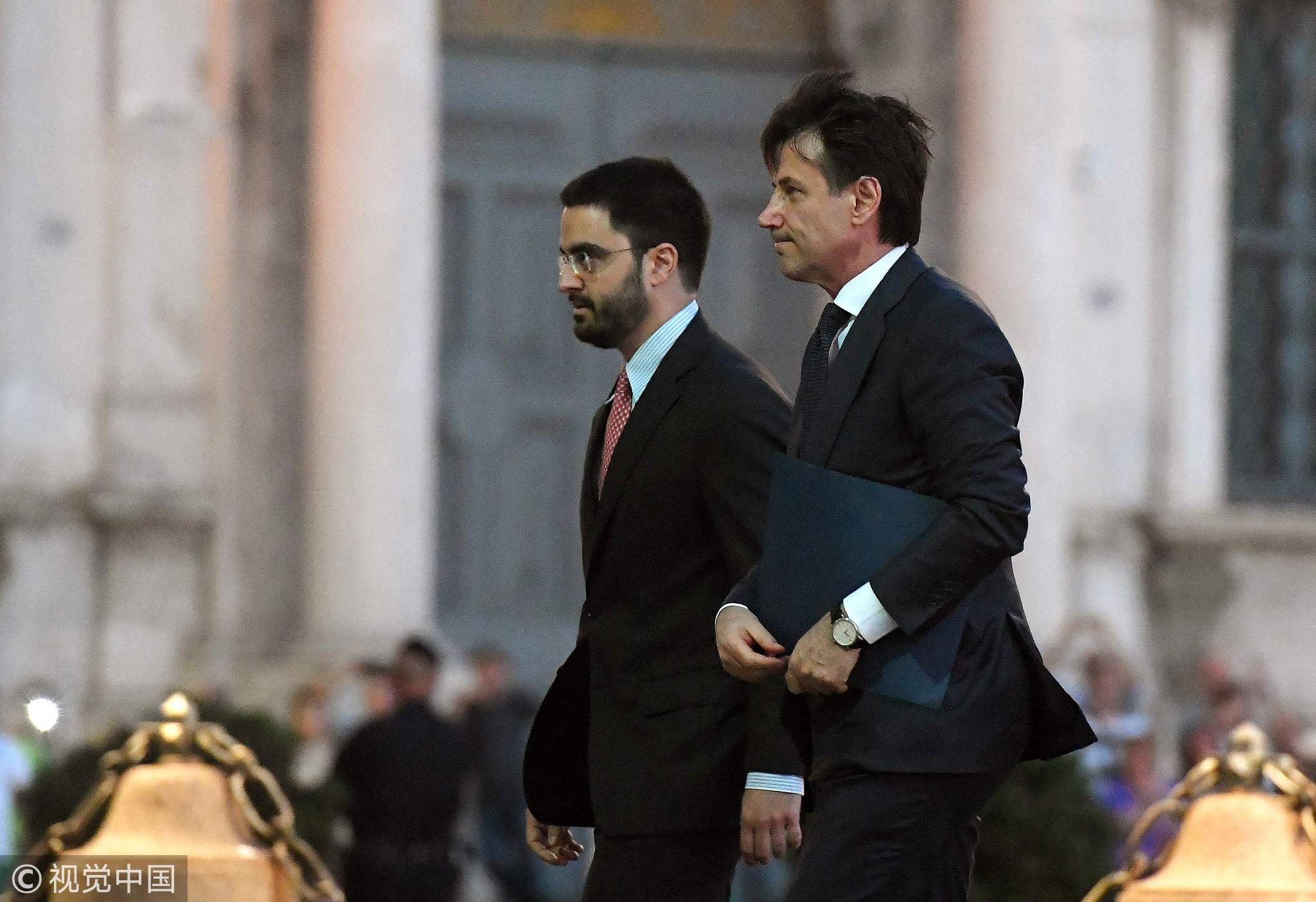
Italy's Prime Minister candidate Giuseppe Conte (R) arrives at the Qurinale presidential palace, May 31, 2018, in Rome to meet Italian President about a mandate to form a government for the second time. /VCG Photo
Italy's Prime Minister candidate Giuseppe Conte (R) arrives at the Qurinale presidential palace, May 31, 2018, in Rome to meet Italian President about a mandate to form a government for the second time. /VCG Photo
Why Italy shows a rise in populism?
Economic problems and refugee crisis are two factors contributing to rising of populism in Italy, said Sun Yanhong to thepaper.cn, an associate researcher on Italian studies at the Chinese Academy of Social Sciences and secretary-general of the Chinese Association for Italian Studies.
What affects election most is the unemployment problem. Since the financial crisis in 2008, economic recovery in Italy is slow. The unemployment rate is around 11 percent in Italy, while youth unemployment rate is over 30 percent. This explains why M5S has won the youth vote, said Sun.
The flow of migrants is another factor. Close to North Africa, Italy is a major destination for migrants and refugees from North Africa.
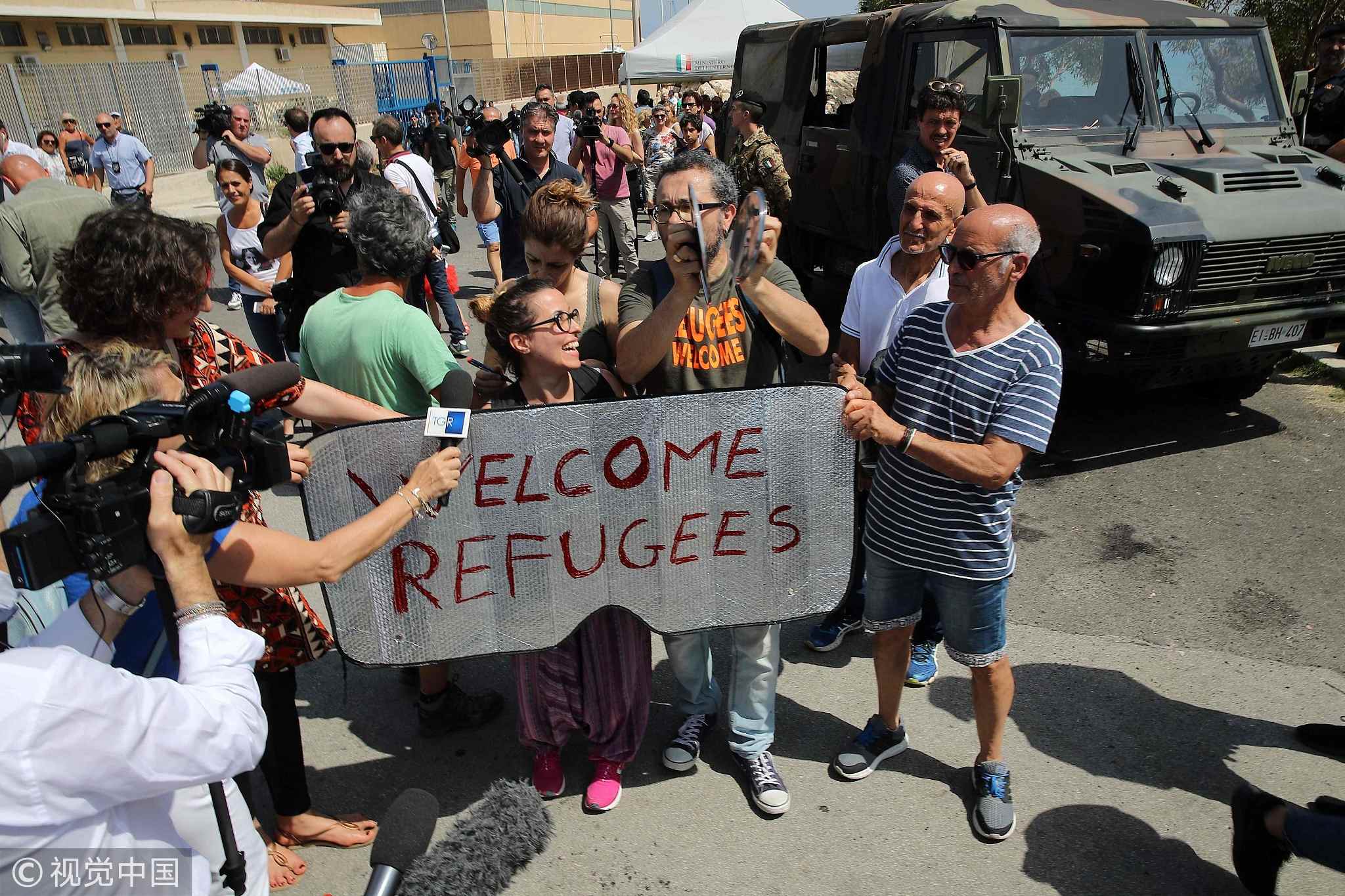
People hold a placard reading "Welcome refugees" as they protest against the visit of Italy's new hardline Interior Minister at the reception center (CPSA) in Pozzallo, Sicily, June 3, 2018. /VCG Photo
People hold a placard reading "Welcome refugees" as they protest against the visit of Italy's new hardline Interior Minister at the reception center (CPSA) in Pozzallo, Sicily, June 3, 2018. /VCG Photo
EU introduced Refugee quota policy in 2015. According to the plan, asylum seekers should be distributed among EU nations based on quotas. In reality, the policy hasn’t been implemented well. For Italy, it is EU which hasn’t offered a satisfactory solution.
During the election campaign, populist parties relate economic problems and refugee crisis to European integration and EU, claiming that austerity measures adopted in Eurozone have made financial situation in Italy worse, and the invalid refugee policy has made Italy suffer a lot, said Sun.
Matteo Salvini said the new government’s plans on migrants were “common sense,” explaining that sending migrants back home and limiting new arrivals would help save their lives. Of course, critics show doubt on this.

 ["china"]